
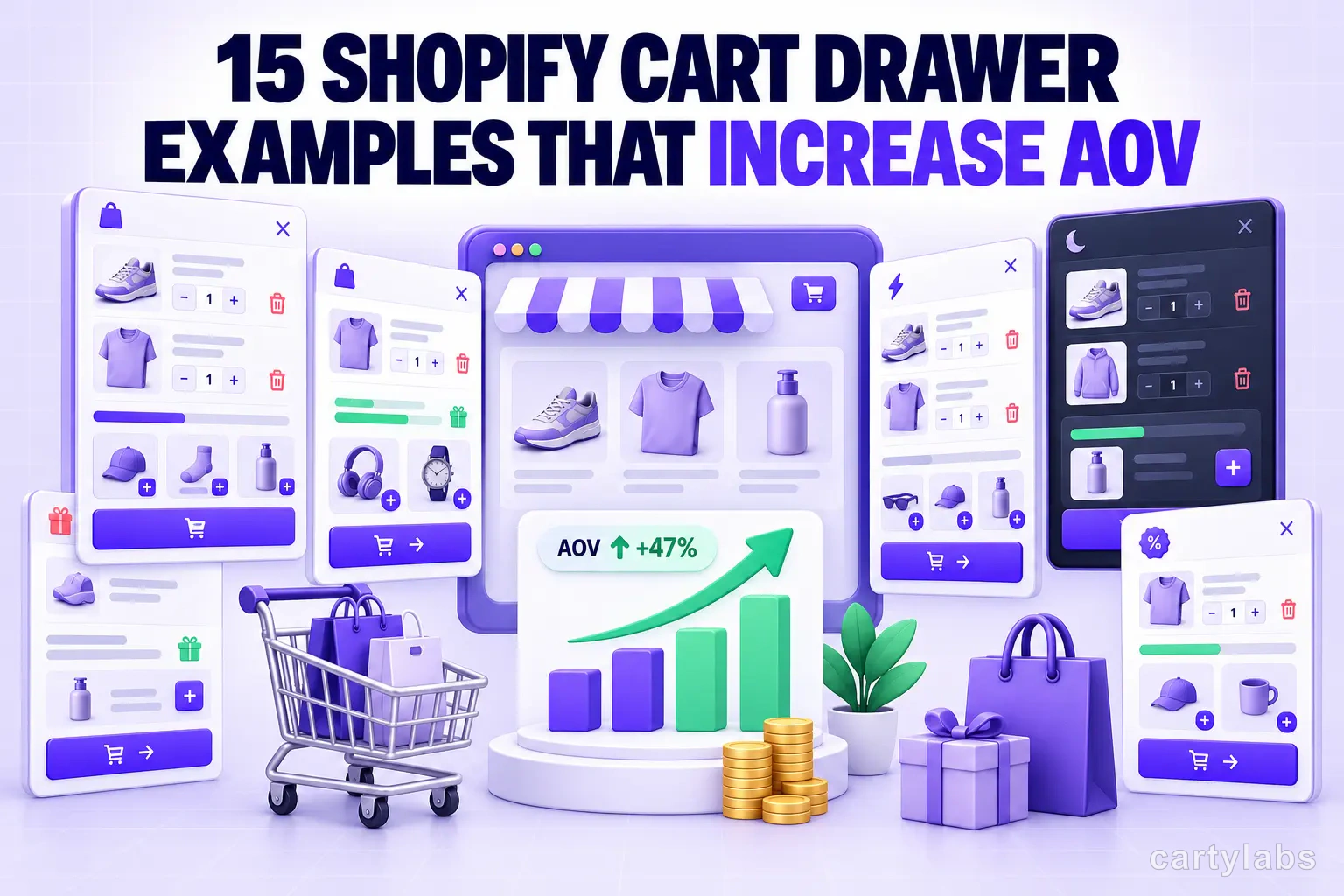
15 Shopify Cart Drawer Examples That Increase AOV
15 real Shopify cart drawers, graded on free-shipping bars, upsells, bundles, rewards, and mobile UX — with the exact tactic to copy from each.
In this article
- 01 Key takeaways#
- 02 How we chose these examples#
- 03 Mechanic 1: The free-shipping progress bar#
- 04 Mechanic 2: Complementary cross-sells#
- 05 Mechanic 3: Build-a-bundle and quantity discounts#
- 06 Mechanic 4: Subscribe & save in the cart#
- 07 Mechanic 5: Rewards, gift-with-purchase, and trust#
- 08 What the best cart drawers have in common#
- 09 How to build a drawer like these#
- 10 Frequently asked questions#
- 11 The bottom line#
The best Shopify cart drawers don’t just show a subtotal — they use the moment of highest purchase intent to lift average order value with a free-shipping progress bar, a relevant cross-sell, a bundle nudge, or a rewards unlock. Below are 15 real, verified-Shopify storefronts grouped by the AOV mechanic each does well, with the specific tactic worth copying. Every store was confirmed to run on Shopify; view each drawer live (add an item to trigger it) for the current design, since implementations change.
Key takeaways
- The five drawer mechanics that move AOV: free-shipping progress bars, complementary cross-sells, build-a-bundle offers, subscribe-and-save, and rewards/GWP.
- Free-shipping bars work because “extra costs too high” is the #1 reason shoppers abandon carts — cited by ~40% (Baymard) — and because of the goal-gradient effect: people push harder the closer they are to a reward (Kivetz et al., 2006).
- Keep cross-sells to 2–3 complementary items with one-click add; never bury the checkout button.
- These are verified Shopify stores; capture your own screenshots from the live drawers before reusing any design.
How we chose these examples
Two rules. First, platform honesty — many “cart drawer examples” roundups mix in stores that aren’t even on Shopify. Every store here returned Shopify signals (cdn.shopify.com / /cdn/shop/ assets or a myshopify.com domain) when we checked. Second, verifiable signals only — a slide-out drawer only renders after an add-to-cart click, so we describe the AOV mechanics each brand publicly advertises (free-shipping thresholds, subscription programs, loyalty, bundles) and, where an agency teardown has documented the drawer itself, we attribute it. Grade each against this 10-point rubric:
- Free-shipping progress bar (remaining-to-threshold shown live)
- Threshold / spend-more nudge
- Complementary cross-sell (2–3, one-click add)
- Rewards / gift-with-purchase / loyalty
- Trust & security microcopy
- Quantity steppers without leaving the drawer
- Sticky, high-contrast checkout button
- Express payment (Shop Pay, Apple Pay, etc.)
- Full-width, tap-friendly mobile behavior
- Clear running subtotal and savings
Mechanic 1: The free-shipping progress bar
The single highest-leverage drawer element. It attacks the top abandonment cause and exploits the goal-gradient effect — see our free shipping bar strategy for the threshold math.
1. Passenger Clothing — Passenger’s site surfaces an explicit progress message (“You’re £X away from free delivery”) alongside trust cues it advertises store-wide: a tree planted per order, Trustpilot reviews, and a 60-day returns policy. Lesson: pair the money nudge (free shipping) with a values nudge (a tree per order) so the shopper has two reasons to add one more item.
2. Allbirds — Allbirds advertises free ground shipping over $100 and shows a “spend more to earn free shipping” notice with the live shipping cost. Lesson: showing the actual shipping cost the shopper avoids makes the threshold feel concrete, not abstract.
3. Primal Kitchen — Primal Kitchen advertises an “add [amount] for free shipping” bar, a free-shipping unlock for account holders, Recharge-powered subscriptions, a Build-a-Bundle, and its Primal Perks rewards program. An agency teardown by Vervaunt documents a Rebuy-powered upsell and one-click subscribe inside the drawer. Lesson: stack the bar with a one-tap subscribe option so shoppers can cross the threshold and commit to repeat revenue.
Mechanic 2: Complementary cross-sells
A relevant “goes-with” recommendation above the checkout button is the core of cart drawer upsells.
4. Gymshark — Gymshark (Shopify Plus) advertises free shipping over $75 and is widely documented running a “People Also Bought” recommendation carousel in-cart. Lesson: apparel cross-sells work best when they’re accessories (socks, shakers, headbands) priced well below the main item, not another $60 hoodie.
5. Kettle & Fire — Kettle & Fire advertises free shipping at a carton threshold, Subscribe & Save, and Bundle & Save. Vervaunt documents a Rebuy-powered drawer with a free-delivery progress bar plus upsells. Lesson: combine the bar and the cross-sell so a single “add” both advances free shipping and raises basket size.
6. Vivo Life — Vivo Life advertises bundles, and Vervaunt’s teardown documents fixed accessory upsells and a delivery-instructions field inside the drawer. Lesson: a small, curated set of fixed accessory upsells (a shaker for a protein) can outperform an algorithmic carousel for focused catalogs.
Mechanic 3: Build-a-bundle and quantity discounts
Bundles raise units per order directly. See frequently-bought-together bundles.
7. Magic Spoon — Magic Spoon advertises Subscribe & Save with a free bowl set, a free-granola threshold, and a Build-Your-Bundle flow. Lesson: a “build your box” mechanic turns a single-flavor purchase into a multi-unit order without feeling like an upsell.
8. Tabs Chocolate — Tabs advertises quantity discounts (“save 16% + free shipping on 3+ boxes”), bundles, and a 30-day guarantee. Lesson: tiered quantity pricing shown in the cart gives shoppers a concrete reason to bump quantity right before checkout.
9. Ghost Lifestyle — Ghost advertises visible loyalty points and a Build-Your-Own-Bundle. Lesson: pairing a bundle builder with points earned makes the larger order feel doubly rewarded.
Mechanic 4: Subscribe & save in the cart
Converting a one-off into a subscription is the highest-LTV move a drawer can make. See subscribe & save cart conversion.
10. Death Wish Coffee — Death Wish advertises Subscribe & Save (up to 30%) and its Ritual Rewards loyalty program. Lesson: a bold, quantified subscription discount in the cart converts price-sensitive shoppers at the exact moment they’re committing.
11. OLIPOP — OLIPOP advertises free shipping over $50 and subscription options. Lesson: for replenishable CPG, a simple “subscribe and save” toggle beside the free-shipping bar compounds two AOV levers at once.
12. Recess — Recess advertises a free-shipping banner, Subscribe & Save, and a give-$10/get-$10 referral; Vervaunt documents a gift-messaging option in its drawer. Lesson: a referral or gift option in the drawer turns one buyer into a second acquisition channel.
Mechanic 5: Rewards, gift-with-purchase, and trust
Perks and reassurance reduce the last flicker of hesitation. See loyalty rewards integration and our take on a free-gift progress bar.
13. Chubbies — Chubbies advertises its “Chubbies Collective” rewards with member free shipping over $50. Lesson: framing free shipping as a membership perk nudges signup and repeat purchase, not just this order.
14. Jones Road Beauty — Jones Road advertises free shipping over $55 and curated Hero Kit / Travel Kit bundles. Lesson: a pre-built kit is the easiest cross-sell of all — it does the “what goes together” work for the shopper.
15. FIGS — FIGS advertises free shipping over $50 with free returns and “The Set” kit bundles. Lesson: pairing free shipping with free returns microcopy in the cart removes the two biggest cost objections at once.
What the best cart drawers have in common
Across all 15, the pattern is consistent: a live free-shipping bar near the top, 2–3 relevant add-ons (not a wall of products), a clear subtotal with visible savings, a sticky checkout button that never scrolls away, and honest trust microcopy. None of them cram every mechanic into one drawer — each picks the two or three that fit its catalog. The failure mode is the opposite: a drawer so stuffed with upsells that the checkout button disappears on mobile, where most ecommerce traffic now lives.
For the deeper anatomy, see the complete cart drawer guide; to decide whether a drawer even fits your store, read cart page vs cart drawer.
How to build a drawer like these
You don’t need to be Shopify Plus. The mechanics above — a free-shipping bar, complementary upsells, bundles, and a rewards nudge — ship in an all-in-one cart drawer app you can style to your brand in minutes, then measure against your baseline average order value. Start with one mechanic (usually the free-shipping bar), confirm it lifts AOV against a holdout, then layer the next.
Frequently asked questions
Do cart drawers actually increase AOV? A drawer itself is neutral — what lifts AOV is what’s inside it: a free-shipping progress bar, relevant cross-sells, bundles, and rewards, placed at the moment of highest intent. Measure against a holdout, because results vary by catalog and price point.
What should I put in a cart drawer to increase order value? The five proven mechanics: a live free-shipping progress bar, 2–3 complementary cross-sells with one-click add, a build-a-bundle or quantity discount, a subscribe-and-save toggle, and a rewards or gift-with-purchase nudge. Pick two or three that fit your catalog.
Why do free-shipping progress bars work so well? Because “extra costs too high” is the most-cited reason shoppers abandon carts (~40% per Baymard), and because of the goal-gradient effect — people accelerate effort the closer they are to a reward, a documented behavioral pattern (Kivetz et al., 2006).
Are all these stores really on Shopify? Yes — each returned Shopify signals when checked. Cart drawer implementations evolve, though, so view each live for its current design rather than treating this list as frozen.
How many upsells should a cart drawer show? Two to three complementary items, one to two on mobile. More creates choice paralysis and risks pushing the checkout button below the fold.
Does adding a cart drawer slow down my store? It can if it loads heavy scripts or large images. A well-built ajax drawer pre-renders and opens instantly; keep upsell images small and lazy-loaded.
The bottom line
The AOV lift lives in the drawer’s contents, not the drawer itself. Copy the mechanic that fits your catalog — a free-shipping bar for threshold-driven CPG, cross-sells for accessory-rich apparel, bundles for build-a-box brands — add it, measure it, then layer the next.
Want these mechanics without stitching together three apps? Install Cartylabs free on Shopify and turn on the free-shipping bar, AI upsells, and rewards in one drawer.
Related reading: Cart page vs cart drawer, How to add upsells to your cart drawer, Free shipping bar strategy.
Next steps
Related Shopify resources
Practical tools and product pages related to this guide.
Keep reading
All articles →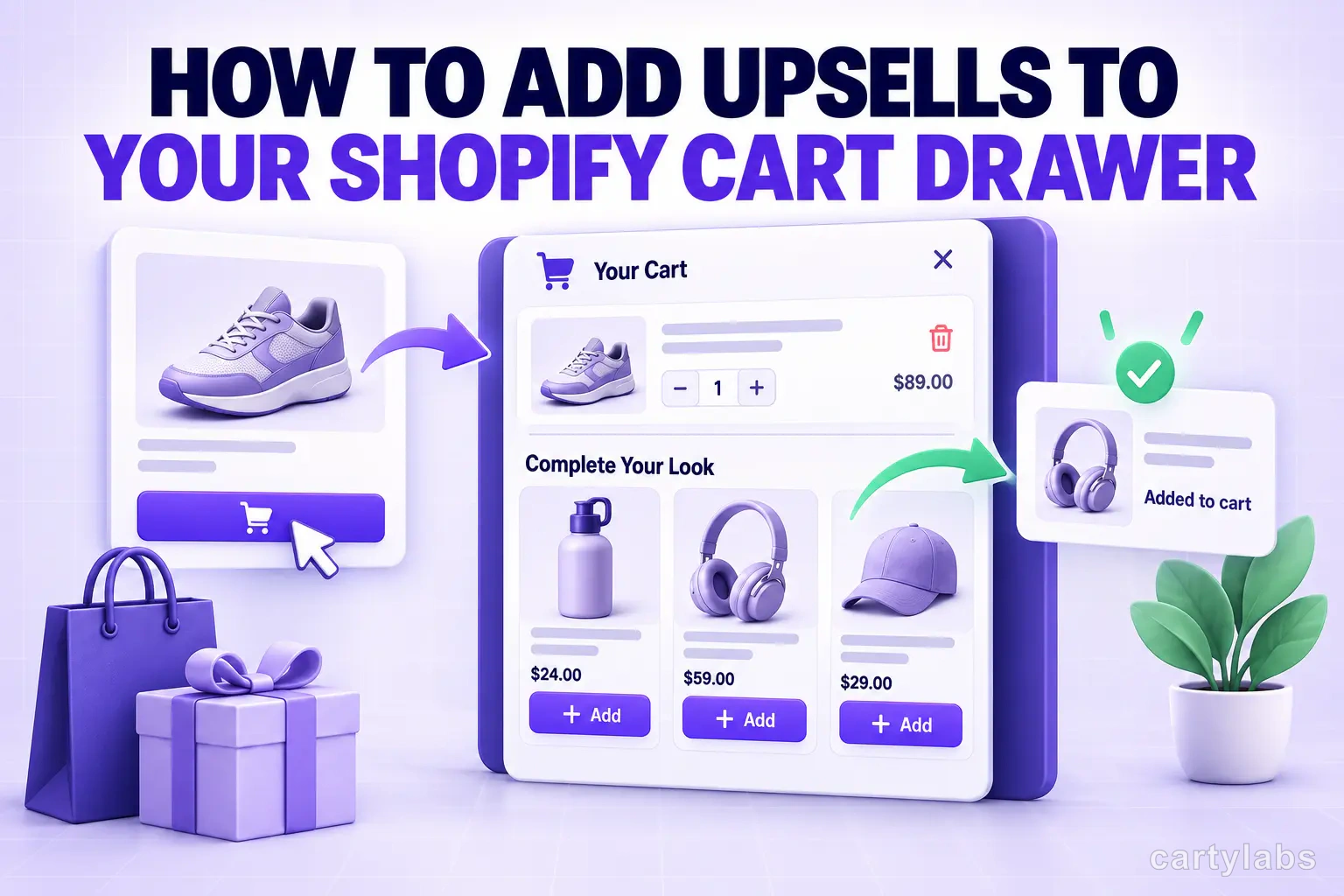
How to Add Upsells to Your Shopify Cart Drawer
Add cart drawer upsells three ways: no-code with Search & Discovery, custom Ajax code, or an app. Product selection, placement, mobile, and measurement.
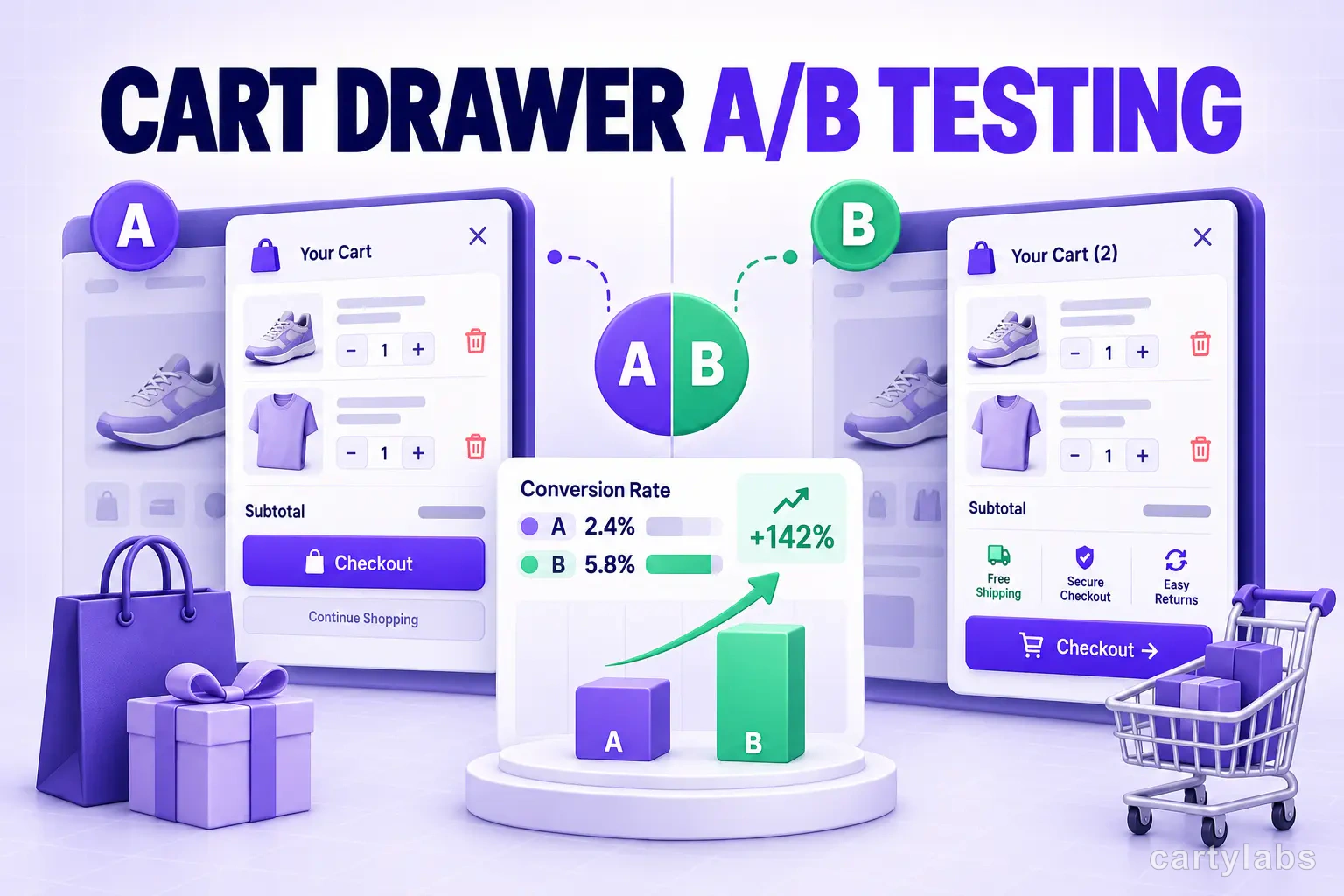
Cart Drawer A/B Testing: 14 Tests That Lifted AOV 20%+
14 cart drawer A/B tests we ran across Shopify stores in 2026 that lifted AOV 20% or more. Setups, sample sizes, results, and what didn't work.
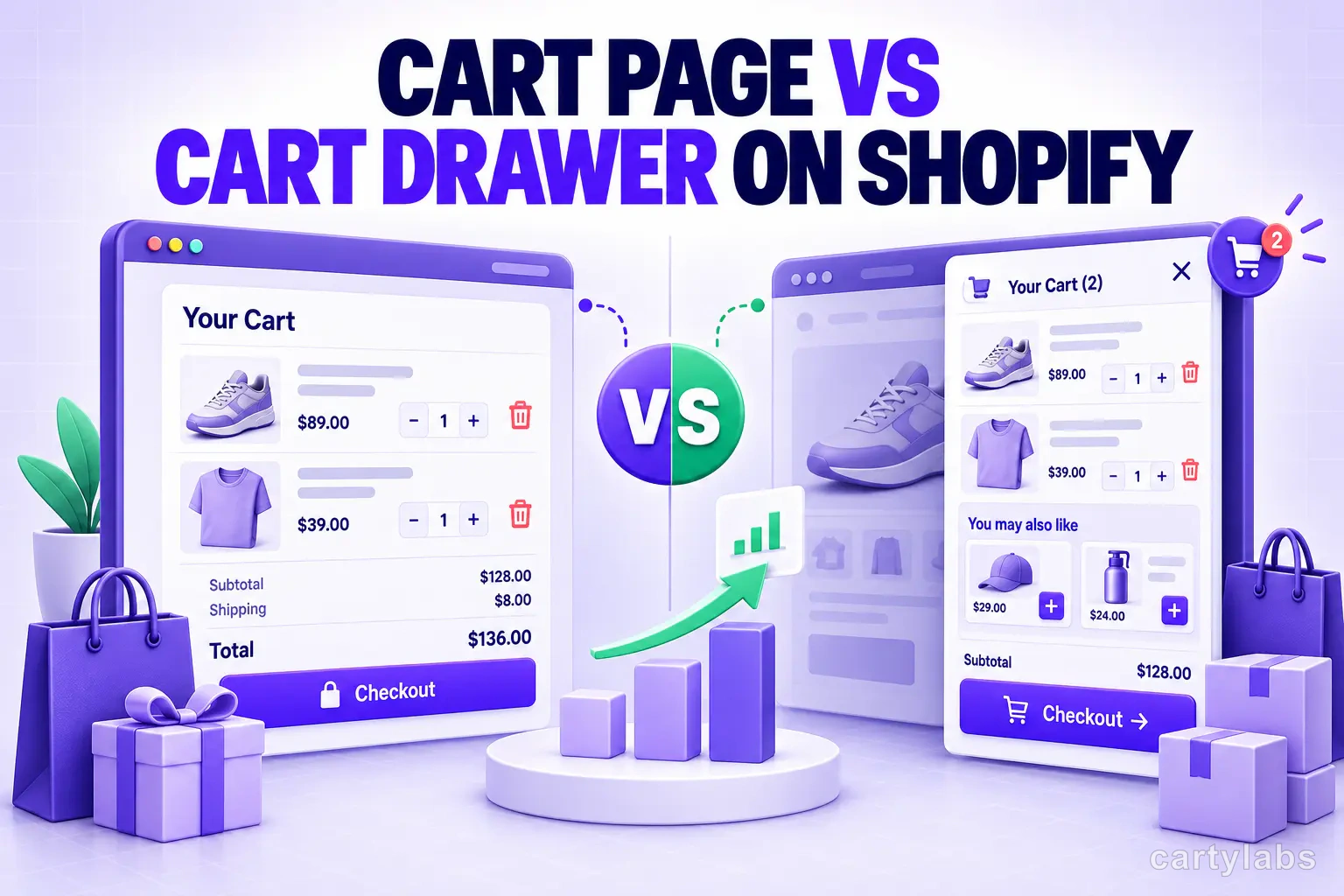
Cart Page vs Cart Drawer on Shopify: Which Converts Better?
Cart drawer or cart page on Shopify? A data-backed decision guide covering mobile, upsells, speed, and the store types where a cart page still wins.
 Install Cart — Free