
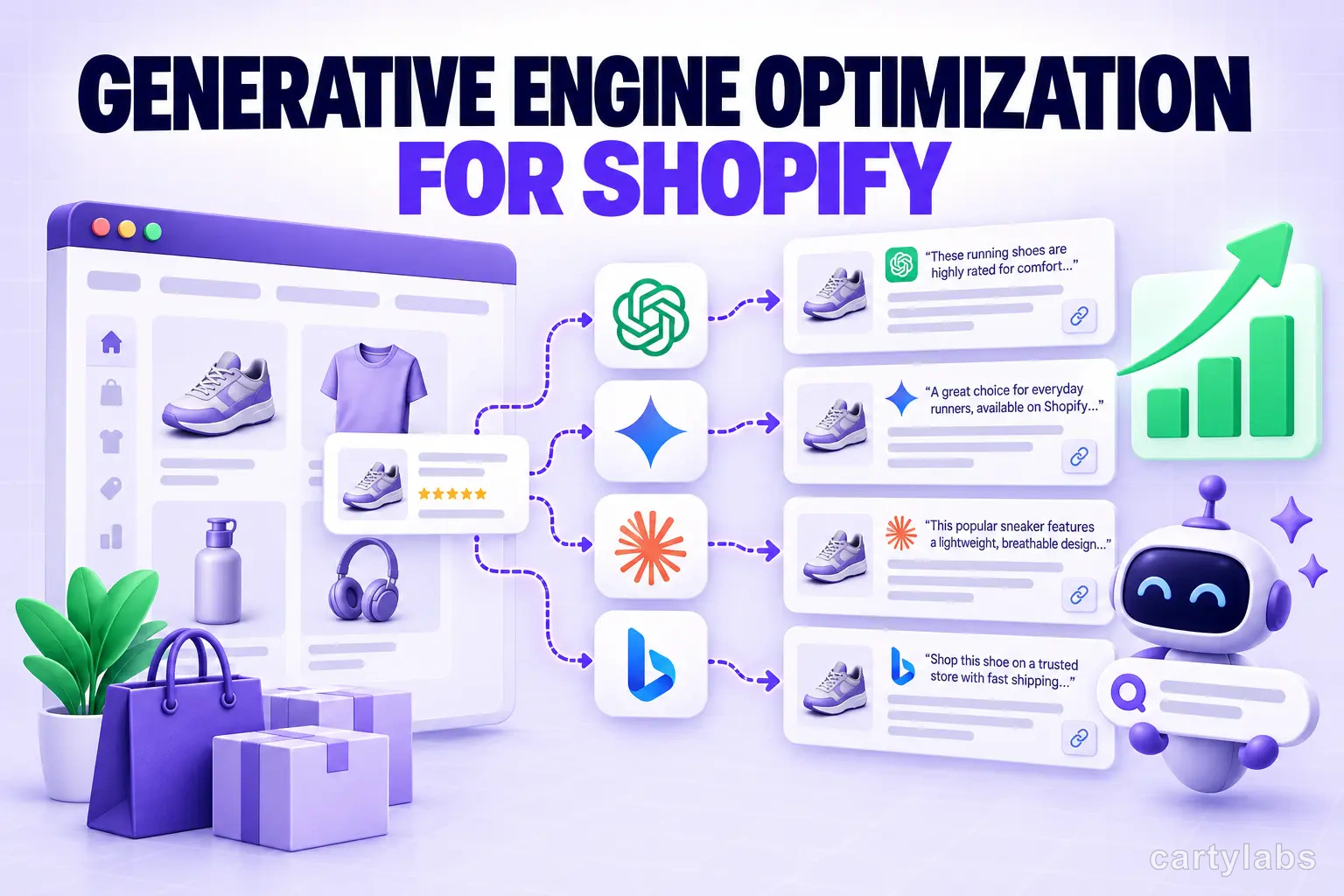
Generative Engine Optimization for Shopify: Practical AI Search Visibility
A practical GEO playbook for Shopify stores: improve crawlability, content clarity, internal linking, and measurement for Google AI features and other answer engines.
In this article
AI referrals can appear in analytics from services such as chatgpt.com, perplexity.ai, gemini.google.com, and claude.ai. Their volume and conversion quality vary by market and implementation, so measure them instead of assuming they will behave like a separate, high-volume channel.
This post uses Generative Engine Optimization (GEO) as a practical label for improving the chance that useful pages are found, understood, and represented accurately in generated answers. The fundamentals overlap heavily with SEO: original content, crawlable pages, clear internal links, good page experience, and accurate structured data. If you’ve already worked through the basics in our Shopify SEO checklist, this is the measurement and content-clarity layer.
What is generative engine optimization, exactly?
GEO is an industry term for practices intended to improve a site’s visibility and representation in generated answers. It covers content clarity, entity consistency, crawlability, and off-site reputation, but it is not a separate Google ranking system with a published checklist.
Traditional SEO ranks pages. A query produces 10 blue links and Google picks them based on relevance, authority, and freshness.
Generated answers combine information from a search index, a product or entity database, and the model’s own systems. The exact retrieval and citation signals differ by provider, so treat entity clarity, structured facts, independent corroboration, and direct answers as useful practices—not guaranteed ranking factors.
The mental shift is from “rank for keywords” to “be the source the model reaches for when answering a question.” Those are correlated but not identical problems.
How do AI search engines actually pick sources?
Many answer systems use some form of retrieval followed by synthesis, although the implementations differ.
Stage 1: Retrieval. When a shopper asks “what’s the best Shopify cart drawer app?”, the engine runs one or more underlying searches against an index (its own crawl, Bing, Google, or a partner). It pulls back 10-50 candidate URLs.
Stage 2: Synthesis. The model may read some candidates, combine relevant information, and cite sources it considers useful. The number and selection of citations varies by provider and query.
The useful overlap is straightforward: make important pages crawlable and useful, then write clear sections with claims that are supported by visible evidence. Search visibility and citations are not guaranteed by a particular word count, schema type, or paragraph shape.
Many stores have indexable pages but still make important answers hard to find or verify. Clear page structure and supporting evidence can reduce that friction for readers and search systems.
The 12 changes that move the needle
These are sequenced from foundational to experimental. If you can only do five, start with the first five and measure the result.
1. Rewrite section headings as direct shopper questions
Question-style headings can make a section easier for readers and retrieval systems to interpret, especially when the following paragraph answers the question directly.
Before: Setting up upsells After: How do you set up an in-cart upsell on Shopify without a developer?
Then answer near the beginning of the section. Do not bury the answer in paragraph three.
2. Use the inverted pyramid inside every section
Lead with the answer, then explain. A concise opening also helps readers understand the section before they decide whether to continue.
Compare these two openings under a heading like “What’s a good free shipping threshold for a Shopify store?”:
- Buried answer: “There’s a lot of nuance here. Margins matter, AOV matters, and your customer mix matters. After working with hundreds of stores, we’ve found that setting the threshold at roughly 10-15% above current AOV tends to perform best.”
- Inverted pyramid: “Set your free shipping threshold roughly 10-15% above your current AOV. Margins, AOV, and customer mix shift the exact number, but that range is where most Shopify stores land after testing.”
Both are honest. The second is easier for a reader or retrieval system to understand quickly.
3. Publish original numbers, benchmarks, and definitions
Original research, first-hand experience, named definitions, and novel frameworks can make a page more useful and differentiating. Report the method, sample, time period, and limitations behind any benchmark; never invent precision to make a claim more extractable.
You don’t need to run a survey. Numbers from your own customer base, A/B tests, or aggregated dashboard data all qualify. Two or three original data points per post is enough.
4. Add FAQPage schema to high-intent pages
Use FAQPage only when the questions and answers are visible on the page and genuinely useful. It can help search systems understand an FAQ, but it is not a guaranteed AI-search lever. Google currently limits FAQ rich results primarily to well-known authoritative government and health sites. See Google’s structured-data guidance.
Add a 4-6 question FAQ block to:
- Your homepage
- Top product and collection pages
- Comparison pages (“X vs Y”)
- Procedural blog posts
The questions should mirror the actual queries shoppers type into AI engines. Look at the “People also ask” boxes for your target keywords. Those are the questions to answer.
5. Add HowTo schema to procedural posts
For a genuinely visible, step-by-step tutorial, HowTo can clarify the procedure for machines as well as readers. It does not guarantee that an AI system will quote the steps, and Google no longer shows HowTo rich results on mobile search. Use it when the markup accurately describes the visible tutorial, not simply because the post contains a numbered list.
The free shipping bar strategy, bundles guide, and post-purchase upsell guide are all candidates. Add the schema once and the entire post becomes citation-friendly.
6. Publish an llms.txt file at your domain root
llms.txt is a proposed, vendor-specific convention for giving language-model tools a short site guide. It is not a replacement for a sitemap or robots.txt, and Google Search currently ignores it for ranking and visibility.
It’s a single file at yourdomain.com/llms.txt with your site overview, your top pages, and brief descriptions of each. A longer llms-full.txt file is an optional documentation format; support varies by tool and it should not duplicate inaccurate or unstable claims.
If you keep one, publish a small, accurate list of canonical pages and maintain it like documentation. Do not claim that it causes more frequent crawls or citations. The Google AI search guide explains that no special AI text file is required for Google.
7. Establish your brand as a clear named entity
Answer systems use information about entities as well as pages. When a shopper asks “is Cartylabs trustworthy?”, consistent naming and clear company information make the brand easier to disambiguate, although the result still depends on the provider and query.
The fixes:
- Use exactly one canonical spelling and capitalization of your brand name on every surface (your site, app store listing, social bios, press mentions).
- Add complete
Organizationschema to your homepage withname,url,logo,sameAs(all social profiles),contactPoint, andfoundingDate. - Keep the brand name, description, logo, and official profiles consistent across the site, app listing, and legitimate third-party profiles.
- Add
sameAslinks only for profiles that really represent the organization. Do not create or populate profiles solely to influence an answer engine.
Consistent entity information helps users and search systems disambiguate the brand, but it cannot guarantee inclusion in an answer.
8. Win third-party “best of” mentions
Legitimate third-party reviews and mentions can support brand discovery and traditional authority. They are not a guaranteed AI-citation tactic, so prioritize useful partnerships, accurate listings, and honest reviews over placement quotas. Never buy or manufacture mentions.
- Niche industry blogs over generic SaaS directories
- Posts with the year in the URL (recency signal)
- Sites that update their round-ups annually rather than abandoning them
The zero-to-$10K launch playbook covers the broader outreach motion if you’re starting from cold.
9. Build topical clusters, not isolated posts
Interconnected, useful content can demonstrate broader topical coverage than a single keyword-focused post. It also gives readers clear paths to related answers.
For a cart-conversion brand, a topical cluster looks like:
- A pillar page on cart optimization
- 8-12 supporting posts on individual cart levers (shipping bar, upsells, bundles, protection, abandonment, and so on)
- Internal links connecting them with descriptive anchor text
One thin post on “free shipping bars” may not satisfy all related questions. A small, well-linked cluster can give readers and search systems broader context, but there is no guaranteed citation multiplier.
10. Keep dateModified accurate and refresh quarterly
Freshness matters when the subject changes, such as pricing, platform behavior, or benchmarks. A post with an older dateModified is not automatically wrong if its content remains accurate.
The fix is procedural: review important posts on a sensible schedule, update stale numbers, screenshots, or pricing references, and bump dateModified only after a meaningful review. Do not change dates without changing the content.
Use dates and current-year references when they make the subject clearer, and remove or update them when the underlying facts change.
11. Allow the major AI crawlers explicitly in robots.txt
A common Shopify mistake is blocking a crawler without understanding its purpose. If a retrieval system cannot access a page, it cannot use that page for its own retrieval; allowing access still does not guarantee a citation.
Audit your robots.txt and make sure these are explicitly allowed (or at minimum not disallowed):
GPTBot(OpenAI and ChatGPT)ClaudeBotandClaude-Web(Anthropic)PerplexityBotGoogle-Extended(Google AI training, separate from Googlebot)Bingbot(powers Bing Copilot and is a major upstream index)Applebot-Extended(Apple Intelligence and Siri)
Allow or block these agents according to your licensing, privacy, and distribution preferences. Allowing a crawler only makes content accessible to that system; it does not guarantee a citation or ranking. Google-Extended is a separate control from Google Search crawling, so keep Googlebot access decisions distinct.
12. Track AI referrals as a first-class channel in GA4
You can’t optimize what you don’t measure. In GA4, create a custom channel group that splits out:
chatgpt.com→ ChatGPTperplexity.ai→ Perplexitygemini.google.com→ Geminiclaude.ai→ Claudebing.com/chat,copilot.microsoft.com→ Bing Copilot or Copilotyou.com,phind.com→ niche engines
Google AI features may not provide a distinct referrer. Use Search Console’s available performance reporting and compare landing pages, queries, clicks, and conversions over time rather than treating incidental URL parameters as proof of an AI visit.
Once you can see AI traffic by source and landing page, you’ll learn which posts are doing the citation work and where to invest next.
Content patterns worth testing
No format guarantees an AI citation, but these patterns can make information easier to scan, verify, and reuse:
1. Comparison posts with explicit pros and cons. “X vs Y” content where each app’s strengths and weaknesses are listed in parallel structure is easy to compare.
2. Numbered lists with specific numbers. “5 reasons” or “12 tactics” posts where each item has a concrete benchmark or stat. The structure is easy to extract. The numbers signal primary research.
3. Definitions of category terms. Posts that lead with “What is [X]?” and give a concise, accurate definition directly answer a common informational need.
4. Pricing and feature breakdowns. Tables that compare plans, pricing tiers, or feature matrices make it easier to answer “how much does X cost?” or “what’s included?” Keep them current.
5. Original benchmarks. Specific, falsifiable claims are useful when tied to a named source, method, sample, and date.
The goal is not to turn every page into a rigid template. Write for people first, make important answers easy to locate, and support claims with evidence.
A 60-day GEO execution plan
If you’re starting from a typical Shopify store with decent SEO basics in place:
Weeks 1-2: Foundations. Audit robots.txt and Search Console coverage. Keep any llms.txt file accurate if you choose to publish one. Clean up Organization schema and set up measurement in Search Console, Bing Webmaster Tools, and analytics.
Weeks 3-4: Schema layer. Validate the structured data that describes visible content. Add FAQPage or HowTo only where the page genuinely meets the relevant guidelines, then validate everything in Google’s Rich Results Test.
Weeks 5-6: Content rewrites. Pick your top 10 organic blog posts. Rewrite H2s as shopper questions. Restructure each section in inverted-pyramid order. Add 2-3 original benchmarks per post. Bump dateModified.
Weeks 7-8: Off-site. Improve legitimate partnerships and listings where they help customers. Audit brand-name consistency across the external profiles you control, and correct inaccurate information.
Use a baseline and review the results after enough time for your normal crawl and reporting cycles. AI referral volume and citation behavior vary widely, so avoid promising a fixed timeline.
A short summary
Generative engine optimization is an industry label for improving how clearly useful content can be found and represented in generated answers. Google describes this work as SEO: create original, helpful content, make pages crawlable, use internal links, provide a good page experience, and ensure structured data matches visible content. Other providers may use different systems, so measure citations and referrals rather than assuming a specific tactic will work.
The Shopify stores that win the AI search era will be the ones that treat their content as a structured knowledge base rather than a content marketing funnel. Fix the schema layer, fix the entity layer, restructure your content for extractability, and the rest follows.
Want a Shopify cart that doesn’t fight your performance budget? Install Cartylabs free on Shopify. Built for Core Web Vitals and SEO, with a 14-day free trial.
Keep reading: Shopify SEO and AI search checklist, AI product recommendations, Mobile conversion optimization.
Related reading: Schema markup for AI search.
Next steps
Related Shopify resources
Practical tools and product pages related to this guide.
Keep reading
All articles →
Shopify SEO & AI Search Checklist: 30 Fixes for Organic + AI Traffic in 2026
A practical Shopify SEO checklist: technical fixes, on-page optimization, structured data, Core Web Vitals, and AI search tactics for 2026.
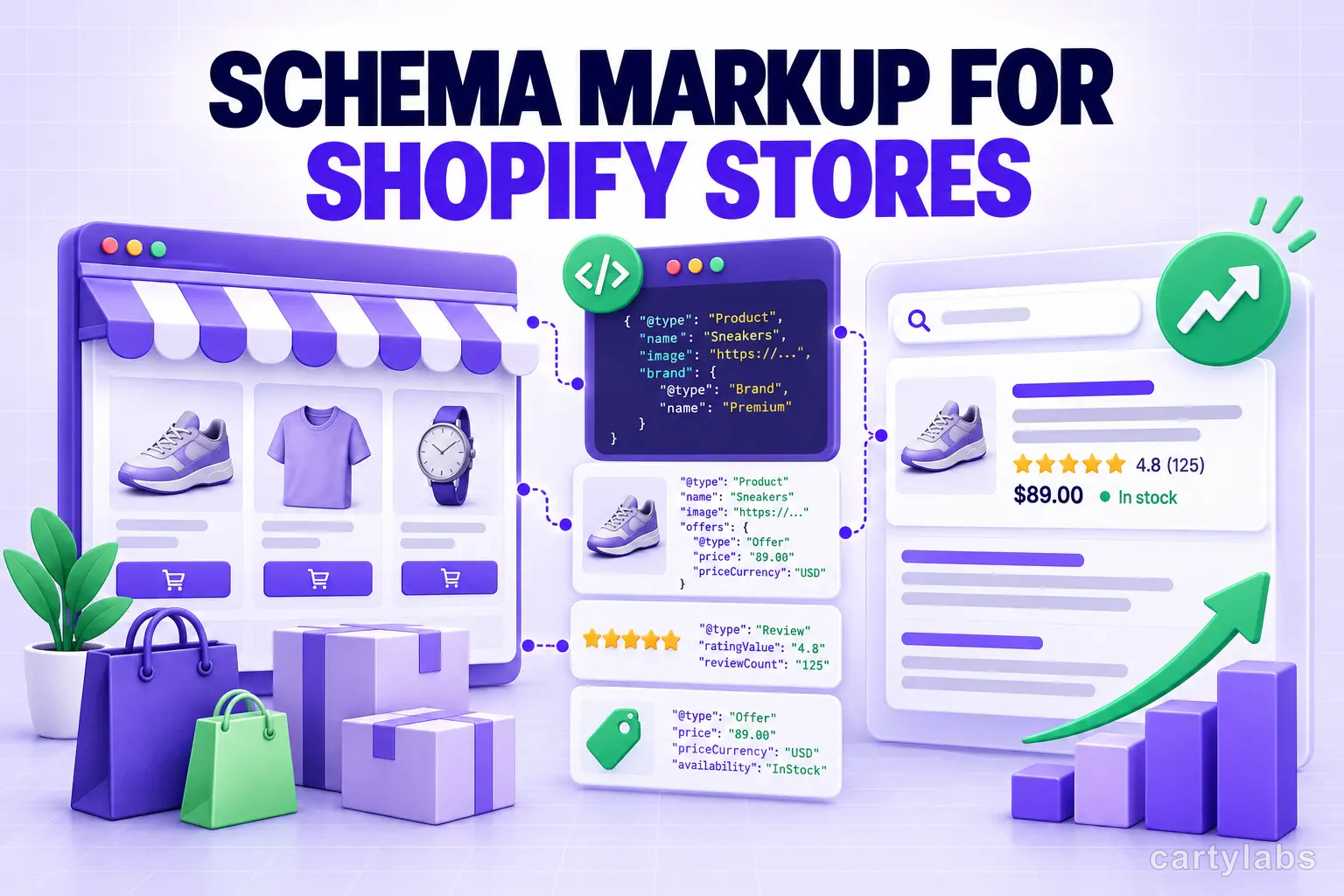
Schema Markup for Shopify Stores: A Practical Structured Data Guide
A practical guide to Shopify schema markup: which JSON-LD types describe products, FAQs, articles, breadcrumbs, and organizations, plus how to validate them.
Gift With Purchase: 11 GWP Campaigns That Print Money on Shopify
Gift With Purchase campaigns lift AOV 18-30% when designed right. The 11 GWP types, the threshold math, and the Shopify implementation patterns for 2026.
 Install Cart — Free