
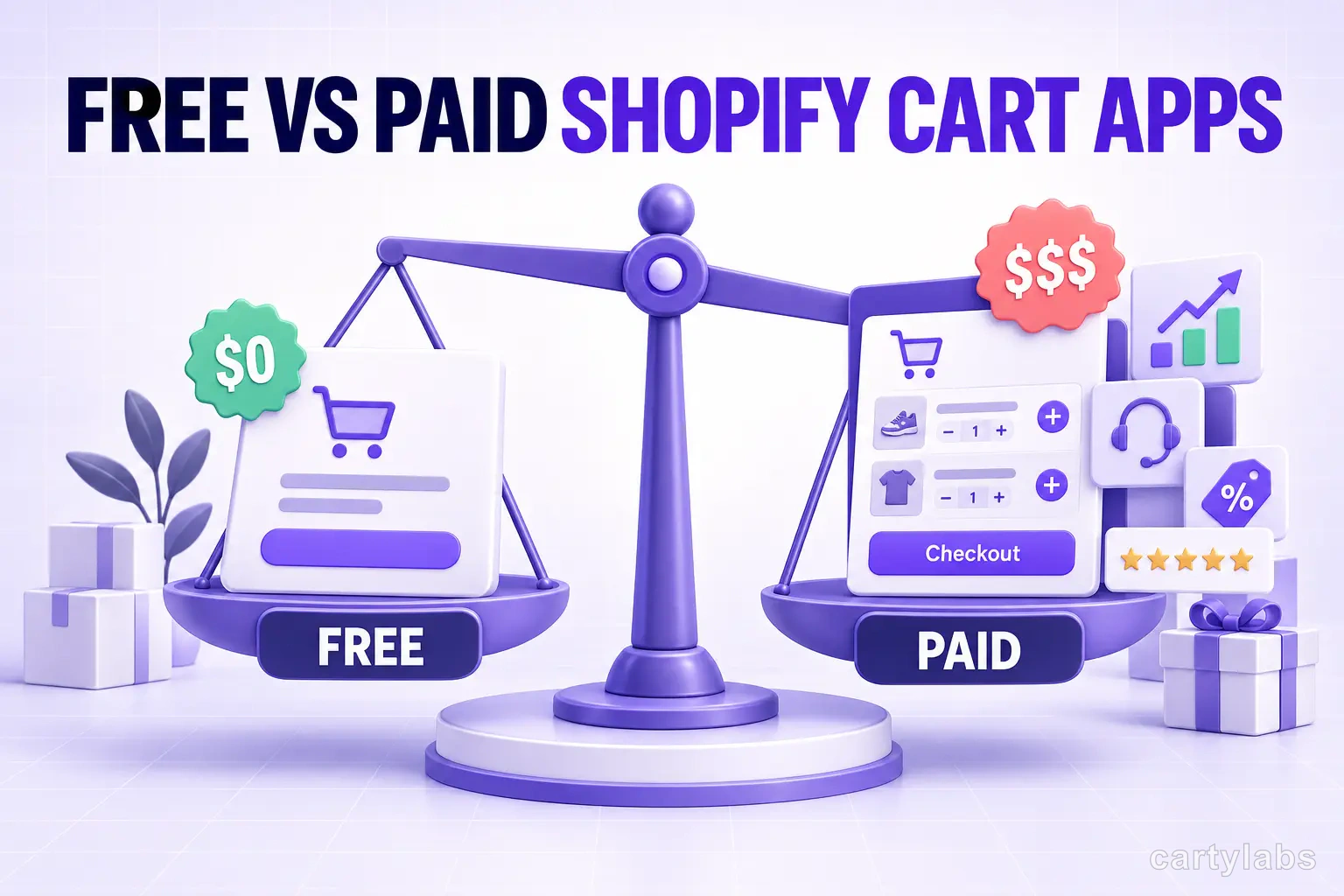
Free vs Paid Shopify Cart Apps: When Each Makes Sense
Free vs paid Shopify cart apps compared on AOV lift, features, and break-even math. The honest answer on when free is enough and when a paid drawer pays back.
In this article
- 01 Quick answer#
- 02 What “free” actually gets you#
- 03 What “paid” actually gets you#
- 04 The break-even math#
- 05 When free is genuinely the right answer#
- 06 When paid is genuinely the right answer#
- 07 The free-tier middle ground#
- 08 Comparison: free vs paid feature delta#
- 09 Hidden costs of “free”#
- 10 A simple upgrade path#
- 11 Mobile: the metric where free hurts most#
- 12 Honest cases for sticking with free#
- 13 A short summary#
The eternal Shopify merchant question: do I really need to pay for a cart app, or is the default cart fine? The honest answer is “it depends on your traffic,” and the math is more straightforward than most vendor pages make it sound. Below ~500 orders/month, the default Shopify cart with a Dawn-class theme is almost always good enough. Above that, the AOV and conversion lift from a paid cart drawer pays for itself in the first week.
This post walks through the real break-even math, the features you actually get for paying, and the honest cases where free is the right answer.
Quick answer
- Under $5k/month revenue → free Shopify default cart. Don’t pay yet.
- $5-15k/month → free tier of a paid app (most have one) — get the drawer + sticky cart benefits without the bill.
- $15k+/month → paid cart drawer pays back inside week one. Don’t leave money on the table.
- Plus / enterprise → paid; the conversion lift on a $300k/month store is $15-30k incremental, which dwarfs any app fee.
The crossover point is roughly 500 orders/month or $15k revenue/month, depending on AOV. Below that, free wins on margin. Above it, paid wins on absolute dollars.
What “free” actually gets you
Shopify’s default cart (in Dawn and most modern themes) gives you:
- A cart page at
/cartwith line items, qty controls, subtotal, and a checkout button - A basic cart drawer in many newer themes (Dawn 12+, several premium themes)
- Native shipping calculator at checkout
- Native discount code field
- Multi-currency and language via Shopify Markets
What you don’t get:
- AI product recommendations inside the cart
- Free-gift / free-shipping progress bar (single-tier or stacked)
- Sticky cart icon that re-opens the drawer
- Countdown timer
- Shipping-protection upsell
- A/B testing of cart variants
- Dedicated cart analytics (cart-to-checkout, items-per-cart, upsell attribution)
For a store doing 100 orders/month, the missing pieces are not the bottleneck. For a store doing 1,000+ orders/month, each missing piece is a measurable revenue leak.
For the broader playbook on cart UX, see our Shopify cart drawer guide.
What “paid” actually gets you
The standard paid cart drawer app (Cartylabs, Rokt Upcart, Amp Slide Cart, Monster Upsells) ships some or all of:
- Slide-out cart drawer with brand-matching design
- Sticky cart icon that re-opens the drawer
- AI product recommendations inside the drawer
- Free-gift / free-shipping progress bar, stacked tiers
- Countdown timer
- One-click in-cart add-ons (shipping protection, samples, warranties)
- Cart analytics dashboard
- A/B testing on higher tiers
Realistic AOV / conversion lift from running a paid cart drawer versus default:
- Cart-to-checkout conversion: +5-12% (drawer alone, no upsell logic)
- AOV: +5-15% (with AI upsells + stacked rewards)
- Items per cart: +0.3 average (with rewards bar nudges)
These are not vendor numbers; they’re consistent across our data of 1,000+ Shopify stores and industry-published benchmarks.
The break-even math
Let’s run numbers. Take a store doing $10k/month, AOV $50, 200 orders/month.
Free cart scenario:
- Revenue: $10,000/month
- App cost: $0
- Net: $10,000
Paid cart scenario (assuming entry tier $20-30/month, midpoint AOV lift 10%, conversion lift 8%):
- Revenue: $10,000 × 1.10 (AOV) × 1.08 (conversion) = $11,880
- Incremental: $1,880/month
- App cost: ~$30/month
- Net incremental: ~$1,850/month
At $10k/month, the paid cart pays back ~60x its cost in the first month. The math is even more lopsided at higher revenue.
Now run the same math at $2k/month:
- Revenue: $2,000 → $2,376 with paid app
- Incremental: $376/month
- App cost: $30/month
- Net incremental: $346/month
Still positive, but the absolute dollar return is smaller and the risk of the paid app underperforming the conversion-lift assumptions is higher. At $2k/month, a free plan or default cart is the lower-risk choice. Below ~$1k/month, the math can flip negative if the conversion lift is on the low end of the range.
For the early-stage version of this analysis, see the first $10k/month Shopify playbook.
When free is genuinely the right answer
Three scenarios where free wins.
1. You’re under $5k/month revenue. The conversion lift in absolute dollars doesn’t yet justify the friction of installing, configuring, and maintaining another app. Spend that effort on traffic instead.
2. You’re testing a new niche / store and not sure it’ll stick. Don’t add monthly recurring costs to a store you might shut down in 90 days.
3. Your bottleneck is genuinely traffic, not conversion. If your cart-to-checkout rate is already above 65% and your AOV is at category benchmark, the cart isn’t the leak. Fix the leak first.
For diagnosing where the leak actually is, see the Shopify cart abandonment playbook.
When paid is genuinely the right answer
Equally, three scenarios where free is leaving money on the table.
1. You’re over $15k/month revenue. Even on conservative assumptions, a paid cart drawer pays back >20x its cost in month one. Not paying is the more expensive choice.
2. Your cart-to-checkout rate is below 50%. This is the classic “you have a leak” signal. The default cart sends shoppers to a separate /cart URL, away from the product they were browsing; a slide-out drawer keeps them in context. The fix is mechanical, not optional.
3. Your catalog is large enough to benefit from AI recommendations. If you have 50+ SKUs with measurable cross-sell affinity, manual rules don’t scale and per-store ML lifts AOV 5-10% by itself. See AI product recommendations on Shopify.
The free-tier middle ground
Many paid cart drawer apps (including Cartylabs) ship a free plan that doesn’t expire, with limited features or order volumes. This is genuinely the right answer for a lot of merchants in the $5-15k/month range.
What you typically get on free tiers:
- Cart drawer with sticky cart
- Basic upsell recommendations
- Single-tier free-shipping bar
- Standard analytics
What you typically don’t get on free tiers:
- AI-trained recommendations
- Stacked rewards (multi-tier)
- A/B testing
- Premium support
- Countdowns / urgency on every cart
For most $5-15k/month stores, the free tier captures 70-80% of the lift the paid version would. Once you cross the volume threshold or want stacked rewards specifically, the upgrade math is clear.
Comparison: free vs paid feature delta
| Feature | Shopify default | Free tier (typical) | Paid tier (typical) |
|---|---|---|---|
| Slide-out cart drawer | Theme-dependent | Yes | Yes |
| Sticky cart icon | No | Often | Yes |
| Free-shipping progress bar | No | Single-tier | Stacked tiers |
| Free-gift progress bar | No | Limited | Yes |
| AI recommendations | No | Basic | Per-store ML |
| Countdown timer | No | Limited | Yes |
| Shipping-protection upsell | No | No | Yes |
| Cart analytics | Native only | Basic | Deep |
| A/B testing | No | No | Yes |
| 16-language support | Markets-based | Often | Yes |
| Cap on order volume | No | Yes (varies) | Higher / none |
| Monthly cost | $0 | $0 | $19-50+/mo |
Pricing reflects 2026 typical entry tiers across the major Shopify cart drawer apps.
Hidden costs of “free”
The default Shopify cart isn’t completely free. Hidden costs include:
- Theme code maintenance. If your theme handles the cart drawer (Dawn 12+ does), every theme update can break customizations. Realistic dev cost: 1-2 hours per theme update.
- Manual upsell merchandising. Without AI recommendations, you maintain “frequently bought together” links by hand. At 100 SKUs, that’s a real workload.
- Lost AOV from missing rewards bar. A single-tier free-shipping bar lifts AOV ~5-8%; absent, you leave that on the table.
- Lost cart-to-checkout from sending shoppers to
/cart. The default flow loses 5-12% of cart-to-checkout conversion versus a drawer.
For a store doing $50k/month, “free” can quietly cost $3-7k/month in unrealized revenue. That’s not “free.”
A simple upgrade path
The cleanest way to think about this:
- $0 - $5k/month: Shopify default cart. Focus on traffic and product-market fit.
- $5k - $15k/month: Free tier of a paid app (Cartylabs free plan, or similar). Get the drawer + sticky cart + basic rewards without paying.
- $15k - $50k/month: Paid entry tier. Unlock AI upsells, stacked rewards, A/B testing.
- $50k+/month: Paid mid/upper tier. Add post-purchase (AfterSell or ReConvert) and consider Plus checkout extensibility.
The first $10k/month playbook covers stages 1-2; the BFCM playbook covers when to layer urgency apps for seasonal pushes.
Mobile: the metric where free hurts most
70% of Shopify traffic is mobile, and the default cart UX is where free hurts most. Default Shopify carts often:
- Send shoppers to a full
/cartpage rather than a drawer (loses browse context) - Don’t have a sticky cart icon (shoppers can’t easily reopen the cart after closing)
- Don’t pre-render the drawer (introduces 100-300ms delay on slower devices)
- Don’t handle iOS keyboard avoidance well on the promo code field
A paid drawer fixes all four. See Shopify mobile conversion optimization for the full mobile playbook.
Honest cases for sticking with free
In fairness, the default cart is genuinely fine if:
- You’re testing and might shut down the store in 90 days
- You’re under $5k/month and traffic is the real bottleneck
- Your cart-to-checkout rate is already above 65%
- You have a senior front-end developer who maintains custom drawer code in your theme already (rare)
- Your AOV is fixed by external constraint (subscription tiers, single-SKU brand) and upsells don’t apply
For everyone else, the paid (or free-tier-of-paid) path is the higher-margin choice.
A short summary
Free Shopify cart apps make sense under ~$5k/month and as testing grounds. Free tiers of paid apps capture most of the lift in the $5-15k/month range. Above $15k/month, paid cart drawers pay back >20x their cost on conservative assumptions, and “free” quietly costs more than the subscription would.
Run the math on your own AOV and order volume before deciding. The break-even point isn’t ideological — it’s arithmetic.
Want to see what a paid drawer looks like on your store? Install Cartylabs free on Shopify (the free plan is genuinely free), or book a 15-minute demo and we’ll walk through the math against your numbers.
Next steps
Related Shopify resources
Practical tools and product pages related to this guide.
Keep reading
All articles →
Best Shopify Cart Drawer Apps 2026 (Ranked & Tested)
The best Shopify cart drawer apps for 2026, ranked and tested on AOV lift, AI upsells, rewards, pricing, and setup time. Honest picks for every store size.
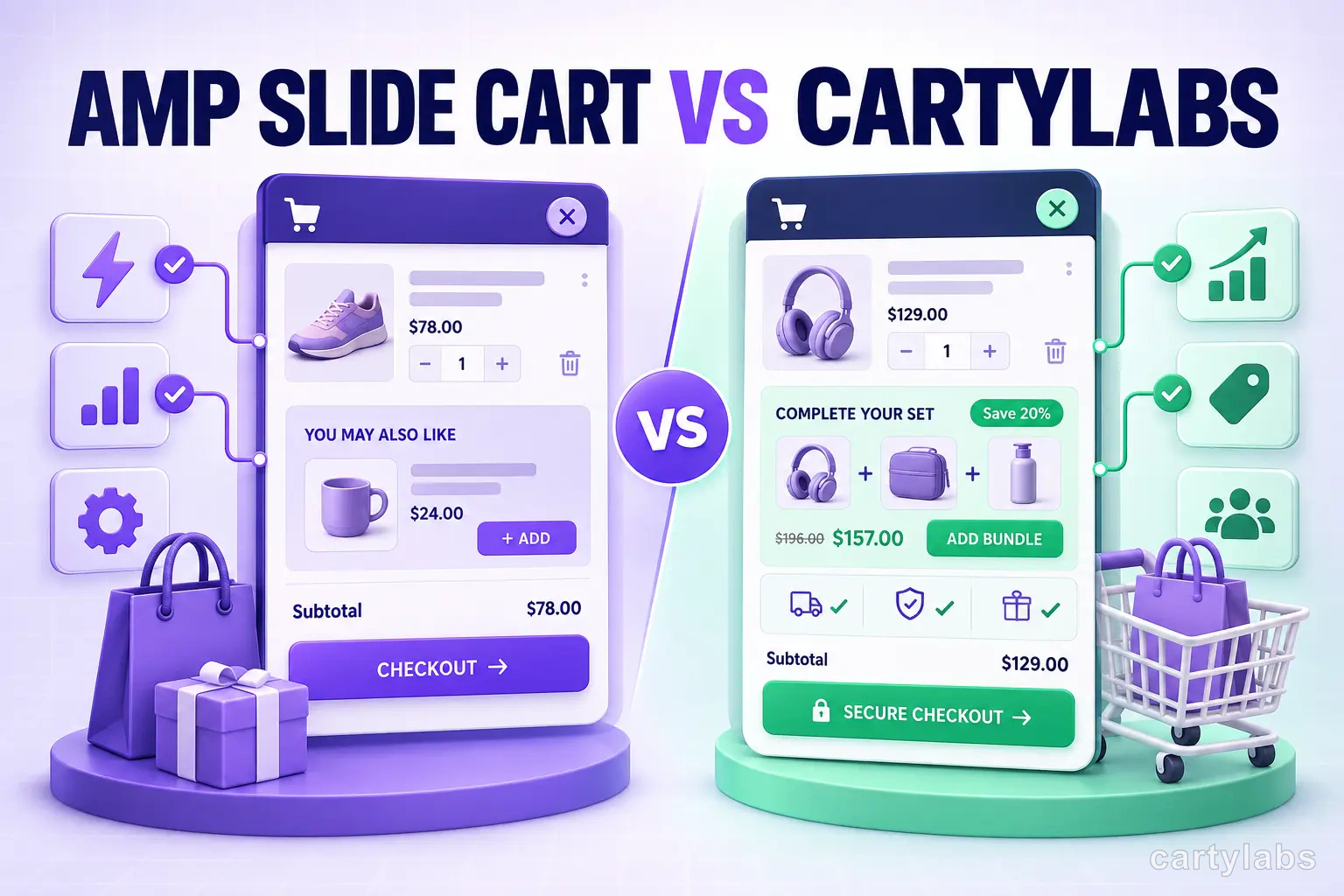
Amp Slide Cart vs Cartylabs: Feature-by-Feature Breakdown
Amp Slide Cart vs Cartylabs compared on Shopify cart drawers, AI upsells, rewards bars, pricing, and setup. An honest, tested breakdown for 2026 merchants.
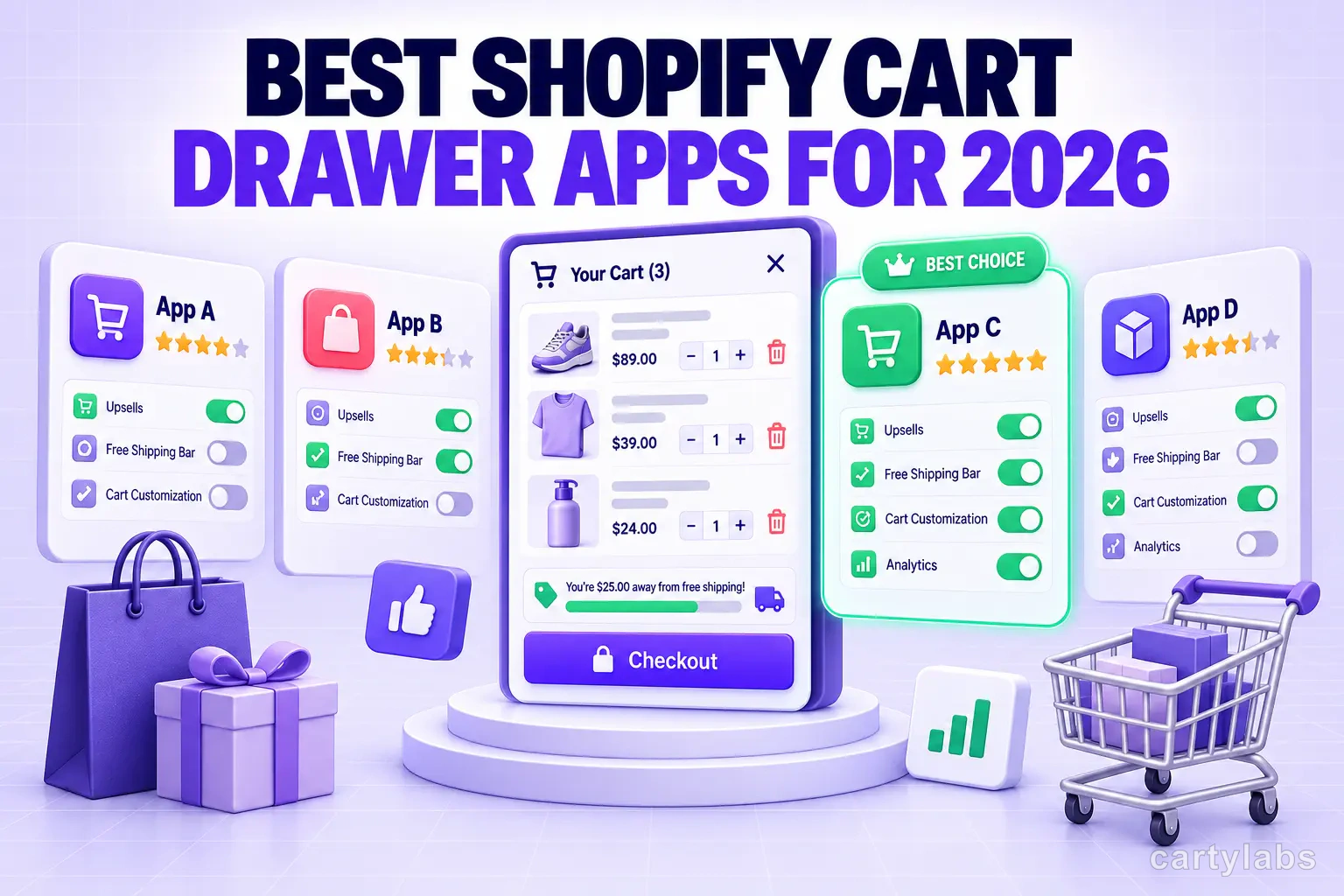
Best Shopify Cart Drawer Apps for 2026: The Honest Comparison
The 8 best Shopify cart drawer apps for 2026 compared on AOV lift, customization, AI upsells, pricing, setup time, and which store profiles each one fits.
 Install Cart — Free