
Upsell vs Cross-Sell vs Down-Sell: The Shopify Playbook
Upsell, cross-sell, and down-sell solve different problems. The definitions, the offer math, and the Shopify patterns that make each one earn its place.
In this article
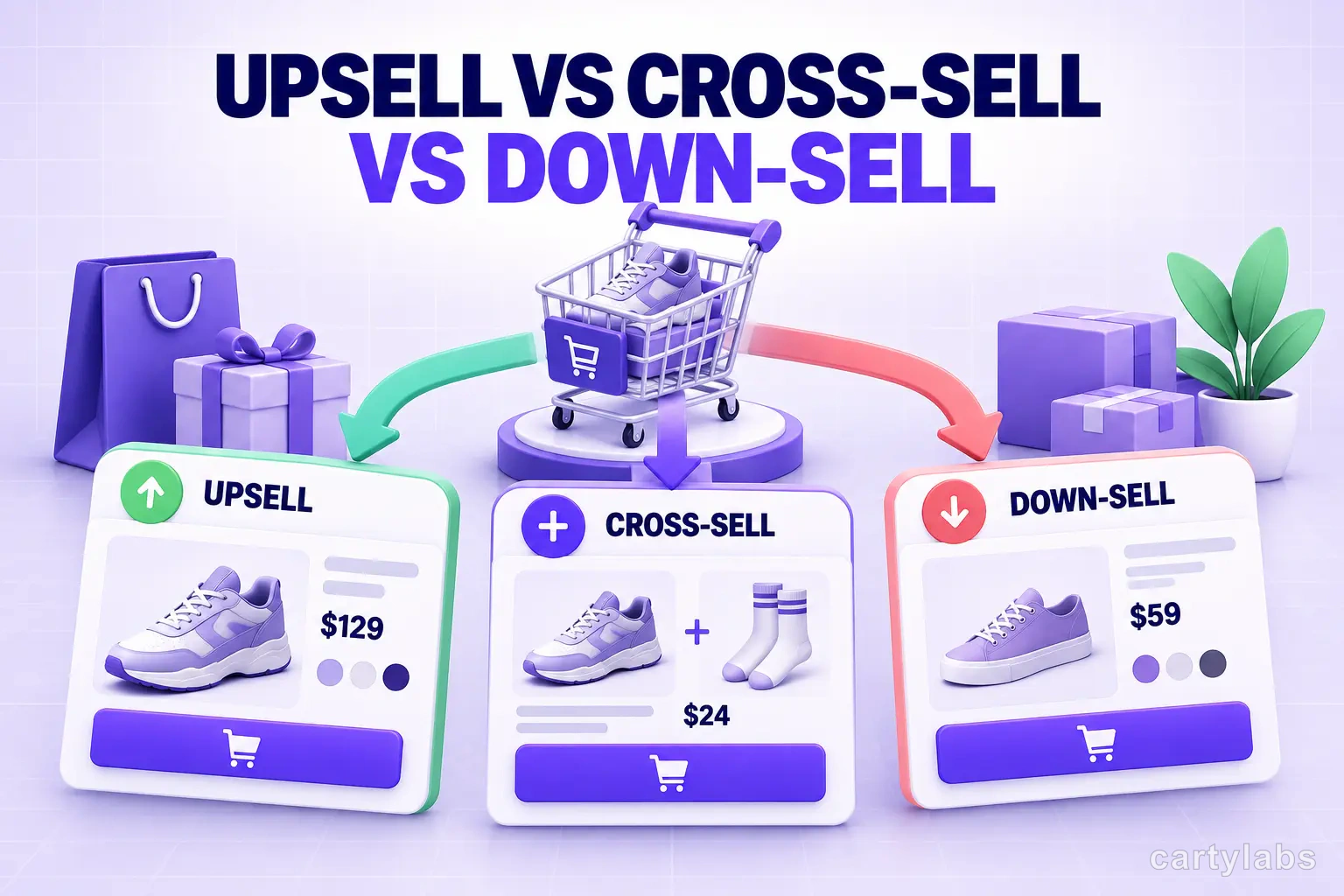
Most Shopify merchants use “upsell” as a catch-all term for any offer that lifts AOV. That’s fine vocabulary, but it muddies the strategy. Upsells, cross-sells, and down-sells are three distinct mechanics, each with a different psychological lever, conversion profile, and best-fit catalog. Picking the wrong one for the moment costs more revenue than running none at all.
This guide is the actual definitions, the offer math behind each, and a Shopify-specific playbook for when to deploy which.
The three definitions
Upsell. Offer the shopper a better/larger/premium version of what they already have in cart or are looking at. Same category, higher price.
Example: Shopper looking at the 8oz hand cream → “Get the 16oz for $24 instead of $32 (33% more product, only 50% more cost).”
Cross-sell. Offer the shopper a complementary product that pairs with what they have. Different category, related use case.
Example: Shopper bought a leather jacket → “Add the matching leather conditioner for 20% off.”
Down-sell. Offer the shopper a cheaper alternative after they’ve rejected the original or are about to abandon. Same category, lower price.
Example: Shopper put the $200 wireless headphones in cart and clicked “Remove” → “Try the $79 wired version instead.”
The three mechanics are not interchangeable. Each one requires a different trigger, different copy, and different placement.
A quick comparison
| Mechanic | Goal | Trigger | Avg conversion | AOV impact |
|---|---|---|---|---|
| Upsell | Trade up to premium | PDP / cart | 4-8% | +12-25% per accepted |
| Cross-sell | Add a related item | Cart / post-purchase | 8-15% | +6-15% per accepted |
| Down-sell | Save the abandoning shopper | Exit / cart-removal | 3-7% | Recovers 30-60% of lost sale |
Cross-sells convert at the highest rate because they’re additive (“I want X and Y”). Upsells require the shopper to swap their pick for a more expensive one, which is psychologically harder. Down-sells convert lower in volume but recover revenue that was already gone.
When to upsell
The upsell needs three conditions:
- The premium variant has a clearly visible benefit. “More product per dollar” is the cleanest. “Better materials” or “extra features” need explicit copy.
- The price gap is under 60%. A $30 → $48 upsell works. A $30 → $90 upsell almost never does.
- The premium variant has retail margin to spare. Otherwise the upsell discount eats the math.
The right surfaces:
- PDP (size/variant selector). This is where most upsells should live. A clean “Save 25% per oz with the 16oz” callout next to the variant picker.
- Cart drawer. Once the small variant is in cart, surface the upgrade as a swap. See the cart drawer guide.
- Post-purchase page. “Want to upgrade your subscription to the bigger size?” See the post-purchase upsell guide.
Upsell copy that converts:
- “Same flavor, 2x the size, only 1.5x the cost”
- “Most customers pick this — runs out 30% slower”
- “Save $X per ounce” (always show the unit-economics math)
When to cross-sell
Cross-sells are the workhorse of Shopify AOV. They convert highest, fit the most catalogs, and stack cleanly with other mechanics.
The conditions:
- A clear functional pairing. Coffee + milk frother, jacket + conditioner, lamp + bulb.
- Cross-sell SKU price is 30-70% of the anchor SKU. Too cheap and the math doesn’t move; too expensive and shoppers won’t add.
- Cross-sell is in stock and ships in the same shipment. Splitting shipments kills both NPS and conversion.
The right surfaces:
- Cart drawer (“frequently bought together”). Highest-conversion surface for cross-sells. See the frequently bought together bundles guide.
- Post-purchase page. Second-best surface, especially for accessory-style add-ons.
- PDP “complete the look” carousel. Lower conversion than cart, but useful for browsing intent.
The recommendation engine matters. Static “manual” cross-sells (merchant picks the pairing) work for catalogs under 50 SKUs. Above that, you need AI-driven recommendations that adapt to actual co-purchase data.
When to down-sell
Down-sells are the most under-implemented of the three because they require detecting an abandonment intent signal.
The conditions:
- You can detect the intent. Cart removal, exit-intent on PDP, mouse-out from checkout, or a specific time-on-cart threshold.
- You have a cheaper alternative that solves the same job. Not just “any product” — a genuine substitute.
- The cheaper alternative isn’t your hero SKU. Don’t down-sell into the product you most want to sell.
The right surfaces:
- Cart-removal modal. When a shopper clicks remove on a $200 SKU, surface the $79 alternative.
- Exit-intent popup. “Wait — there’s a $X version of this. Want to see it?” Lower conversion but cheap to ship.
- Email cart-recovery sequence. Email 1: original cart. Email 2: down-sell alternative. See the cart abandonment playbook.
Down-sell copy that converts:
- “Same battery life, half the price”
- “Most-popular pick under $100”
- “If $200 is more than you wanted to spend, here’s the $79 version”
The honesty in the copy matters. Down-sells that pretend to be a “special offer” feel manipulative; ones that acknowledge price as the friction feel respectful.
The offer math
Each mechanic has a different break-even calculation.
Upsell break-even:
Profit per upsell = (premium price - small price) × accept rate × premium marginFor a $30 → $48 upsell at 50% margin and 6% accept rate: $18 × 6% × 50% = $0.54 per shopper exposed. At 1,000 sessions, that’s $540.
Cross-sell break-even:
Profit per cross-sell = cross-sell price × accept rate × cross-sell margin
                      - app fee per accepted offer
A $20 cross-sell at 50% margin and 12% accept rate: $20 × 12% × 50% = $1.20 per shopper exposed. Higher than upsell because the entire price contributes margin, not just the gap.
Down-sell break-even:
Profit recovered = down-sell price × accept rate × margin
                 - opportunity cost of cannibalized full-price orders
The opportunity cost is the killer here. If 30% of accepted down-sells were going to buy the full-price version anyway, you lose money. This is why down-sells need an actual abandonment trigger — without one, you’re just discounting orders that didn’t need a discount.
A 5-step decision playbook
For each product or offer surface, work through this:
- Is the shopper considering, in cart, or abandoning? Considering → upsell on PDP. In cart → cross-sell in drawer. Abandoning → down-sell on exit.
- Do you have a clear premium variant? If yes → upsell. If no, skip to cross-sell.
- Do you have a complementary SKU at 30-70% of anchor price? If yes → cross-sell.
- Can you detect abandonment intent? If yes → ship a down-sell. If no, skip.
- Is the offer math positive after app fees? Run the formula above. If margin per exposed shopper is below $0.20, the mechanic isn’t worth shipping yet.
Stacking the three
The three mechanics don’t compete; they fire at different moments:
- PDP: upsell (variant ladder) + cross-sell (“complete the look”)
- Cart drawer: cross-sell (FBT) + free shipping bar + GWP
- Cart-removal: down-sell
- Post-purchase page: cross-sell (the highest-conversion surface)
- Email sequence: down-sell + retention offer
A fully stacked Shopify funnel runs all three across these surfaces. Lift over a non-optimized funnel: 22-35% on revenue per session. See the pre/in/post upsell breakdown for the surface-by-surface playbook.
Mistakes that flatten the lift
Calling everything “upsell” in your offer logic. If your app treats every offer the same, you’ll surface a cross-sell at an upsell moment and lose conversion. Tag offers explicitly.
Down-selling without a trigger. A cheaper alternative shown to every shopper is just a discount on the cheaper SKU.
Cross-selling unrelated products. “Bought a leather jacket → buy a yoga mat” doesn’t work. The recommendation has to be functionally adjacent.
Upsells that hide the original. If the shopper picked the small size, don’t replace the cart line with the big one. Surface the upgrade as a swap, not a stealth substitution.
Stacking three offers in the same surface. A cart drawer with an upsell, a cross-sell, and a down-sell creates choice paralysis. Pick one or two per surface.
When not to run any of them
- Catalogs with one SKU. No upsell variant, no cross-sell pairing, no down-sell alternative. Use a volume discount instead.
- Pre-launch / first 30 days. You don’t have co-purchase data, accept-rate baselines, or abandonment patterns. Ship the cart drawer first; layer offers later.
- Luxury / single-ticket considered purchases. A $4,000 handbag doesn’t take a cross-sell.
A short summary
Upsell, cross-sell, and down-sell are not synonyms. Each one fires at a specific moment, against a specific intent signal, with a specific math. Cross-sells convert highest and fit most catalogs. Upsells need a clear premium variant and tight price gap. Down-sells recover lost sales but require an abandonment trigger to avoid cannibalizing full-price orders.
Tag your offers explicitly, run them on the right surfaces, and stack the three across PDP, cart, post-purchase, and email. A fully layered funnel lifts revenue per session 22-35% over a non-optimized one.
Want all three mechanics in one app? Install Cartylabs free on Shopify, or book a 15-minute demo and we’ll map the right offers to your top SKUs.
Next steps
Related Shopify resources
Practical tools and product pages related to this guide.
Keep reading
All articles →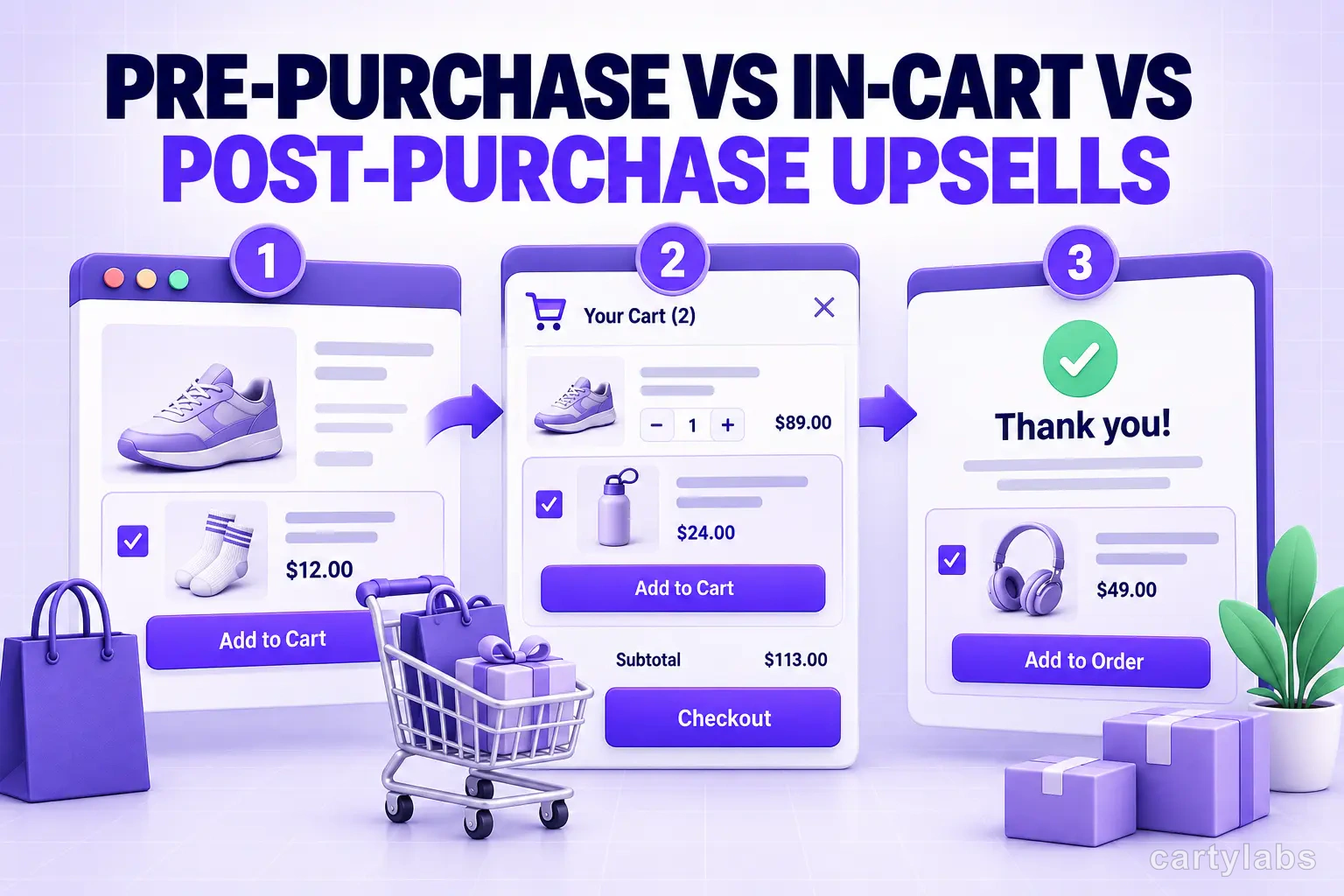
Pre-Purchase vs In-Cart vs Post-Purchase Upsells: Shopify Surfaces in 2026
Three upsell surfaces, three different conversion profiles. The math, the offer types, and which Shopify upsell surface to deploy when in 2026.
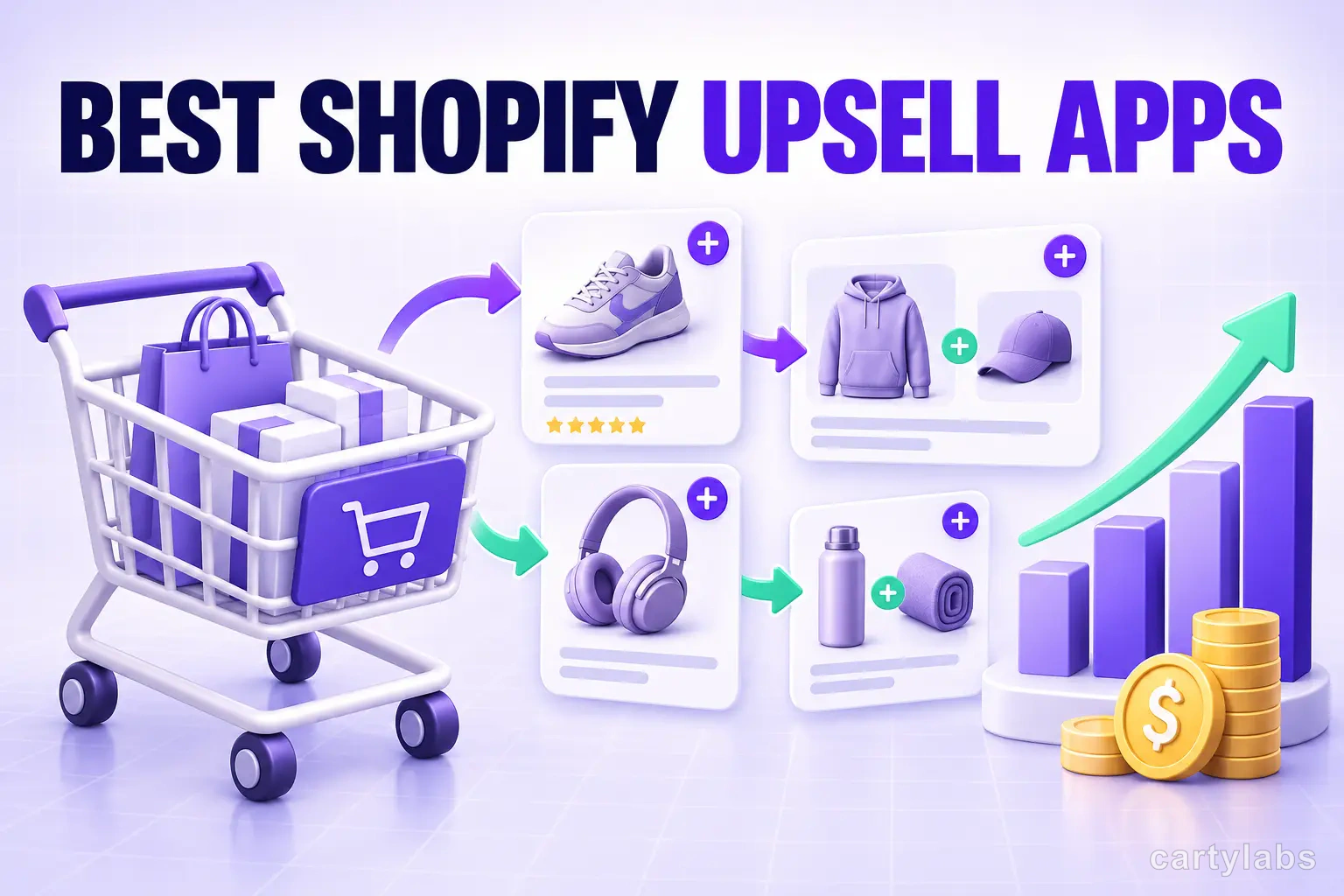
Best Shopify Upsell Apps: 12 Apps Compared
The best Shopify upsell apps for 2026 compared on AOV lift, pricing, AI logic, and funnel position. 12 apps tested for in-cart, post-purchase, and bundle upsells.
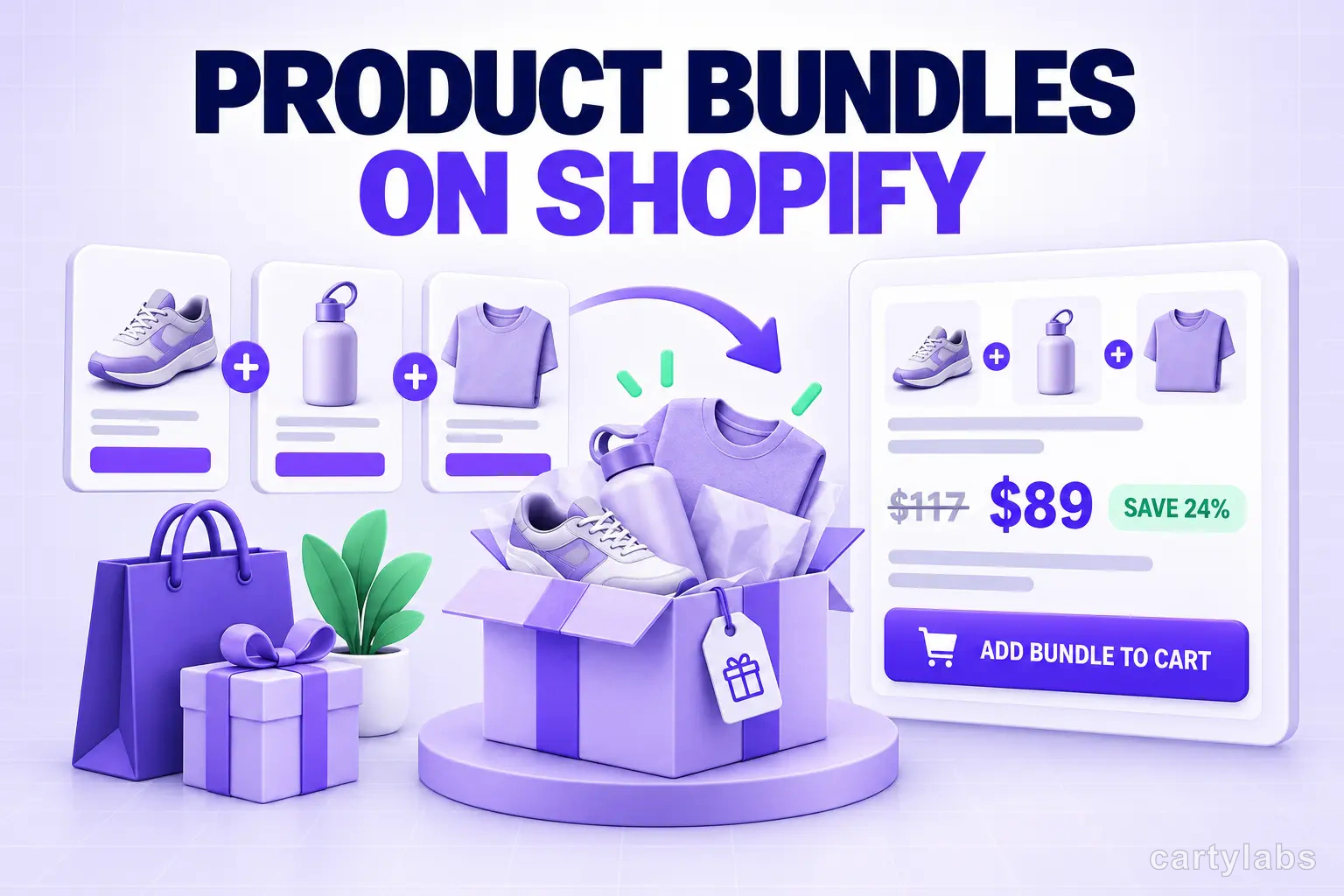
Product Bundles on Shopify: Fixed, Mix-and-Match, BOGO and More
The 6 bundle types on Shopify, the AOV math behind each, and the catalog conditions that make bundles convert. A no-fluff playbook for 2026.
 Install Cart — Free