
Volume Discounts & 'Buy More, Save More' Tactics for Shopify
Volume discounts lift AOV 15-30% on the right catalogs. The tier math, the SKU rules, and the Shopify implementation patterns that don't erode margin.
In this article
- 01 What counts as a volume discount#
- 02 When volume discounts work — and when they don’t#
- 03 The tier math#
- 04 The “round up to the next tier” effect#
- 05 Volume discount vs. bundle: which to pick#
- 06 A 6-step rollout playbook#
- 07 Mistakes that kill the lift#
- 08 Implementation: native Shopify vs. app#
- 09 When not to use volume discounts#
- 10 A short summary#
“Buy more, save more” is the oldest AOV mechanic in retail and one of the most consistent revenue lifts on Shopify when applied to the right catalog. The conventional setup — “2 for 10%, 3 for 15%, 4+ for 20%” — looks simple but is full of margin traps. Set the tiers wrong and you’re discounting orders that would have been placed at full price. Set them right and you’re trading 12-18 points of margin for a 15-30% AOV lift, which is almost always net-positive.
This guide is the math behind volume discount tiers, the SKU criteria that make the mechanic work (or fail), and the Shopify implementation patterns merchants actually ship in 2026.
What counts as a volume discount
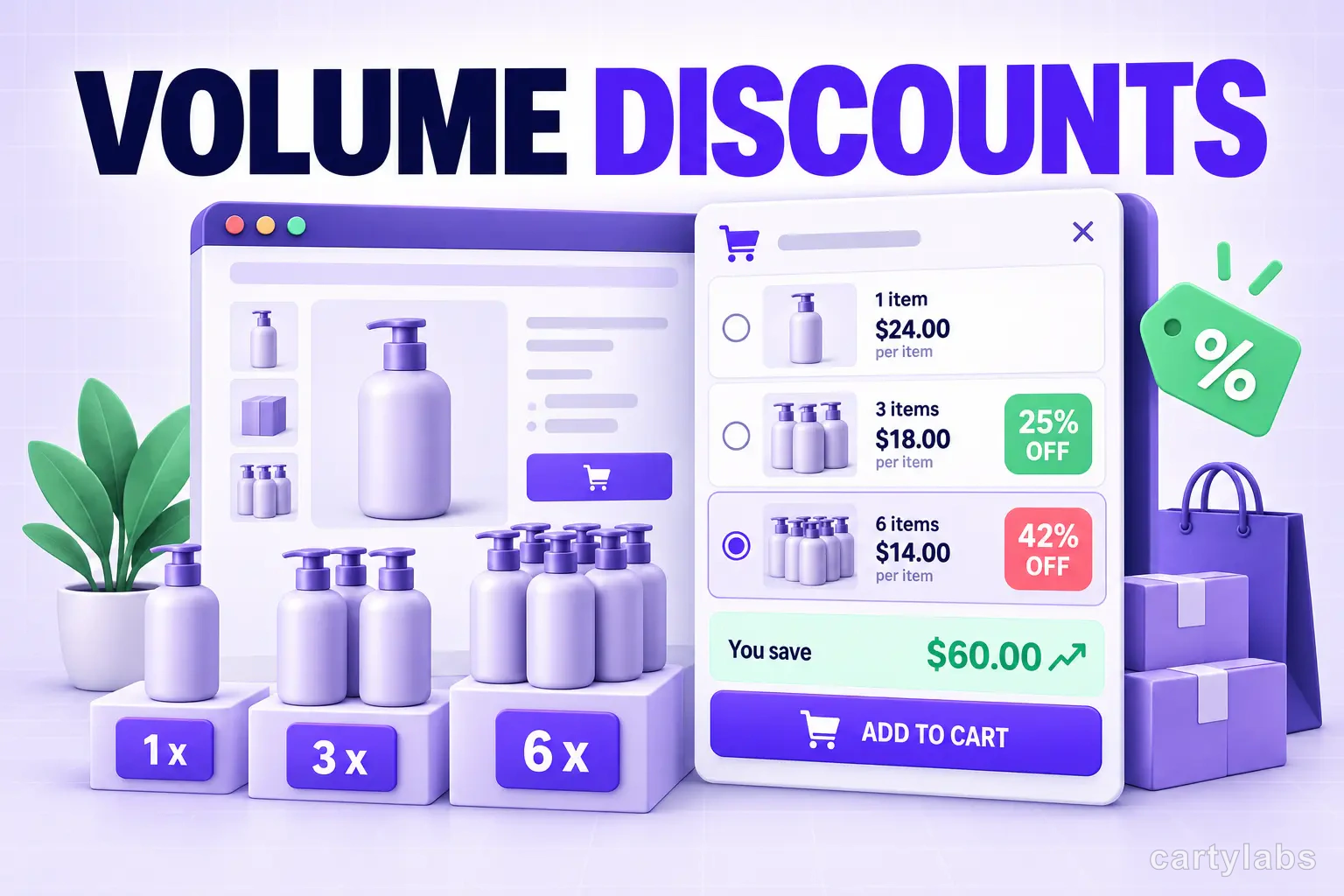
A volume discount triggers automatically when a shopper adds N units of the same SKU (or, in some implementations, N items from the same product set). The discount is unit-level: every unit gets the discount, not just the marginal one.
The standard tier ladder:
| Quantity | Discount | Effective unit price (on $20 base) |
|---|---|---|
| 1 | 0% | $20.00 |
| 2 | 10% | $18.00 |
| 3 | 15% | $17.00 |
| 4+ | 20% | $16.00 |
Every increment has to be visible to the shopper before they hit it. A discount that only appears at checkout converts at half the rate of one shown on the PDP. This is why the in-cart variant (a “buy 1 more for 10% off” nudge inside the cart drawer) outperforms a static PDP table.
When volume discounts work — and when they don’t
The mechanic only earns its keep on catalogs where multi-unit purchase is actually plausible. Three filters:
Consumability. Will the shopper use multiple units within a reasonable timeframe? Skincare, candles, supplements, snacks, socks: yes. Mattresses, mountain bikes, kitchen appliances: no.
Stockpile-friendliness. Will the shopper accept a 6-month supply if it saves 20%? Razor blades, coffee beans, cat food: yes. Fresh produce, perishables: no.
Gift-friendliness. Could a buyer plausibly purchase 3-4 units to give as gifts? Candles, books, small accessories: yes. Custom-fit apparel: usually no.
If the SKU passes none of those filters, volume discounts will discount orders that would have been placed at single-unit price anyway — pure margin loss. Use a free shipping threshold or a bundle instead.
The tier math
The right tier ladder depends on three numbers: gross margin, current basket distribution (what % of orders are 1, 2, 3, 4+ units today), and price elasticity.
A simple decision rule:
Maximum sustainable discount at tier N
= gross margin × (1 - 1/N) × 0.6
Where 0.6 is a safety factor that accounts for the share of orders that would have placed N units anyway, and now get discounted.
A worked example. A skincare SKU at $30 retail, $9 COGS (70% gross margin):
- Tier 2: max discount = 70% × (1 - 1/2) × 0.6 = 21% → set at 10-12%
- Tier 3: max discount = 70% × (1 - 1/3) × 0.6 = 28% → set at 15%
- Tier 4: max discount = 70% × (1 - 1/4) × 0.6 = 31.5% → set at 20%
If your gross margin is 40% instead of 70%, every cap roughly halves, and the standard “2/3/4 → 10/15/20” ladder is too aggressive. Use 5/8/12 or skip the mechanic entirely.
The “round up to the next tier” effect
The behavioral lift comes from shoppers who were going to buy 2 units and bump to 3 to capture the bigger discount, or buy 3 and bump to 4. In aggregate, this redistributes basket sizes upward by 0.4-0.7 units on average.
The lift is almost entirely a function of how visible the next tier is. Three rules that compound:
- Show the tier ladder on PDP. A tiny table near the price.
- Repeat the tier in the cart drawer. “Add 1 more to save 5%” with a one-click “+1” button.
- Use a stacked rewards bar. Combine the volume tier with a free shipping threshold and a free-gift unlock so the shopper sees three reasons to add one more.
The third element — stacking — is the difference between a 15% AOV lift and a 30% one.
Volume discount vs. bundle: which to pick
Volume discounts and bundles overlap but solve different problems:
| Mechanic | Best for | AOV lift | Margin impact |
|---|---|---|---|
| Volume discount (same SKU) | Consumables, stockpilable | 15-25% | Moderate |
| Mix-and-match bundle | Multi-SKU catalogs | 18-30% | Moderate |
| Fixed bundle (preset combo) | Curated kits | 25-40% | Lower (priced for margin) |
| BOGO | Inventory clearance | 10-20% | Highest discount |
If your catalog is single-SKU heavy (one supplement, one candle, one shirt), volume discounts win. If you sell coordinated sets, mix-and-match bundles win. If you’re moving end-of-season stock, BOGO wins.
A 6-step rollout playbook
- Pick one SKU. Start with the consumable bestseller — highest order share, highest margin, highest reorder rate.
- Calculate the tier caps using the formula above. Round to clean numbers (5%, 10%, 15%, 20%).
- Set 3 tiers, not 5. More than three tiers confuse shoppers and increase the share of orders that hit a discount they didn’t reach for.
- Show the tier table on PDP and inside the cart drawer. Both surfaces, not just one.
- Track three metrics: AOV (should rise 12-22%), units per order (should rise 0.4-0.7), and gross margin per order (should hold or rise).
- A/B test for 21 days minimum. Volume discount lifts are noisy week-over-week; you need three weeks to read the signal.
Mistakes that kill the lift
Stacking volume discount with sitewide promo codes. A 15% volume discount + a 20% sitewide code = 35% off, which usually breaches your margin floor. Either disable codes when volume tiers trigger, or scope codes to exclude tiered SKUs.
Hiding the next tier inside the cart. If shoppers can’t see “Add 1 more for 5% off” without scrolling, they don’t add. Pin the message above the line items.
Tiering by total cart value instead of unit count. “$100 → 10% off, $150 → 15% off” is a free shipping bar variant, not a volume discount. Both work but they’re different mechanics; mixing them up confuses shoppers.
Using the same tier ladder across all SKUs. A 70%-margin candle and a 25%-margin electronics accessory cannot share a tier ladder. Either segment by product category or pick one category and skip the rest.
Shopify discount conflicts. Native Shopify automatic discounts don’t always combine cleanly with app-driven volume discounts. Test in checkout, not just in-cart.
Implementation: native Shopify vs. app
Native Shopify supports automatic discounts at the order, product, and shipping level, but volume tiering specifically — different discounts at different quantity breakpoints — needs either Shopify Functions (developer effort) or an app.
Most stores ship via app because:
- Tier ladders need a UI to display on PDP and cart, which native discounts don’t render natively.
- Stacking with a free gift bar or shipping protection upsell requires a single coordinated frontend.
- A/B testing tier ladders is impossible without app-level logic.
Cartylabs handles the tier ladder, the cart-drawer nudge (“Add 1 more for 5%”), and the visual stacking with rewards bars in a single embed.
When not to use volume discounts
- Luxury and considered-purchase brands. Discounting a $1,500 watch for a 2-pack purchase doesn’t fit the brand and there’s no behavioral substrate (people don’t stockpile watches).
- Single-SKU stores selling unique items. Art, custom commissions, made-to-order furniture.
- Catalogs where a single unit is already a multi-unit pack. A 12-pack of soap doesn’t need a 2-pack discount.
- Stores with margins under 30%. The math doesn’t pay back unless the AOV lift exceeds 25%, which is hard to hit on thin-margin catalogs.
- Subscription-led catalogs. Use a subscribe-and-save mechanic instead; it captures the same multi-unit intent with better LTV.
A short summary
Volume discounts are a margin-for-AOV trade. Done right (tiered against gross margin, surfaced on PDP and in the cart, stacked with shipping/gift unlocks) they lift AOV 15-30% with neutral-to-positive margin impact. Done wrong (flat ladder across all SKUs, no in-cart nudge, stacked with promo codes) they leak margin without lifting basket size.
Pick one SKU, calculate the tier caps, ship the in-cart nudge, and measure for 21 days. The mechanic is mature, predictable, and one of the fastest paybacks on Shopify when the catalog fits.
Want stacked volume tiers, a free-gift bar, and a cart drawer in one app? Install Cartylabs free on Shopify, or book a 15-minute demo and we’ll map the right tiers for your top SKUs.
Next steps
Related Shopify resources
Practical tools and product pages related to this guide.
Keep reading
All articles →
Product Bundles on Shopify: Fixed, Mix-and-Match, BOGO and More
The 6 bundle types on Shopify, the AOV math behind each, and the catalog conditions that make bundles convert. A no-fluff playbook for 2026.
Best Shopify Cross-Sell Apps for 2026: The Honest Comparison
The 9 best Shopify cross-sell apps for 2026 compared on recommendation quality, placement coverage, free plans, pricing model, and setup time — plus which store profile each one actually fits.
How to Add Upsells to Your Shopify Cart Drawer
Add cart drawer upsells three ways: no-code with Search & Discovery, custom Ajax code, or an app. Product selection, placement, mobile, and measurement.
 Install Cart — Free