
Product Bundles on Shopify: Fixed, Mix-and-Match, BOGO and More
The 6 bundle types on Shopify, the AOV math behind each, and the catalog conditions that make bundles convert. A no-fluff playbook for 2026.
In this article
- 01 The six types#
- 02 1. Fixed bundle#
- 03 2. Mix-and-match#
- 04 3. BOGO#
- 05 4. Frequently bought together (FBT)#
- 06 5. Build-a-box#
- 07 6. Subscription bundle#
- 08 A decision tree for picking the right bundle#
- 09 Bundle pricing math#
- 10 Implementation: native Shopify vs. app#
- 11 Mobile rules#
- 12 When not to bundle#
- 13 How bundles stack with the wider funnel#
- 14 A short summary#
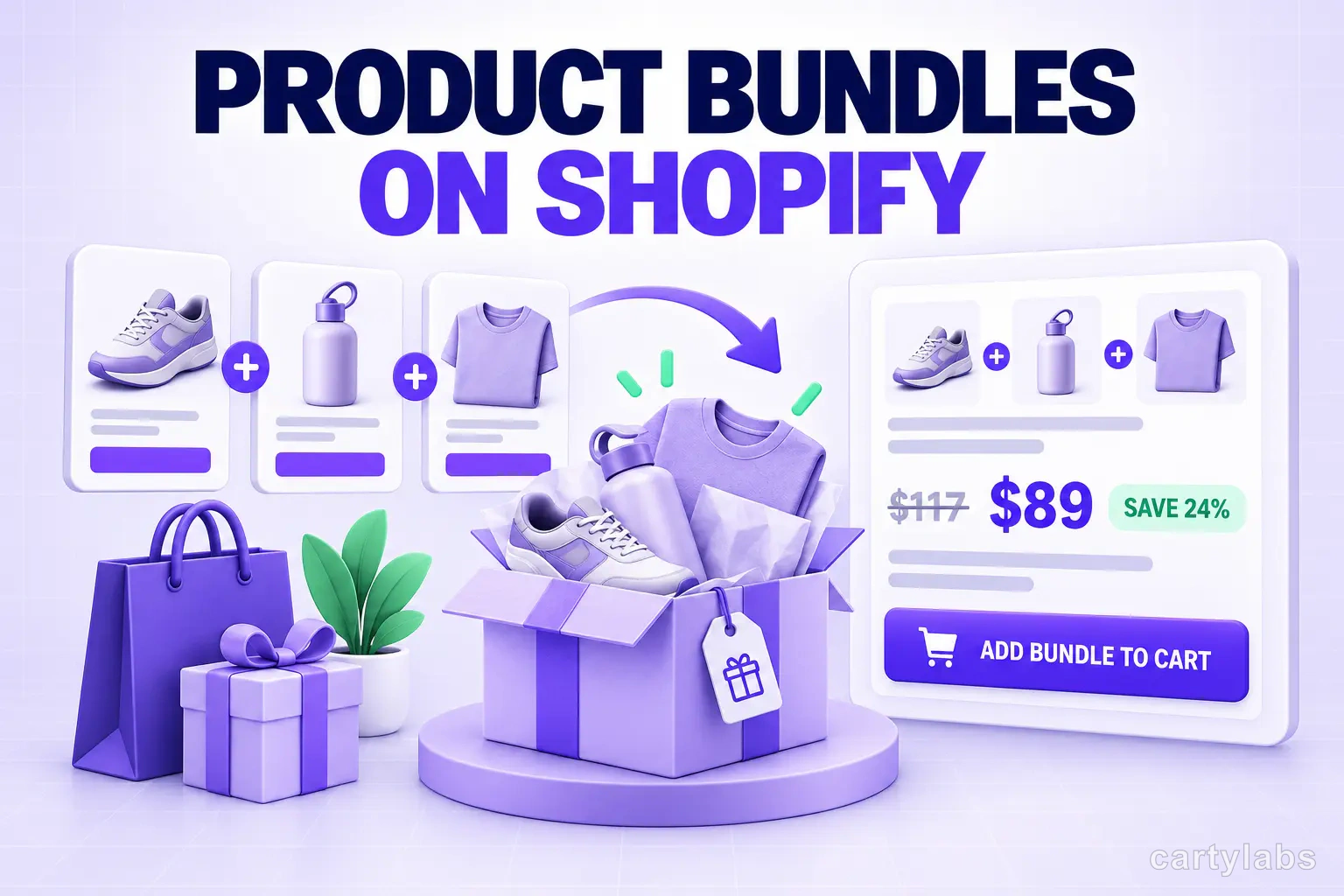
“Bundle” is one of those words that means six different things on Shopify. A fixed routine kit and a build-a-box subscription are both bundles, but they convert differently, fit different catalogs, and need different implementations. The wrong bundle type for your catalog produces a beautiful PDP that nobody buys; the right one lifts AOV 25-40% and creates SKUs that outsell their components.
This guide is the six bundle types worth running on Shopify, the math behind each, and the catalog conditions that decide which one earns its place.
The six types
| Bundle type | What it is | Best for | Typical AOV lift |
|---|---|---|---|
| Fixed bundle | Preset combo at preset price | Curated routines, kits | +25-40% |
| Mix-and-match | Pick N from a set, get bundle price | Multi-SKU catalogs | +18-30% |
| BOGO | Buy one, get one (free or discounted) | Inventory clearance | +10-20% |
| Frequently bought together | Auto-suggested complementary items | Cross-sell-rich catalogs | +6-15% |
| Build-a-box | Customer composes a custom bundle | DTC subscription | +30-50% LTV |
| Subscription bundle | Recurring delivery of bundled items | Replenishable categories | +40-70% LTV |
The lift numbers are gross over baseline; net lift depends on how much margin you give up. Fixed bundles typically retain the most margin because the bundle price is set to your target unit economics; BOGO leaks the most.
1. Fixed bundle
A preset combination of 2-5 SKUs sold at a single price. The bundle is its own SKU on Shopify with its own PDP and inventory logic.
Best for:
- Curated routines (cleanser + toner + moisturizer)
- Starter kits (knife + cutting board + sharpener)
- Gift sets for holiday/BFCM
The math: bundle price is typically set 10-20% below the sum-of-parts price. This is enough to feel like a deal but small enough that bundle margin holds.
Bundle margin = sum(component margin × component count)
              - bundle discount (% off sum-of-parts)
Example: three SKUs at $20 retail / $8 COGS each. Sum of parts: $60 / $24 COGS = $36 gross profit (60% margin). Bundle priced at $54 (10% off). Bundle gross profit: $54 - $24 = $30 (56% margin).
Fixed bundles outperform other types when shoppers don’t want to assemble the kit themselves. Gift buyers, beginners, and “tell me what to buy” shoppers convert at 2-3x the rate on a fixed bundle vs. a mix-and-match.
2. Mix-and-match
The shopper picks N items from a defined set; the cart applies bundle pricing automatically. “Pick any 3 t-shirts for $50.”
Best for:
- Apparel (sizes, colors, patterns)
- Snacks/drinks (flavor variety)
- Beauty (shade variation)
The math: bundle price assumes the shopper picks the average-priced items. Sale-priced and premium items inside the set break the math, so most stores either exclude high-priced SKUs from the mix or set a flat per-unit bundle price.
Mix-and-match lifts choice-engagement metrics (time on PDP, items viewed) but converts at slightly lower rates than fixed bundles because of decision fatigue. Cap the picker at 3-5 items; above that, conversion drops sharply.
For the wider cross-sell strategy, see the Shopify AOV upsell guide.
3. BOGO
Buy one, get one — free, half-price, or a fixed discount. The classic clearance mechanic.
Best for:
- End-of-season inventory
- New SKU trial seeding
- BFCM and seasonal events
The margin trade is steep: BOGO free is effectively a 50% discount on every BOGO order. Most stores can’t sustain it as an evergreen offer. BOGO 50% (buy one, get the second 50% off) is a 25% effective discount — sustainable for shorter campaigns.
When BOGO works:
- The “get” item has high COGS but low retail (clearance) → the discount disposes of inventory you’d write off anyway.
- The “buy” item has high margin (so you can absorb the discount).
- Restricted to a specific collection (not sitewide).
When it fails:
- Sitewide BOGO across all SKUs. Margin disappears.
- BOGO on hero SKUs. You’re discounting orders that would have happened at full price.
4. Frequently bought together (FBT)
The Amazon-style “customers also bought” carousel, surfaced on PDP and inside the cart drawer. Functionally a cross-sell mechanic, but presented as a bundle (one-click “Add all 3 to cart”).
Best for:
- Catalogs with strong co-purchase patterns
- Stores with 50+ SKUs (enough data for the algorithm)
- Cart-drawer placements
FBT outperforms manual cross-sells because the recommendations adapt as buying patterns shift. See the frequently bought together bundles guide for the recommendation logic.
The lift is smaller per-bundle (6-15%) but the volume is higher because FBT runs on every PDP and cart, not just bundle-tagged products.
5. Build-a-box
The shopper composes a custom box from a wide menu — pick 6 candles from 30 options, pick 12 snacks from 80, etc. Bundle pricing applies once the box is filled.
Best for:
- DTC subscription brands
- High-variety catalogs (snacks, beverages, beauty)
- Gift-with-customization use cases
Build-a-box has the highest engagement metric of any bundle type (time on page often 4-6 minutes) but the lowest conversion rate. The shoppers who finish the flow are heavily self-selected and convert at premium AOV (40-60% above store average).
Implementation is the heaviest of the six types: you need a custom PDP flow, inventory logic that handles per-component stock, and a fulfillment process that can pick 6+ SKUs per order without errors. Most build-a-box stores ship via a dedicated bundle app rather than core Shopify.
6. Subscription bundle
A recurring delivery of a bundle (fixed or build-a-box) at a discounted rate vs. one-time purchase. The bundle and the subscription mechanic combine.
Best for:
- Replenishable consumables (coffee, supplements, pet food)
- Curated discovery (subscription box of the month)
- High-LTV categories where the bundle locks in retention
LTV impact is the highest of any bundle type. A subscription bundle subscriber typically delivers 4-8x the LTV of a one-time bundle buyer. See the subscribe-and-save guide for the mechanic details.
A decision tree for picking the right bundle
Work through these in order:
- Do you have replenishable consumables? → Subscription bundle.
- Do you have a curated routine you want to teach? → Fixed bundle.
- Do you have variety within a single category (sizes, flavors, colors)? → Mix-and-match.
- Are you clearing end-of-season inventory? → BOGO.
- Do you have 50+ SKUs and want a passive cross-sell? → Frequently bought together.
- Do you have an enthusiastic community and a wide-variety catalog? → Build-a-box.
Most stores end up running 2-3 of these in parallel — for example, fixed bundles as hero SKUs, FBT as a passive cross-sell on every PDP, and BOGO as a BFCM campaign.
Bundle pricing math
Across all bundle types, the pricing rule of thumb:
Bundle discount = 8-15% off sum-of-partsBelow 8%, shoppers don’t perceive a deal. Above 15%, you’re discounting orders that would have been multi-item anyway. The exception is BOGO (effectively 25-50% discount on the bundle), which is a clearance mechanic, not a margin-positive bundle.
For mix-and-match, the discount is built into the per-unit bundle price (“$15 each when you buy 3” vs. $19 retail = ~21% discount per unit, which is high but offset by the 3x basket size).
Implementation: native Shopify vs. app
Native Shopify supports:
- Multi-SKU products (good for fixed bundles where the bundle is its own SKU)
- Automatic discounts (passable for BOGO and simple mix-and-match)
What native Shopify doesn’t support:
- Per-component inventory tracking inside a bundle
- Build-a-box flows
- Cart-drawer-level bundle pricing
- AI-driven FBT recommendations
Most multi-bundle catalogs ship via a dedicated bundle app. Cartylabs handles FBT and cart-level bundle pricing as part of the cart drawer; fixed bundles and build-a-box typically need a specialist tool.
Mobile rules
Bundles are bigger UI surfaces than typical cross-sells, and mobile is where they break:
- Show the bundle price prominently. The savings vs. sum-of-parts should be the headline number.
- Stack bundle items vertically on mobile. Side-by-side carousels feel cramped under 375px.
- Pre-select default sizes/variants. Forcing shoppers to pick variant for every item in the bundle drops conversion 30-50%.
- One-tap “Add all to cart.” A “Customize” path is fine as a secondary action; the primary path should be one tap.
When not to bundle
- Catalogs with one or two SKUs. Use a volume discount or a free-gift offer instead.
- Luxury / single-ticket items. Bundling a $4,000 watch with a strap cheapens the watch.
- First 30 days of a new store. No co-purchase data; FBT and mix-and-match won’t work yet.
- Catalogs with high variant complexity. If every SKU has 30 size/color combinations, bundles become a fulfillment nightmare.
How bundles stack with the wider funnel
Bundles work best as a hero offer surface with a rewards progress bar layered on top. The combined stack:
- Bundle PDP: lifts the basket with the bundle pricing itself.
- Cart drawer rewards bar: nudges the shopper to add one more item past the bundle to hit free shipping or a free gift.
- Post-purchase upsell: extracts a second purchase after the bundle order completes.
A fully layered bundle funnel typically lifts revenue per session 30-45% over a non-bundled baseline.
A short summary
Bundle is a category, not a tactic. Six distinct types, each fitting a different catalog and goal. Fixed bundles teach routines; mix-and-match handles variety; BOGO clears inventory; FBT runs passively across every PDP; build-a-box monetizes high-variety catalogs; subscription bundles lock in LTV.
Pick one or two that fit your catalog, set the discount at 8-15% off sum-of-parts (BOGO is the exception), and stack them with a rewards progress bar for compounding lift. Most stores see AOV move within 21 days.
Want FBT bundles inside the cart drawer, with the rewards bar built in? Install Cartylabs free on Shopify, or book a 15-minute demo and we’ll map the right bundle types for your catalog.
Next steps
Related Shopify resources
Practical tools and product pages related to this guide.
Keep reading
All articles →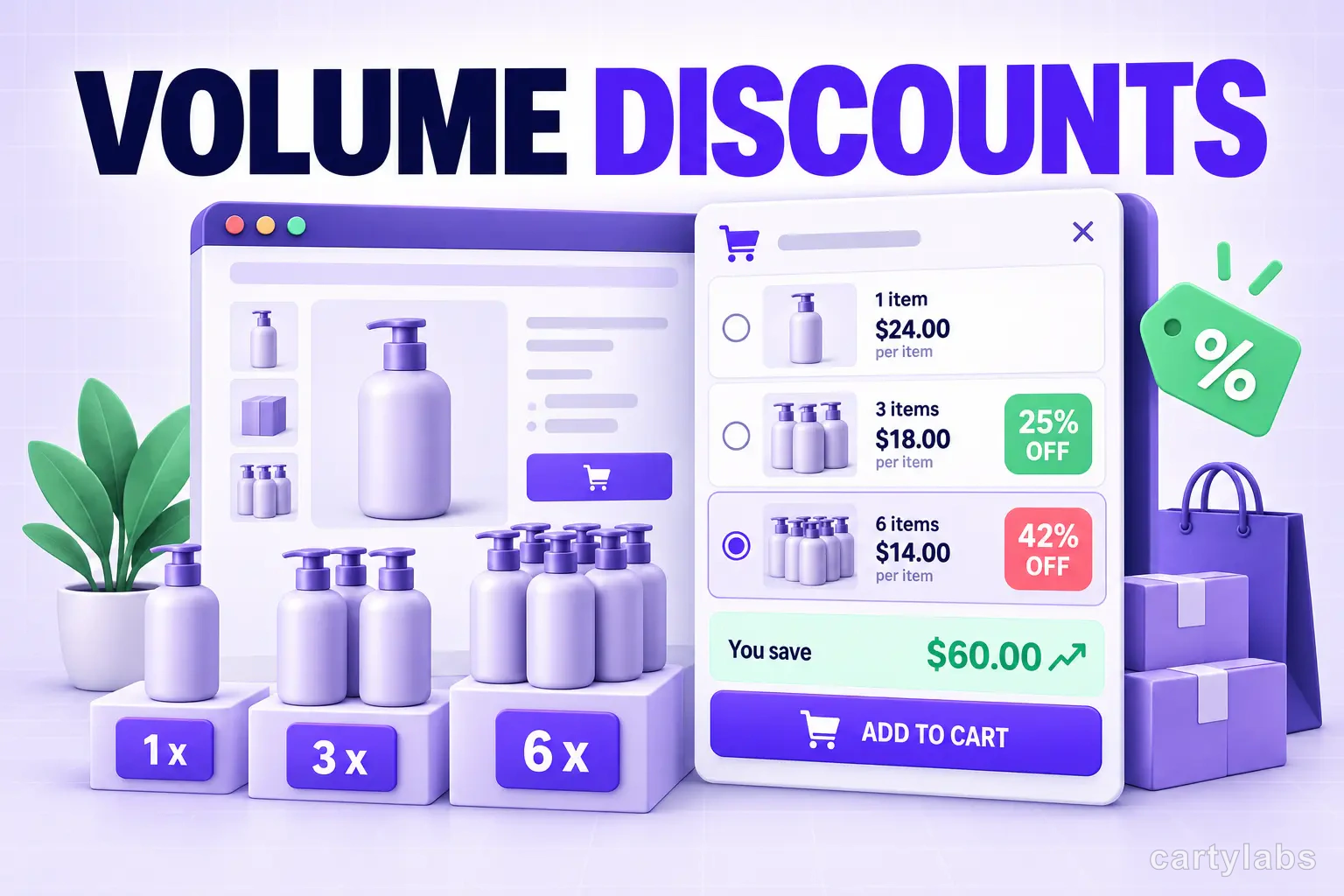
Volume Discounts & 'Buy More, Save More' Tactics for Shopify
Volume discounts lift AOV 15-30% on the right catalogs. The tier math, the SKU rules, and the Shopify implementation patterns that don't erode margin.
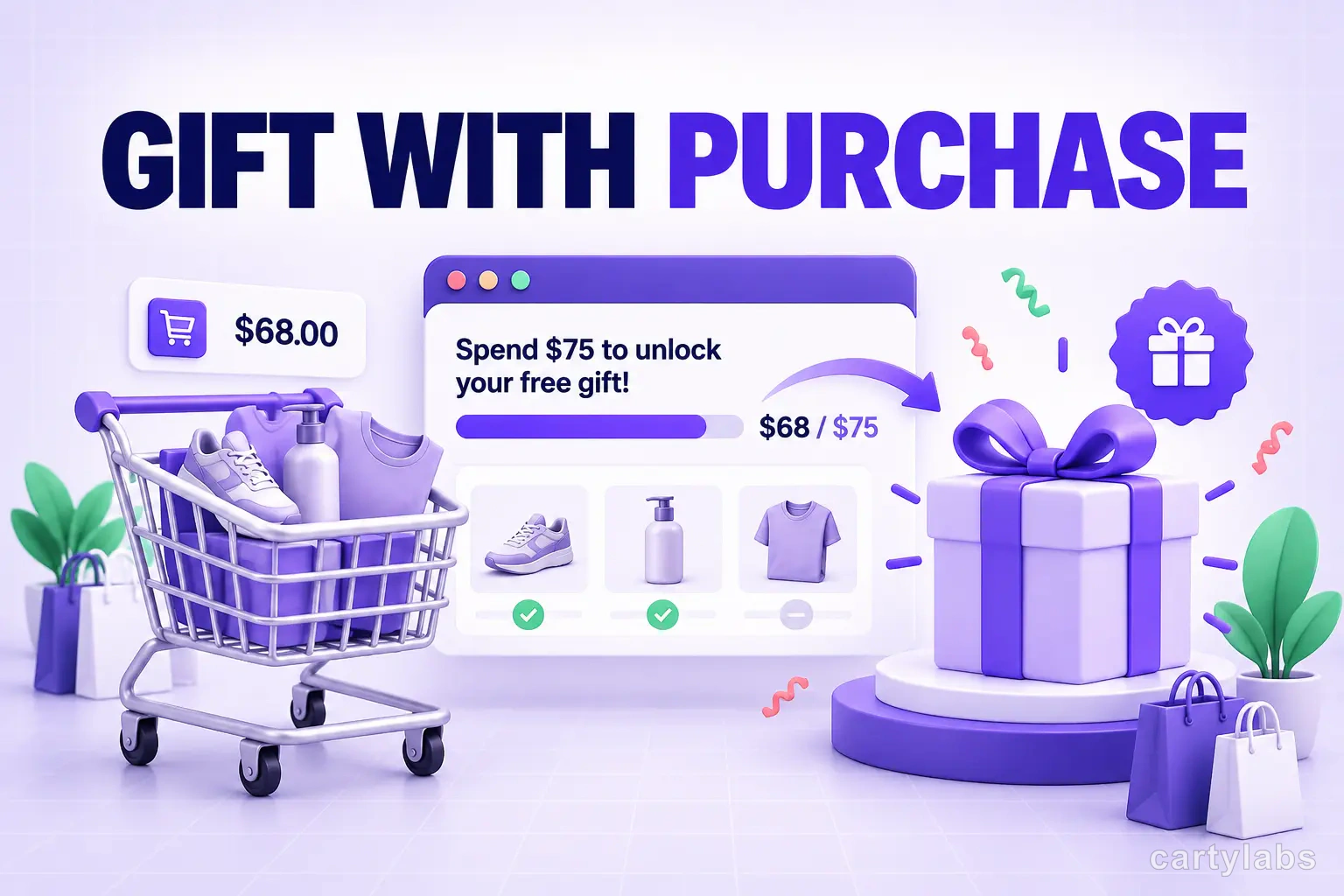
Gift With Purchase: 11 GWP Campaigns That Print Money on Shopify
Gift With Purchase campaigns lift AOV 18-30% when designed right. The 11 GWP types, the threshold math, and the Shopify implementation patterns for 2026.
Best Shopify Upsell Apps: 12 Apps Compared
The best Shopify upsell apps for 2026 compared on AOV lift, pricing, AI logic, and funnel position. 12 apps tested for in-cart, post-purchase, and bundle upsells.
 Install Cart — Free