
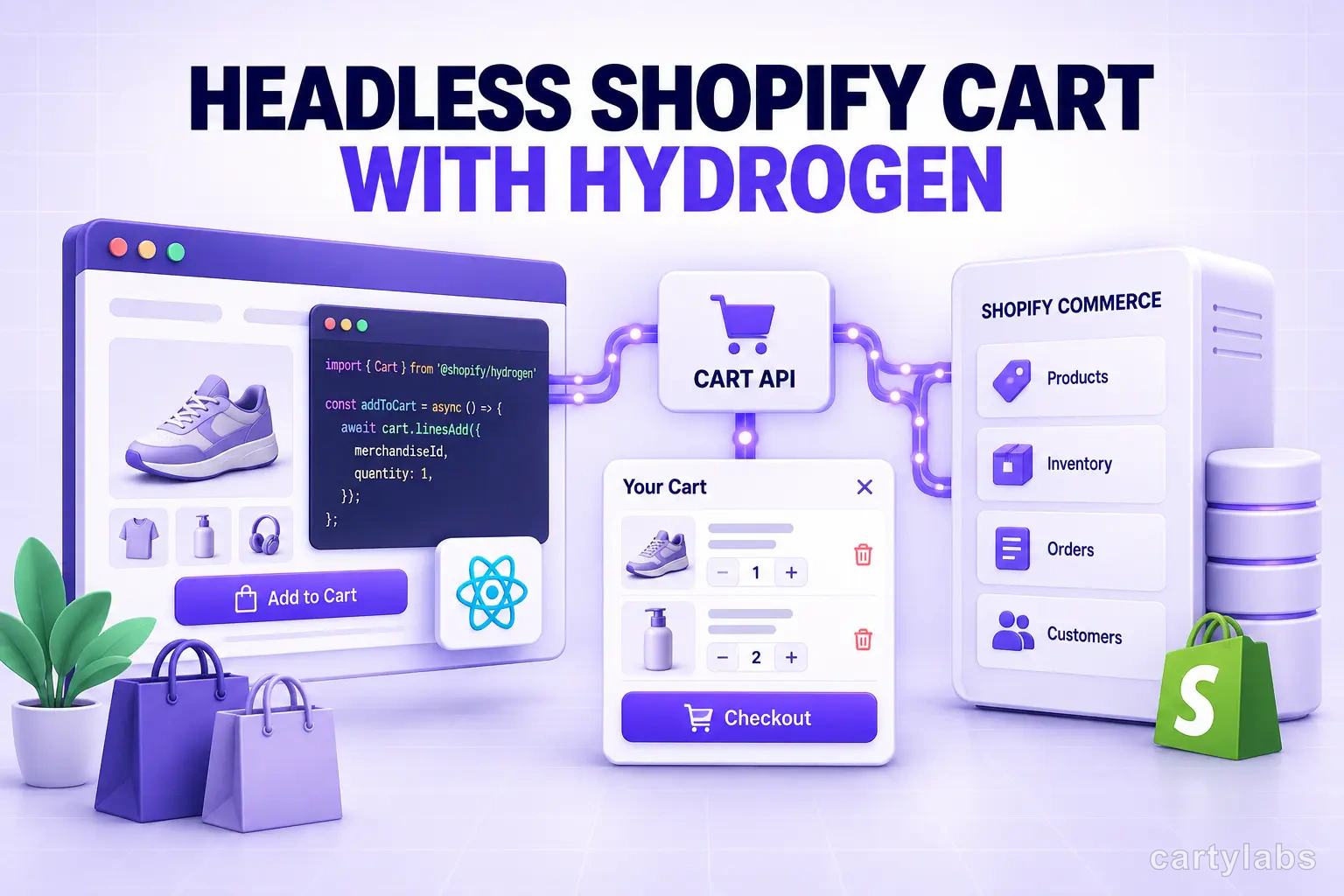
Headless Shopify Cart with Hydrogen: When It's Worth It
Headless Shopify cart with Hydrogen: when the React framework actually pays back, what breaks, and the honest trade-offs vs. a Liquid theme cart drawer.
In this article
- 01 What “headless cart” actually means#
- 02 The honest “when it’s worth it” answer#
- 03 What Hydrogen actually buys you#
- 04 What you give up#
- 05 The Hydrogen Cart object: what it actually does#
- 06 What a headless cart drawer looks like to build#
- 07 When it actually works: real-world profiles#
- 08 When teams pick Hydrogen and regret it#
- 09 A decision tree#
- 10 How to ship a great Liquid cart drawer instead#
- 11 A short summary#
Hydrogen is Shopify’s React-based framework for building headless storefronts. The pitch is appealing: full control over the front-end, modern React patterns, server-side rendering, and a Cart object built into the framework. The reality is more nuanced. For some stores, Hydrogen pays back fast. For most, it’s overkill.
This post is the honest trade-off analysis we wish we’d had two years ago: when a headless cart on Hydrogen is worth the engineering investment, what breaks compared to a Liquid theme cart drawer, and the realistic timeline and cost.
What “headless cart” actually means
A traditional Shopify storefront uses Liquid templates (cart-drawer.liquid, cart.liquid) rendered by Shopify’s servers, with cart state managed via the Storefront API or AJAX endpoints. The cart UI is HTML+JS layered over a Liquid render.
A headless cart on Hydrogen decouples the front-end entirely. Hydrogen is a Remix-based React framework that runs on Oxygen (Shopify’s hosting) or any Node.js host. The cart is managed via Shopify’s Storefront API Cart object (introduced in 2022, GA in 2023), with React components rendering the cart UI.
Headless ≠ Hydrogen, strictly. You can build headless on Next.js, Astro, Nuxt, or anything else that can call the Storefront API. Hydrogen is just Shopify’s first-party framework with built-in primitives for cart, checkout, and metaobjects.
The honest “when it’s worth it” answer
Hydrogen is worth it if all of the following are true:
- You have a senior React/TypeScript developer on staff (or budget for one at $150k+/year).
- Your storefront UX has requirements that Liquid + apps can’t deliver (real-time multi-vendor inventory, complex configurators, native-feeling animations Liquid can’t ship).
- You’re doing above $1M/year in revenue, so the engineering cost amortizes.
- You can commit to a 3-6 month build timeline and ongoing maintenance.
It is not worth it if:
- You’re under $500k/year in revenue.
- You don’t have an in-house React developer.
- Your goal is “faster site” alone (Liquid + a CDN gets there 80% of the way).
- You want a quick AOV lift (a slide cart app ships in 5 minutes; Hydrogen takes months).
Most Shopify stores are in the second bucket. We’d estimate less than 5% of Shopify merchants benefit from going headless in 2026. The other 95% are better off with a well-tuned Liquid cart drawer.
What Hydrogen actually buys you
The legitimate wins, when you fit the profile:
1. Full UI control
You’re not constrained by Liquid’s templating, theme architecture, or App Embed sandboxing. Custom cart animations, complex multi-step add-to-cart flows, real-time inventory feedback, AR-driven product configurators in cart, all become achievable.
2. Performance ceiling
A well-built Hydrogen storefront can hit Largest Contentful Paint under 1.0s on mobile, versus 1.8-2.5s typical for Liquid themes. The difference matters for SEO and for pages with image-heavy heroes. Note: a poorly built Hydrogen storefront is slower than a default Liquid theme. Performance isn’t free; it’s a discipline.
3. Composable architecture
Cart state can integrate with non-Shopify systems: a custom CMS for content, a separate inventory service, a third-party loyalty backend. Liquid can do this with apps and APIs, but Hydrogen makes it native and faster.
4. Modern developer experience
For teams used to React/TypeScript, Hydrogen feels like home. For teams used to Liquid, it’s a complete rewrite of mental models. The DX advantage only applies to teams already in the React ecosystem.
What you give up
The trade-offs that don’t get talked about enough:
1. Most apps don’t support Hydrogen out of the box
Shopify App Embeds are designed for Liquid themes. A Hydrogen storefront can’t simply “install” a slide cart app the way a Liquid theme can. Instead, you either:
- Use the app’s headless SDK (some apps, including Cartylabs, expose React components for Hydrogen).
- Rebuild the feature in Hydrogen yourself.
Apps that lift AOV in 5 minutes on Liquid (rewards bars, AI cross-sells, sticky cart) take days to weeks to integrate on Hydrogen. The “all-in-one slide cart in 5 minutes” advantage disappears.
2. Theme editor visual customization is gone
Merchants on Liquid themes can drag-and-drop sections, swap colors, reorder cart elements via the theme editor. On Hydrogen, every change is a code change and a deploy. Non-technical merchandisers lose the ability to ship cart UX changes themselves.
3. Maintenance burden
Shopify ships breaking changes to the Storefront API regularly (deprecations have a 12-month sunset typically). Hydrogen versions also bump. A Liquid theme might run untouched for 2 years; a Hydrogen storefront needs developer attention every quarter.
4. Hosting complexity
Liquid storefronts are hosted by Shopify; nothing to manage. Hydrogen on Oxygen is also Shopify-hosted, but Hydrogen on Vercel/Netlify/your own infra means you own the hosting, the build pipeline, the CDN, the env vars, the secrets, the monitoring. None of that is hard, but it’s all overhead a Liquid store doesn’t have.
The Hydrogen Cart object: what it actually does
For developers evaluating, the Cart object is the core primitive:
// Pseudo-code: Hydrogen cart usage
const cart = await getCart(cartId);
await cart.linesAdd([{ merchandiseId, quantity: 1 }]);
await cart.linesUpdate([{ id: lineId, quantity: 2 }]);
await cart.discountCodesUpdate(['PROMO10']);
const checkoutUrl = cart.checkoutUrl;
Mutations return updated cart state. The framework handles caching, optimistic updates, and revalidation. It’s a clean API once you’ve used it for a week.
What it doesn’t do:
- Render cart UI (you build that).
- Handle upsell logic (you build that).
- Show a rewards bar (you build that).
- Compute free-shipping thresholds (you build that).
- Recommend cross-sells (you call the Storefront API for product recommendations and build the carousel yourself).
In other words: the Cart object handles state, you handle everything else. This is great if you want full control and have the team. It’s a lot of work if you don’t.
What a headless cart drawer looks like to build
A realistic scope, in person-weeks:
| Feature | Liquid + app | Hydrogen build |
|---|---|---|
| Slide-out drawer UI | Pre-built (5 min) | 1-2 weeks |
| Cart state management | Pre-built | Cart object handles |
| Free-gift progress bar | Pre-built (5 min) | 1 week |
| AI cross-sells | Pre-built (5 min) | 2-4 weeks (need ML or vendor integration) |
| Sticky cart icon | Pre-built (5 min) | 3-5 days |
| Countdown timer | Pre-built (5 min) | 2-3 days |
| A/B testing framework | Pre-built | 1-2 weeks |
| Mobile keyboard avoidance | Pre-built | 2-3 days |
| Express checkout buttons | Pre-built | 3-5 days |
| Multi-currency display | Pre-built | 1 week |
Total Hydrogen build, conservatively: 6-12 weeks of senior front-end developer time. At $150-200/hour blended, that’s $40k-100k. Then ongoing maintenance.
The same feature set on Liquid + Cartylabs ships in an afternoon for $0-50/month. The math is brutal until you cross a revenue threshold where the engineering investment is rounding error.
When it actually works: real-world profiles
Three store profiles where we’ve seen Hydrogen pay back:
1. $5M+/year DTC brand with a content-heavy storefront
If your site is half product, half editorial, with custom layouts per article, Hydrogen’s component model wins. You get a unified codebase for products and content, server-rendered, with shared design tokens. Liquid forces you to choose: theme-driven (limited content) or headless (this).
2. Multi-region brand with localized inventory
Real-time inventory across 4 warehouses, with customer-aware pricing and shipping. Liquid + apps can do this clumsily. Hydrogen does it cleanly. We covered the multi-locale Liquid approach in multi-currency multi-language cart for stores not yet at this scale.
3. Configurator-heavy product line
Custom furniture, custom apparel, made-to-order kits. The configurator state is complex, the cart needs to surface configuration options, and the UI demands aren’t well-served by Liquid sections. Hydrogen makes this manageable.
When teams pick Hydrogen and regret it
Three patterns we see repeatedly:
1. Founder/CEO read about Hydrogen on Twitter and pushed a rewrite.
Two months in, the team realizes 80% of the rewrite is rebuilding what apps already did on Liquid. AOV is flat or down because the rewards bar and cross-sells haven’t been ported yet. The “fast” Hydrogen storefront launches 9 months late.
2. Agency proposed Hydrogen because the agency wants to learn it.
The store doesn’t have the in-house team to maintain it. The agency disengages after launch. Six months later, the store can’t ship cart UX changes without paying the agency $15k for each change.
3. Performance was the goal, but the team didn’t measure first.
The Liquid site loaded in 2.0s. The Hydrogen site loads in 1.4s. Conversion didn’t move because LCP wasn’t the bottleneck; cart UX was. The whole rewrite was in service of a metric that didn’t matter.
A decision tree
Run through these in order:
- Are you above $1M/year in revenue? If no → stay on Liquid.
- Do you have a senior React developer in-house or a 6-month engineering budget of $50-100k? If no → stay on Liquid.
- Do you have storefront UX requirements that Liquid + apps demonstrably can’t deliver? If no → stay on Liquid.
- Are you OK losing the theme editor’s visual customization for merchandisers? If no → stay on Liquid.
- Otherwise → Hydrogen is a credible choice. Build a 4-6 week prototype before committing to a full migration.
For most readers, the answer drops out at step 1 or 2.
How to ship a great Liquid cart drawer instead
If Hydrogen isn’t the right call, the high-ROI Liquid path is:
- Pick a slide cart app (we recommend Cartylabs for the all-in-one case; see Rokt Upcart alternatives for the full comparison).
- Enable App Embed in your theme editor.
- Configure stacked rewards, AI cross-sells, sticky cart icon.
- Run the 14 cart drawer A/B tests over the next 90 days.
- Track AOV and cart-to-checkout monthly.
This path produces 80-90% of the conversion gains a Hydrogen rewrite would, at 1% of the engineering cost.
A short summary
Hydrogen is a powerful framework for the right store. For most Shopify merchants, “the right store” means above $1M/year, with an in-house React team, and storefront UX requirements that Liquid + apps can’t meet. Below that bar, it’s an expensive rewrite of features apps already ship in 5 minutes.
If you fit the profile, Hydrogen is worth the investment and pays back in performance, customization, and architectural flexibility. If you don’t, a well-tuned Liquid cart drawer with a slide cart app delivers 80-90% of the conversion lift at 1% of the cost.
Want to see what a fully tuned Liquid cart drawer looks like before deciding? Install Cartylabs free on Shopify, or book a 15-minute demo and we’ll walk through the trade-offs against your specific roadmap.
Next steps
Related Shopify resources
Practical tools and product pages related to this guide.
Keep reading
All articles →
Free vs Paid Shopify Cart Apps: When Each Makes Sense
Free vs paid Shopify cart apps compared on AOV lift, features, and break-even math. The honest answer on when free is enough and when a paid drawer pays back.
Best Shopify Cart Drawer Apps 2026 (Ranked & Tested)
The best Shopify cart drawer apps for 2026, ranked and tested on AOV lift, AI upsells, rewards, pricing, and setup time. Honest picks for every store size.
Amp Slide Cart vs Cartylabs: Feature-by-Feature Breakdown
Amp Slide Cart vs Cartylabs compared on Shopify cart drawers, AI upsells, rewards bars, pricing, and setup. An honest, tested breakdown for 2026 merchants.
 Install Cart — Free