
How to Turn Cart Additions Into Completed Sales on Shopify
Convert more Shopify cart additions into completed sales with proven tactics for reducing cart-to-checkout drop-off, optimizing the cart drawer, and timing reassurance messaging.
In this article
- 01 Diagnose where the drop-off lives#
- 02 Make the cart drawer feel like progress, not a pause#
- 03 Eliminate the “let me think about it” exit#
- 04 Lead with the highest-confidence payment method#
- 05 Add a single in-cart upsell, not three#
- 06 Surface social proof inside the cart#
- 07 Speed matters more than design#
- 08 A weekly experiment cadence#
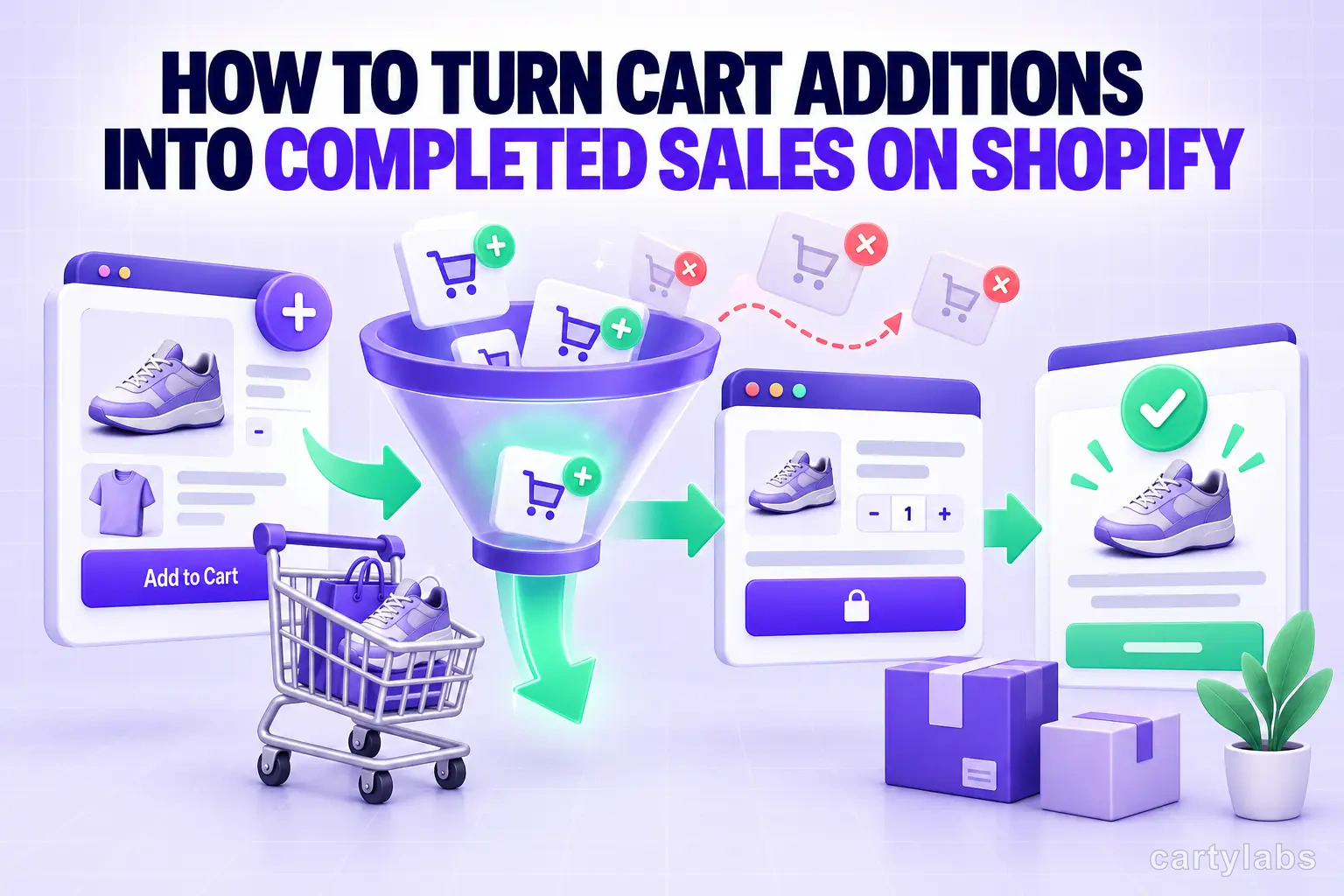
Add-to-cart is the moment a browsing session turns into a buying session. On most Shopify stores, around eighteen percent of sessions reach this point. Of those, only thirty to forty percent end in a completed purchase. The forty-percent gap between cart addition and order completion is where the highest-leverage optimization on your store lives, because every shopper in this segment has already signaled real intent.
This guide walks through exactly how to close that gap. The tactics are ordered by impact and grouped by where in the post-add-to-cart funnel they apply.
For context on the funnel before this stage, the Shopify product page best practices post covers what gets buyers to add. For what happens after checkout starts, see the Shopify checkout optimization guide.
Diagnose where the drop-off lives
Before fixing anything, segment your funnel:
- Add-to-cart rate: sessions that added an item
- Cart-to-checkout rate: cart sessions that reached checkout
- Checkout completion rate: checkout sessions that paid
Most stores lose more at the cart-to-checkout step than at the checkout-completion step. If yours is the opposite, this guide is less urgent than the Shopify checkout UX best practices post.
Make the cart drawer feel like progress, not a pause
The default Shopify cart drawer is a static list. Modern high-converting drawers are dynamic: they show free-shipping progress, suggest a complementary product, and surface trust signals. The buyer should feel like they are moving forward by reviewing the cart, not stalling to second-guess.
The exact elements that lift cart-to-checkout rate:
- A progress bar to the next reward (free shipping, free gift)
- A frequently-bought-together row with one-tap add
- Stock or shipping reassurance (“Ships in 24 hours” or “12 left in stock”)
- A primary CTA that is visually unmistakable
Compare your current setup against the best Shopify cart drawer apps to see what high-converting brands ship.
Eliminate the “let me think about it” exit
Most cart abandonment in the cart drawer is procrastination, not rejection. The buyer wants to think. Your job is to reduce the cost of deciding now relative to deciding later.
Two patterns work for this. The first is a soft time-bound incentive: a countdown timer on a specific shipping cutoff (“Order in the next forty-three minutes for Tuesday delivery”), not a fake sitewide timer. The second is a recoverable cart: if the buyer comes back tomorrow, their cart is intact, their discount auto-applies, and their address pre-fills. This shifts the cost of deferral down, which counterintuitively lifts immediate completion because deferral is no longer scary.
Our Shopify cart countdown timer guide covers what works and what reads as desperate.
Lead with the highest-confidence payment method
If the buyer is signed into Shop Pay, surface Shop Pay one-tap before they see the regular checkout button. If they used Apple Pay last time, lead with Apple Pay. The cart drawer should adapt to what the buyer is most likely to complete fastest.
This is a setting most merchants never configure. The default cart shows a generic checkout button. Stores that customize this lift cart-to-checkout completion three to six percent.
Add a single in-cart upsell, not three
Multiple upsells in the cart drawer fight the primary action. One well-targeted upsell lifts AOV without dragging conversion. Two or three upsells lift AOV but drag conversion enough to net out negative on revenue.
The upsell offer should be cheap relative to cart value (under twenty percent), complementary to what is already in the cart, and one tap to accept. The Shopify AOV upsell strategies guide covers offer construction.
Surface social proof inside the cart
A short review line (“4.8 stars from 2,341 buyers”) directly under the cart contents lifts completion two to four percent. The review must be real, current, and product-specific. Generic store-wide testimonials in the cart do nothing.
Speed matters more than design
Every additional second of cart-drawer load time costs about one percent of cart-to-checkout completion. If your cart drawer loads via a heavy app, every additional script tag is taxing your conversion rate. Audit cart load time on a throttled mobile connection.
A weekly experiment cadence
Pick one of the patterns above. Implement it. Hold for seven days. Measure cart-to-checkout completion rate. Keep what wins, revert what does not. Repeat. In two months you will have systematically rebuilt your post-add-to-cart funnel and your conversion rate will reflect it.
For a cart drawer that handles free-gift progress, in-cart upsells, smart payment-button surfacing, and trust signals without code, Cartylabs ships these patterns as defaults.
Next steps
Related Shopify resources
Practical tools and product pages related to this guide.
Keep reading
All articles →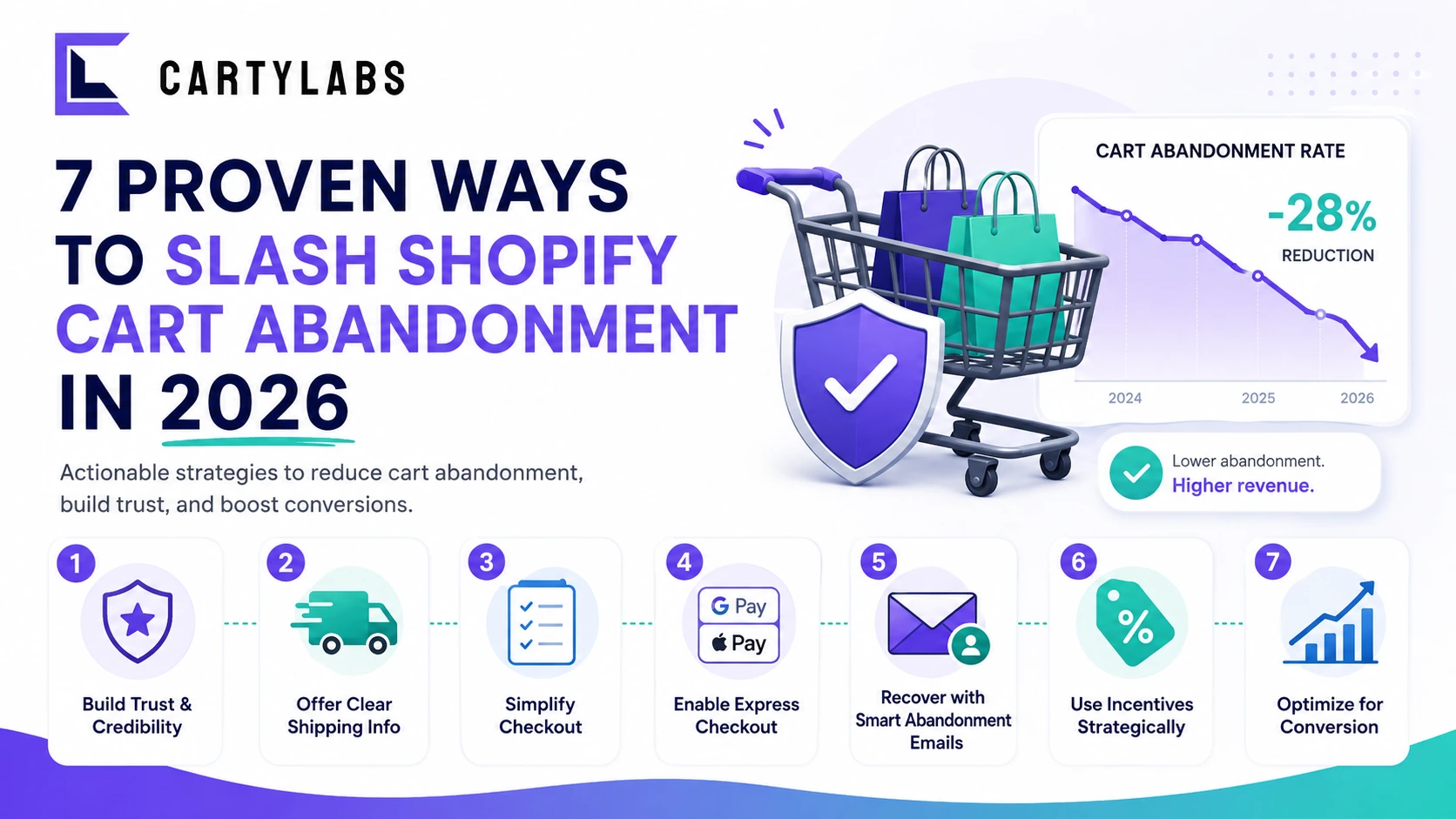
7 Proven Ways to Slash Shopify Cart Abandonment in 2026
Cut Shopify cart abandonment fast with seven field-tested tactics covering shipping transparency, express checkout, exit recovery, trust signals, and post-purchase win-back.
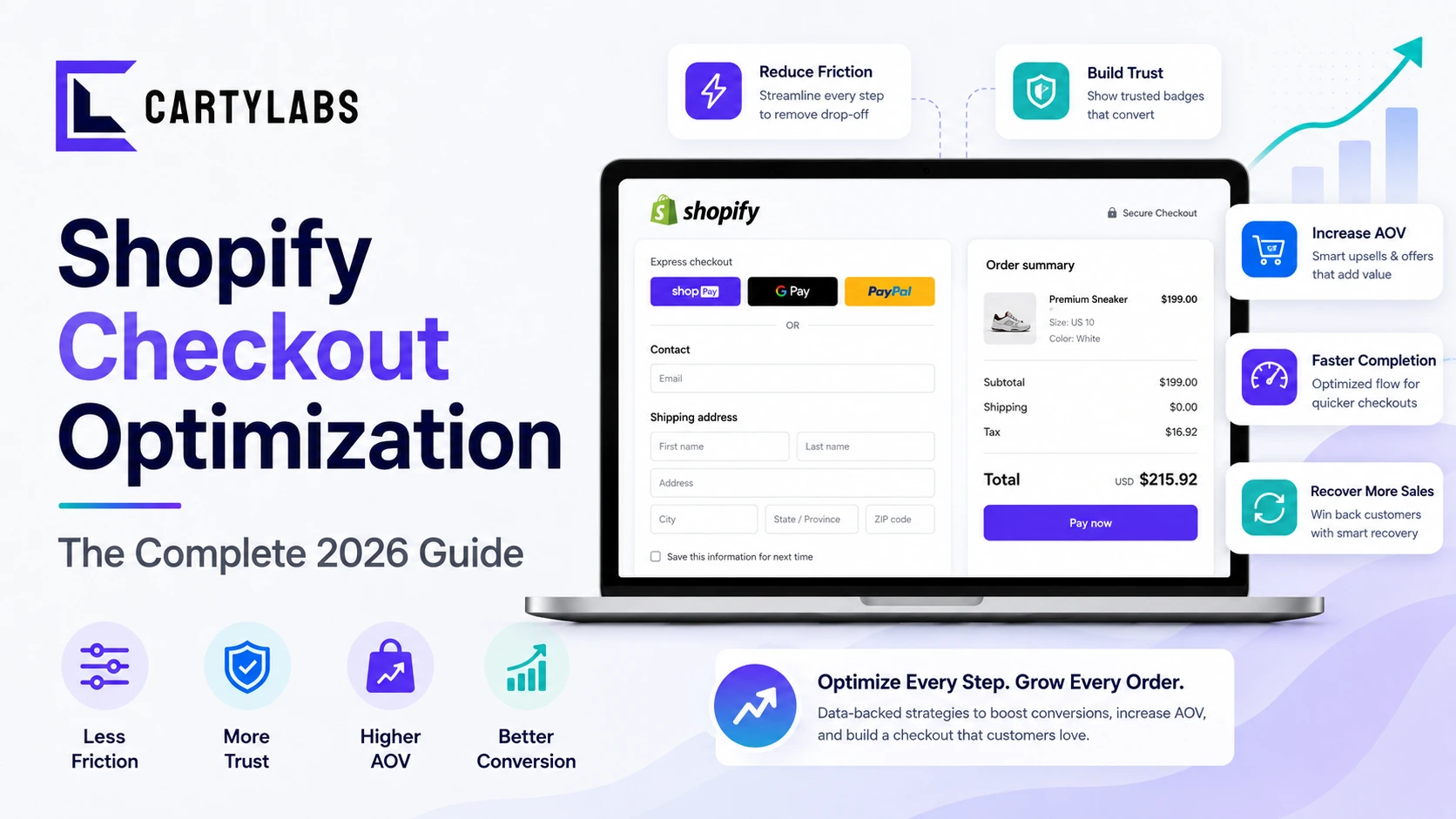
Shopify Checkout Optimization: The Complete 2026 Guide
The complete framework for optimizing Shopify checkout in 2026. Friction, trust, recovery, and AOV levers, plus what changed with Checkout Extensibility. Covers Standard, Advanced, and Plus.
The Shopify CRO Checklist: 80 Fixes That Actually Move Conversion in 2026
A no-fluff conversion rate optimization checklist for Shopify. Homepage, PDP, cart, checkout, and post-purchase. 80 high-impact fixes ordered by leverage, with the diagnostic question for each.
 Install Cart — Free