
How to Build a Shopify Revenue Engine App Stack in 2026
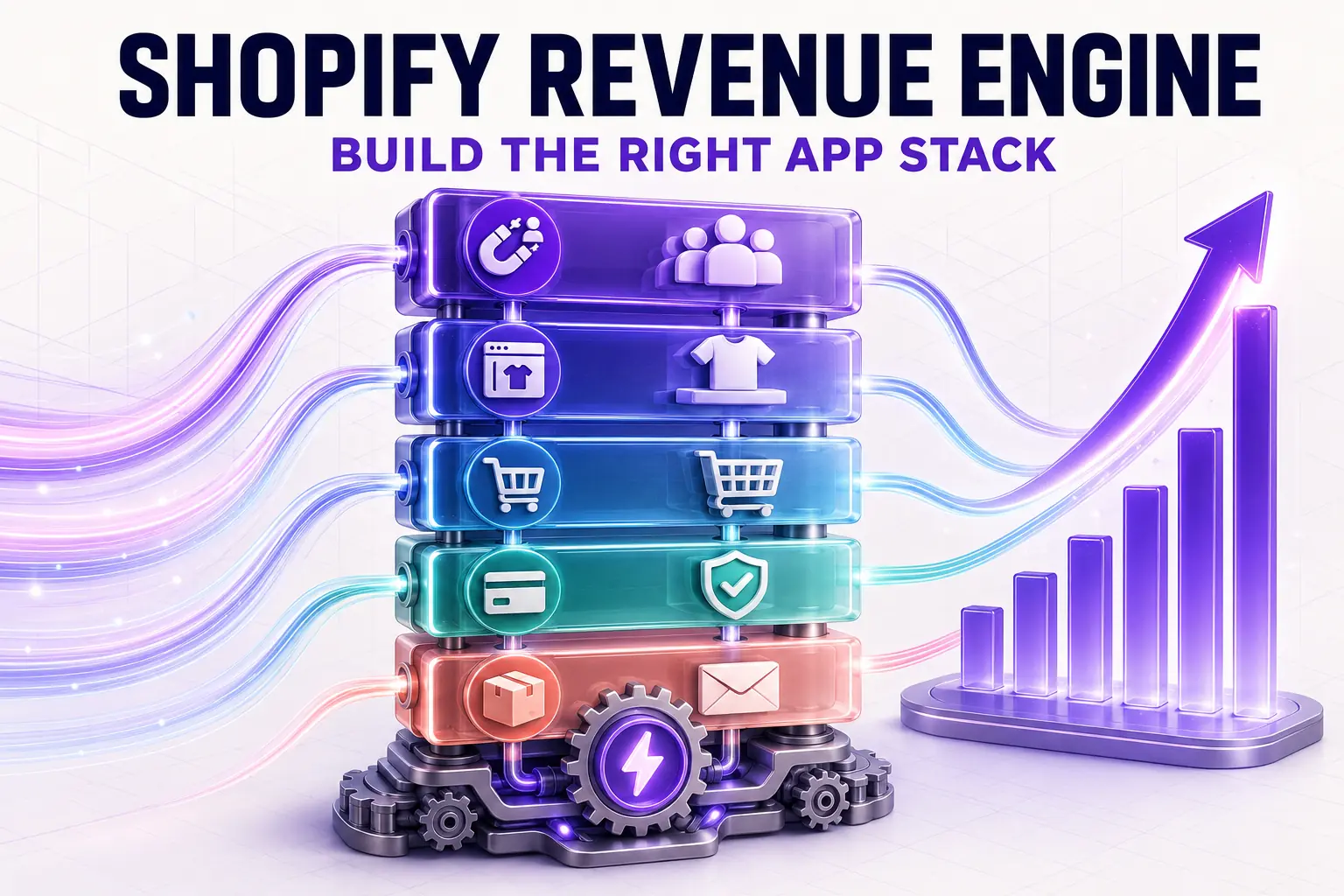
A structured guide to building the Shopify app stack that functions as a revenue engine: which apps belong at each layer, how they connect, and the order that maximizes ROI without over-engineering.
In this article
- 01 The three revenue surfaces every Shopify store has#
- 02 Layer 1: Pre-checkout revenue (install first)#
- 03 Layer 2: Email and SMS automation (install second)#
- 04 Layer 3: Social proof and conversion rate (build in parallel with Layer 2)#
- 05 Layer 4: Loyalty and repeat purchase (add at 20%+ repeat rate)#
- 06 Layer 5: Subscriptions (add for consumable SKUs only)#
- 07 Layer 6: Post-purchase upsell funnels (add when catalog supports it)#
- 08 The integration map#
- 09 The over-engineering trap#
A Shopify app stack is not a collection of useful tools. It is a system where each layer supports the others. Install tools in the wrong order and you end up with compounding overhead rather than compounding revenue. Install them in the right order and each new layer amplifies everything already in place.
This guide is about building the second kind of stack.
The three revenue surfaces every Shopify store has
Before selecting any apps, map your store’s three core revenue surfaces. Every app worth installing touches at least one of them.
Surface 1: The pre-checkout surface. Everything between the moment a shopper lands on your site and the moment they place an order. This includes product pages, the cart, and the checkout flow. Apps that operate here lift AOV and conversion rate.
Surface 2: The post-purchase surface. Everything between order placement and delivery. This includes the thank-you page, order confirmation emails, and post-purchase upsell flows. Apps that operate here lift revenue per completed transaction and collect reviews for future CVR improvement.
Surface 3: The re-engagement surface. Everything that brings a buyer back for a second, third, or tenth purchase. Email flows, loyalty programs, subscription mechanics, and win-back campaigns all live here. Apps at this surface lift LTV and reduce dependence on paid acquisition.
Most Shopify stores over-invest in the pre-checkout surface and under-invest in re-engagement. The revenue engine approach treats all three surfaces as equally important and connects them so data flows between layers.
Layer 1: Pre-checkout revenue (install first)
The pre-checkout layer is the highest-leverage starting point because it touches every converting session. A 7% AOV lift from cart upsells applies to every order, from the first day of installation.
What goes in this layer
Cart drawer with AI upsells. The foundational pre-checkout install. A cart drawer replaces the /cart page with a slide-out experience that keeps shoppers in context, reducing friction at the cart-to-checkout transition. AI upsells inside the drawer add relevant product recommendations trained on your catalog’s actual purchase patterns. See the Shopify cart drawer guide for a full breakdown of what this surface does.
Free-shipping and reward progress bars. Behavioral economics at work: when a shopper is $12 away from free shipping, most of them will add another product to cross the threshold. Stacked reward tiers — free shipping → free gift → discount threshold — produce AOV lifts of 8–18% in stores that implement them correctly. The full strategy is in Shopify free shipping bar strategy.
Checkout trust signals. Trust badges, return policy summaries, and social proof elements injected near the payment button via checkout extensions. The checkout step has the highest abandonment rate of any step in the funnel precisely because purchase anxiety peaks at the moment of payment. Trust signals reduce that anxiety without changing the offer. The complete approach is in Shopify checkout trust signals.
Shipping protection. A near-margin-pure add-on that most shoppers accept because it addresses a real concern (what if the package is lost or damaged?) at a low price point. Adds 1–3% to revenue per order with no inventory or fulfillment overhead.
The right app for this layer
Cartylabs covers all four of these in one install. This matters because the pre-checkout signals reinforce each other: a shopper who sees they are $15 from a free gift tier in the progress bar is more likely to accept a relevant upsell suggestion because both mechanics point toward the same goal (add more, get more). Splitting these features across multiple apps means they do not interact, and the compound effect disappears.
Setup time: 2–5 minutes via App Embed. Pricing: Free plan, then $9.99/$29.99/$99.99.
Layer 2: Email and SMS automation (install second)
The second layer recovers revenue that the pre-checkout layer did not capture. Every store has shoppers who browse with intent, add items to the cart, and leave without purchasing. Email and SMS automation converts a portion of that lost intent into orders.
What goes in this layer
Abandoned cart sequences. Three emails over 24 hours is the standard implementation. Email 1 fires 1–2 hours after abandonment: low friction, no discount, just a reminder with the items they left behind. Email 2 fires 12 hours after Email 1: adds mild urgency or social proof. Email 3 fires 24 hours after Email 2: optional discount (5–10%) to close the undecided shoppers. A properly configured sequence recovers 5–9% of abandoned cart revenue.
Browse abandonment sequences. Shallower intent than cart abandonment, but larger volume. Shoppers who viewed a product page and left without adding to cart represent 3–5x the session volume of cart abandoners. Browse abandonment emails convert at 1–3%, which adds meaningful incremental revenue at scale.
Post-purchase flows. The 7-day and 30-day emails are the highest-ROI flows in Klaviyo for most stores. Day 7: the customer has received and used the product; this is the right moment for a review request and a cross-sell to a complementary product. Day 30: if no second purchase has happened, surface the most popular repeat-purchase SKU with a 5% loyalty incentive.
Win-back campaigns. Shoppers who last purchased 90 or 180 days ago need a specific reason to return. Win-back campaigns with a clear offer (exclusive discount, new product announcement, free shipping on the next order) convert lapsed buyers at 4–8%, which costs a fraction of what acquiring equivalent new buyers via paid channels costs.
Integration with Layer 1
Connect Cartylabs and Klaviyo at the cart event level. Cartylabs fires cart abandonment events to Klaviyo when a shopper closes the cart drawer without checking out. This gives your abandonment sequences more data points than a simple “left the checkout” trigger, and it allows segmentation between shoppers who only viewed the cart versus those who interacted with the upsell widget or the reward progress bar.
Layer 3: Social proof and conversion rate (build in parallel with Layer 2)
Social proof is the conversion rate amplifier for every upstream investment. Paid traffic that lands on product pages with 4.5+ stars and 25+ photo reviews converts 15–25% better than traffic landing on unreviewed pages. Higher CVR means more sessions reach the cart (Layer 1) and more email addresses are captured (Layer 2).
What goes in this layer
Product review automation. Post-purchase review request emails fired 7 days after delivery. Target 20+ reviews per product before scaling paid traffic to that product. For stores with large catalogs, prioritize getting reviews on the top 20% of SKUs by revenue before covering the full catalog.
Photo and video UGC. Photo reviews convert better than text-only reviews for any category where product appearance matters. Video reviews are most effective for products that require explanation or demonstration. Configure your review request emails to actively request photos by showing the request with an image upload prompt, not just a text field.
Google seller ratings. Third-party review platforms that integrate with Google Shopping give products star ratings in paid search results. Products with 4.5+ stars see 10–15% higher click-through rates from Google Shopping. This improves ROAS on paid campaigns, which compounds the effectiveness of your traffic investment.
Q&A sections. Unanswered purchase objections are one of the most common reasons shoppers leave without buying. Product page Q&A sections that address sizing, compatibility, ingredients, and shipping questions reduce abandonment at the product decision stage.
The right app for this layer
Judge.me covers all four of these mechanisms with a free plan that is sufficient for stores up to 500 monthly orders. The paid plan ($15/month) adds coupon-for-review incentives and Google Shopping integration. Loox is an alternative with stronger photo UGC tooling at a higher price point.
Layer 4: Loyalty and repeat purchase (add at 20%+ repeat rate)
The loyalty layer is the most frequently installed too early. Loyalty programs compound existing repeat purchase behavior — they do not create it where it does not exist. If fewer than 15–20% of your customers are returning within 90 days, a loyalty program will produce low ROI because there are not enough repeat buyers to accumulate meaningful points balances.
When the repeat purchase rate is above 20%, loyalty mechanics have a measurable effect on three metrics:
Repeat purchase frequency. Customers with accumulated points or VIP status visit your store more often than non-members. The benchmark is 15–30% higher purchase frequency for active loyalty members vs. non-members.
Churn prevention. A customer with 800 points has a concrete reason not to shop elsewhere. The psychological effect of sunk-cost accumulation is one of the most reliable retention mechanisms available without price competition.
Referral-sourced acquisition. Smile.io’s referral mechanic turns your best customers into acquisition channels. A properly configured referral program (10% off for the referee, $10 in points for the referrer) consistently produces referral-sourced orders at 40–60% lower CAC than cold paid traffic.
See the complete strategy in Shopify customer retention and repeat purchases.
Layer 5: Subscriptions (add for consumable SKUs only)
Recharge or a comparable subscription app belongs in the stack only for stores with SKUs where the same customer demonstrably re-purchases the same product. If you cannot point to a specific SKU where 15%+ of buyers purchase it again within 60 days, subscription mechanics will not find a natural audience.
When the data supports it, subscriptions produce the highest LTV lift of any mechanic in e-commerce. Subscription buyers spend 3–5x more over their lifetime than one-time buyers in most consumable categories. The subscribe-and-save discount (10–15%) pays back within the second subscription cycle in virtually every case.
The full playbook for setting up subscription-to-AOV integration is in Shopify subscribe and save cart.
Layer 6: Post-purchase upsell funnels (add when catalog supports it)
Post-purchase upsells require catalog depth to work. A single-product store cannot implement a meaningful post-purchase upsell because there is nothing to upsell to. Stores with two or more complementary products — or accessories to a primary product — are the natural home for dedicated post-purchase upsell flows.
ReConvert or Zipify OCU (depending on whether you want a page-based or thank-you page approach) belong here. The critical implementation detail: one offer per post-purchase flow. A grid of three products at the post-purchase stage produces decision paralysis that reduces overall take rates below what a single well-chosen product achieves.
For the mechanics, see post-purchase magic: Shopify revenue from the thank-you page.
The integration map
Here is how data should flow between layers in a properly connected stack:
| From | To | Data flowing |
|---|---|---|
| Cartylabs (Layer 1) | Klaviyo (Layer 2) | Cart abandonment events, cart value, products left behind |
| Klaviyo (Layer 2) | Smile.io (Layer 4) | Post-purchase flows that award loyalty points on purchase events |
| Judge.me (Layer 3) | Klaviyo (Layer 2) | Review submission events → brand advocate segment |
| Smile.io (Layer 4) | Cartylabs (Layer 1) | Points balance displayed in cart drawer, tier status visible at cart |
| Recharge (Layer 5) | Klaviyo (Layer 2) | Subscription events → dedicated subscriber flows |
| ReConvert (Layer 6) | Klaviyo (Layer 2) | Post-purchase upsell accept/decline → targeted follow-up segments |
The goal of the integration map is not technical complexity. It is ensuring that each app’s data improves the effectiveness of every other app it touches. A shopper who accepts a Cartylabs upsell, earns Smile.io points, and then receives a Klaviyo post-purchase email referencing both their order and their new points balance is experiencing a coherent, branded journey — not six disconnected marketing tools fighting for attention.
The over-engineering trap
The biggest risk in building a Shopify revenue engine stack is over-engineering it before the fundamentals are working. Stores that install all six layers simultaneously before Layer 1 is optimized typically see lower ROI from every layer because they are dividing optimization attention rather than concentrating it.
The revenue engine compounds when each layer has been configured well before the next is added. A Cartylabs cart drawer with an AOV lift of 8% and a Klaviyo abandoned cart sequence recovering 6% of abandoned sessions is a better foundation for adding Judge.me than a store with eight apps installed but none optimized.
Start with Layer 1. Measure it for 30 days. Then add Layer 2. The compounding is real, but it requires the layers to be in place before it starts. For the complete revenue tool comparison across all layers, see 7 best Shopify apps that act as a revenue engine.
Related reading: 25 best Shopify apps to increase sales, 15 best AI tools for Shopify, Top Shopify AOV apps.
Next steps
Related Shopify resources
Practical tools and product pages related to this guide.
Keep reading
All articles →
7 Best Shopify Apps That Act as a Revenue Engine in 2026
The 7 Shopify apps that function as true revenue engines in 2026 — not add-ons, but systems that compound cart value, recover sessions, build loyalty, and drive repeat purchase. Honest comparison by mechanic and ROI.
Shopify Apps That Pay for Themselves: The ROI-First Stack for 2026
An ROI-first breakdown of Shopify apps that generate more revenue than they cost — with the math, the realistic lift ranges, and the store profiles where each app earns positive ROI in 30 days or less.
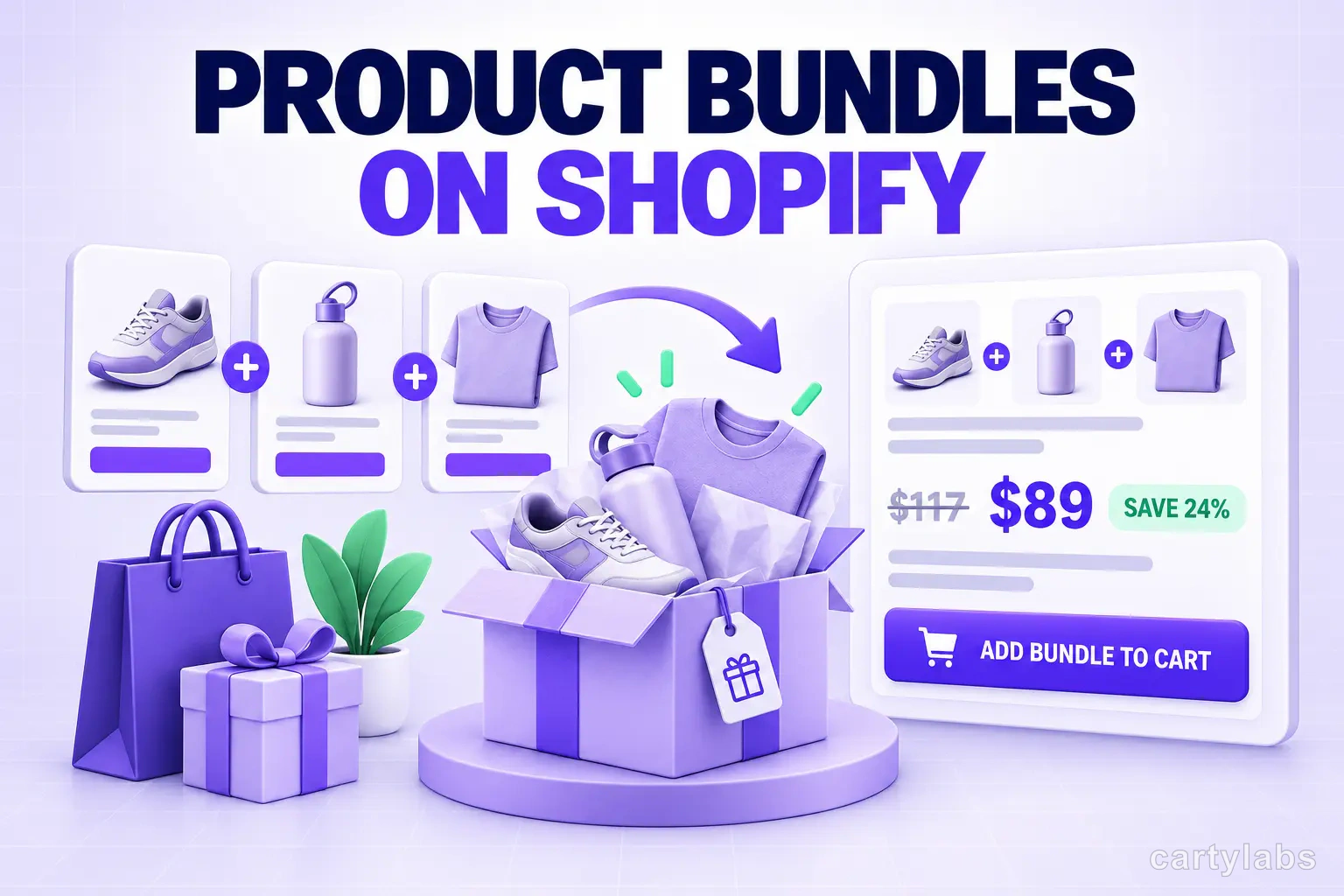
Product Bundles on Shopify: Fixed, Mix-and-Match, BOGO and More
The 6 bundle types on Shopify, the AOV math behind each, and the catalog conditions that make bundles convert. A no-fluff playbook for 2026.
 Install Cart — Free