
Post-Purchase Magic: Maximize Shopify Revenue After the Click
Turn the Shopify Thank You page into a revenue engine with one-click post-purchase upsells, account creation, referral CTAs, and the cohort-personalized offer flows that lift AOV ten to twenty percent.
In this article
- 01 Why post-purchase is conversion-risk-free#
- 02 The four elements every Thank You page should carry#
- 03 Element 1: the one-click post-purchase upsell#
- 04 Element 2: the account creation prompt#
- 05 Element 3: the referral CTA#
- 06 Element 4: the loyalty or community nudge#
- 07 Cohort-personalized Thank You pages#
- 08 Mobile Thank You page considerations#
- 09 Measuring Thank You page performance#
- 10 The compounding effect#
The Thank You page is the most undervalued surface in Shopify. The buyer has paid, their attention is high, their stress is gone, and they are in the most positive emotional state of the entire purchase journey. Almost every store responds to this opportunity with a generic “Thanks for your order!” and zero further offers. The merchants who treat the Thank You page as the highest-attention surface in their funnel routinely add ten to twenty percent to AOV with zero conversion risk.
This guide walks through exactly what to put on the Thank You page, the order to layer it in, and the personalization rules that make each element compound.
For the upstream context, the Shopify checkout post-purchase upsell guide covers the specific upsell apps and offer structures.
Why post-purchase is conversion-risk-free
The order is complete. The buyer has paid. Anything the buyer does on the Thank You page is incremental to the order they already placed. The only way to lose money on the Thank You page is to do nothing.
This means experimentation on post-purchase offers is the lowest-risk experimentation available anywhere on your store. Ship aggressively, measure, and iterate.
The four elements every Thank You page should carry
Every high-performing Shopify Thank You page in 2026 carries some combination of these four elements:
- A one-click post-purchase upsell or bundle
- An account-creation prompt
- A referral CTA
- A loyalty or community onboarding nudge
The exact ordering and weighting depends on customer cohort. We will walk through each.
Element 1: the one-click post-purchase upsell
This is the highest-revenue element. The buyer sees an offer (“Add the matching strap for fifty percent off, one click”), accepts or declines, and the order updates automatically. No new payment, no new shipping address, no friction.
The offer should be:
- Cheap relative to the order they just placed
- Functionally complementary
- Available only as a one-click acceptance (no quantity picker, no variant selector)
- A real discount, not a fake one
Acceptance rates of twelve to twenty-five percent are normal for well-targeted post-purchase offers. The revenue contribution is direct and measurable.
Element 2: the account creation prompt
This is the highest-LTV element. Converting a guest checkout into an account customer at the Thank You page captures all the retention upside of forced signup without any of the checkout-conversion cost.
The framing that works: “Save your order history, track shipping, and earn fifty loyalty points. One field, one click.” Make it bypassable. See our guest checkout vs account creation post for the full pattern.
Element 3: the referral CTA
Most stores discover their highest-quality acquisition channel is post-purchase referral. The buyer just bought something, they trust the brand, and they have friends who would also benefit. A “Give a friend fifteen percent off, get a fifteen-dollar credit when they buy” CTA on the Thank You page consistently produces qualified traffic at near-zero cost.
The reward structure matters: two-sided (both giver and receiver benefit) outperforms one-sided. Cash credits to the giver outperform percentage discounts. Friction-free sharing (pre-filled link plus copy button) outperforms social-network-specific buttons.
Element 4: the loyalty or community nudge
If you run a loyalty program, the Thank You page is where signup happens. Surface the points the buyer just earned, the rewards they could redeem next, and a one-click join button. Loyalty signup conversion at this surface is three to five times higher than on a static loyalty landing page.
If you run a community or content channel, the Thank You page is a low-friction signup surface for that too. A “Join 12,000 other coffee enthusiasts in our weekly tasting newsletter” line, with a single field, can convert ten to twenty percent of buyers.
Cohort-personalized Thank You pages
The mistake most stores make is treating every buyer the same on the Thank You page. The mistake the top decile avoids is exactly this. Personalize by:
First-time buyers
Lead with: account creation, brand story, what to expect next, customer service contact.
Returning buyers
Lead with: post-purchase upsell, referral CTA, loyalty status.
High-AOV buyers
Lead with: VIP referral CTA, concierge contact, subscription offer.
Subscription customers
Lead with: account portal link, “manage your subscription” CTA, related product suggestions.
Different cohorts have different next-best-actions. The Thank You page should serve each one differently. Tools like Shopify’s customer segments plus a post-purchase app make this configurable without code.
Mobile Thank You page considerations
Mobile Thank You pages have to be more ruthless about element selection. Three elements maximum; pick the highest-ROI three for your store. The pattern that works most often on mobile:
- Order confirmation (one short line)
- One-click upsell offer (visually dominant)
- Account creation (below the fold)
Skip the referral CTA on mobile if it crowds the upsell. Surface it via the post-purchase email instead.
Measuring Thank You page performance
The metrics that matter:
- Upsell acceptance rate (target: twelve to twenty percent)
- Account creation rate (target: thirty to fifty percent of guest checkouts)
- Referral CTA click rate (target: five to ten percent)
- Total post-purchase revenue per order (target: ten to twenty percent of original AOV)
If any of these is below the target range, the corresponding element of the Thank You page is the next thing to optimize.
The compounding effect
A Thank You page that lifts AOV fifteen percent and pulls in account creation, referrals, and loyalty signups does not just contribute to today’s revenue. It pulls forward the LTV of every customer who passes through it. Stores that take this seriously see compound improvements in repeat rate and CAC efficiency that show up months later in the data.
For a Thank You page module that ships post-purchase upsells, account creation prompts, and referral CTAs with cohort personalization out of the box, Cartylabs handles the full Thank You page stack so the highest-attention surface in your funnel is doing work from day one.
Next steps
Related Shopify resources
Practical tools and product pages related to this guide.
Keep reading
All articles →
Gift With Purchase: 11 GWP Campaigns That Print Money on Shopify
Gift With Purchase campaigns lift AOV 18-30% when designed right. The 11 GWP types, the threshold math, and the Shopify implementation patterns for 2026.
Best Shopify Upsell Apps: 12 Apps Compared
The best Shopify upsell apps for 2026 compared on AOV lift, pricing, AI logic, and funnel position. 12 apps tested for in-cart, post-purchase, and bundle upsells.
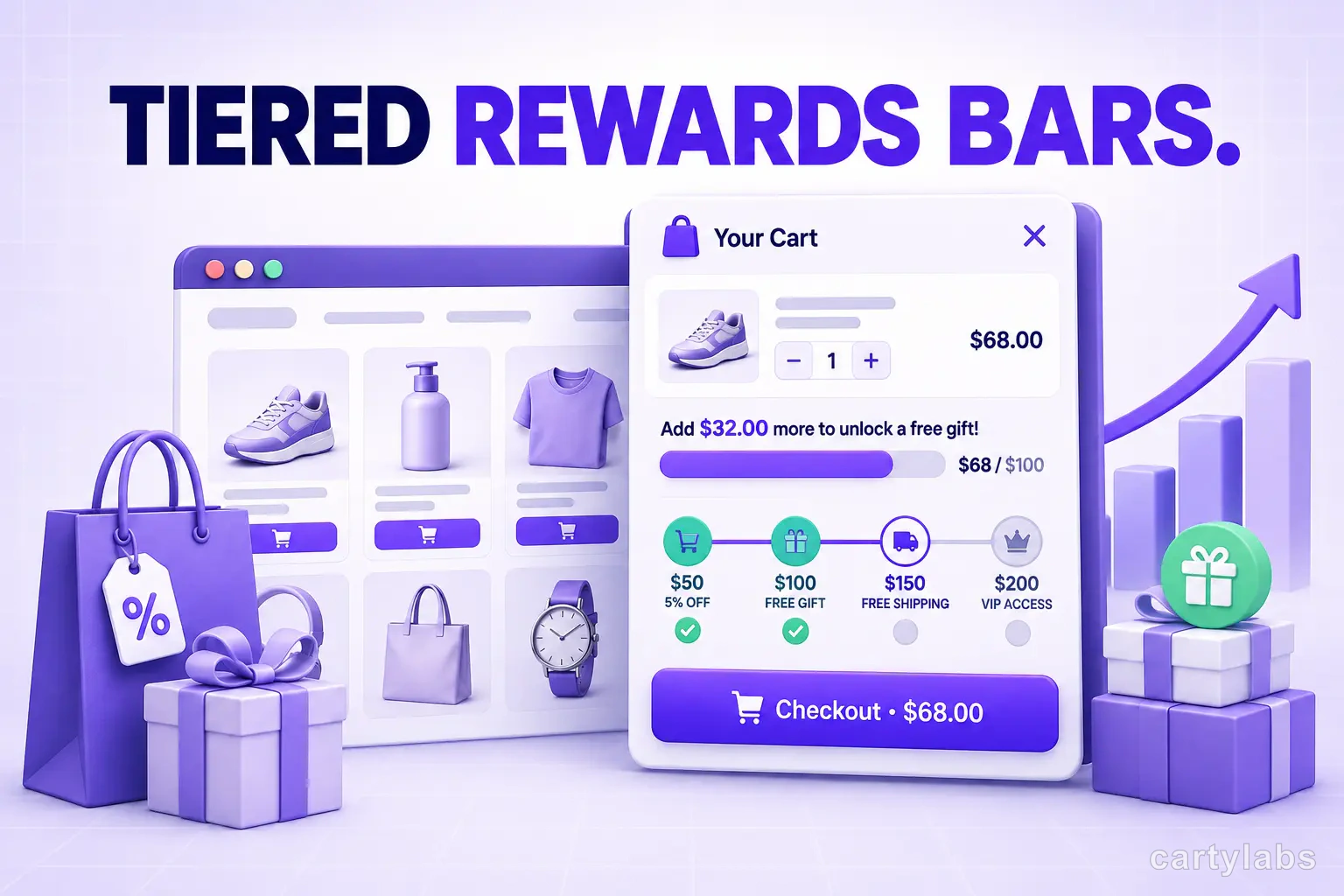
Tiered Rewards Bars: Stacked Incentives That 2x AOV on Shopify
A tiered rewards bar stacks free shipping, free gift, and discount unlocks into one progress bar. The math, the design, and how to ship it on Shopify.
 Install Cart — Free