
Bundle Discounts vs Cart Upsells: How to Know Which Fits Your Shopify Store
Bundle discounts vs cart upsells: see which fits your Shopify store based on catalog type, and when running both makes sense.
In this article
The question of bundle discounts vs cart upsells comes down to what your catalog looks like, not which tactic wins on paper.
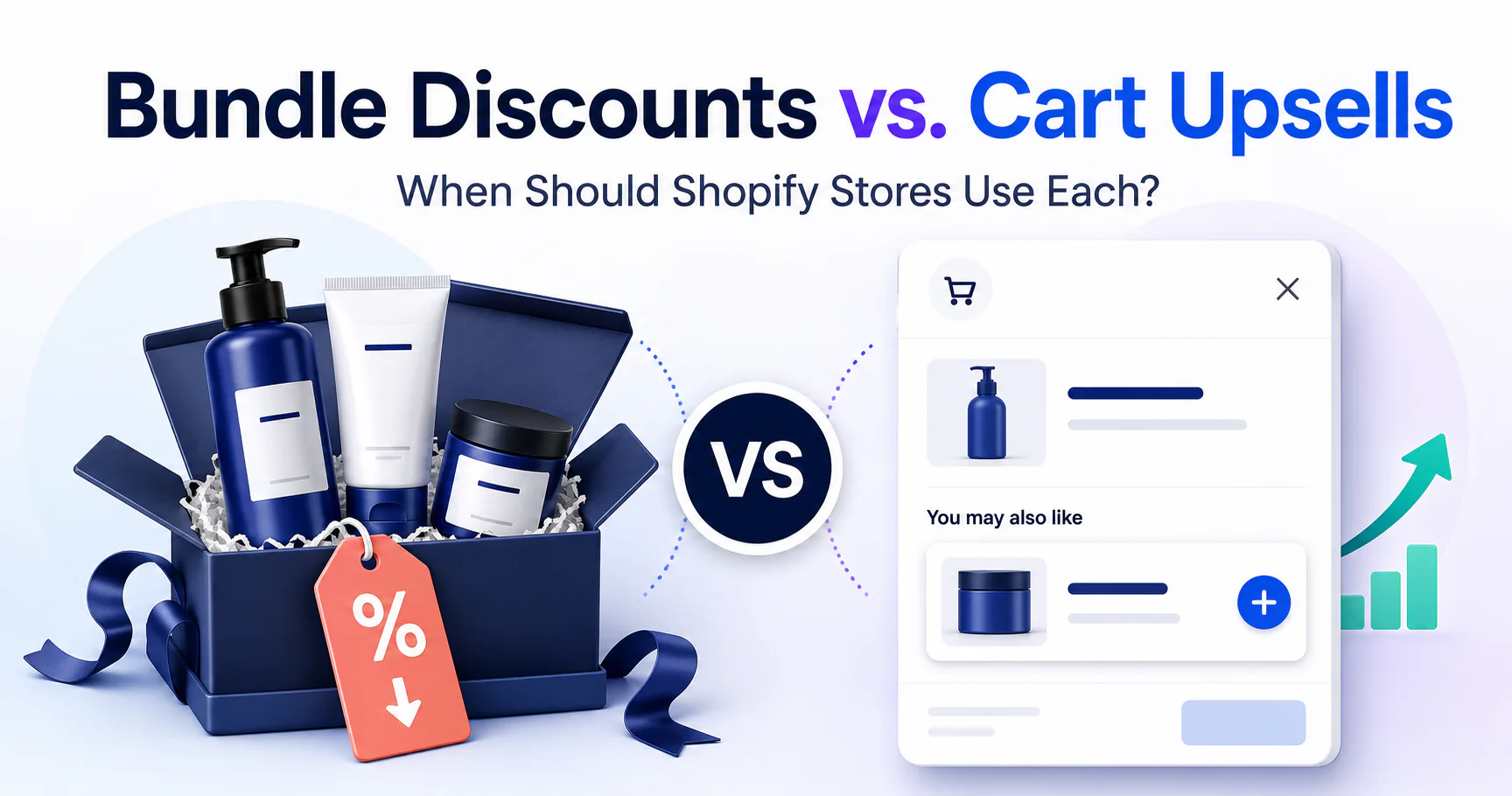
A cart upsell reacts to whatever a specific shopper already has in their cart, closer to what Cartylabs’ in-cart upsell app does inside the cart drawer. A bundle discount packages products together before a customer ever lands on your site, the kind of offer a dedicated app like PushBundle is built to handle.
Neither one is the better choice in general. The right answer depends on whether your catalog has natural combinations worth packaging in advance, or whether it’s broad enough that the smarter move is reacting to each cart individually.
Bundle Discounts vs Cart Upsells: The Real Difference
A bundle discount is a set of products you choose ahead of time, priced together at a discount, and shown as one offer. The merchant decides what goes in it and what it costs before a single customer sees it.
A cart upsell works the opposite way. It looks at what’s actually sitting in a shopper’s cart right now and suggests one more item that fits, without any pre-set combination behind it.
Bundles are planned. Upsells are reactive. That single difference explains almost every tradeoff between them.
| Bundle Discount | Cart Upsell | |
|---|---|---|
| When it’s decided | Set in advance by the merchant | Generated in the moment, based on cart contents |
| What the shopper sees | A fixed, curated combination | A suggestion tailored to their specific cart |
| Margin predictability | Fixed and known before launch | Varies with whatever gets suggested |
| Inventory risk | Tied to the lowest-stock component in the set | Limited to the single suggested item |
| Best catalog fit | Curated or complementary product lines | Broad or single-category catalogs |
| Typical placement | Product page | Cart, checkout, or post-purchase |
How Bundle Discounts Work (and Where They Win)
Bundles work best when products genuinely belong together, the kind of combination a customer would likely buy anyway if you just made it easier. A skincare brand pairing a cleanser, serum, and moisturizer into a routine. An apparel store bundling a jacket with a matching scarf. A supplement company packaging a starter stack.
In each case, the merchant already knows the combination customers want, so the bundle just removes the friction of adding three items separately.
Bundle discounts tend to fit stores when:
- The catalog has clear “always bought together” sets rather than dozens of unrelated categories.
- Predictable margin math matters more than personalization, since the discount is fixed in advance.
- A slower-moving item benefits from being paired with a bestseller.
- The brand wants to sell an outcome, like a “first week kit,” rather than a list of separate SKUs.
The real cost of bundling shows up on the operations side. Shopify’s own guidance on product bundles notes that bundle availability is tied to the product with the lowest stock among the components, so if one item in a five-product bundle sells out, the whole bundle can go unavailable even though four of the five items are still in stock.
That’s not a flaw specific to any app, it’s how bundles work structurally, and it means bundle inventory needs more attention than single-SKU inventory does. For stores that need mix-and-match or build-a-box logic beyond what Shopify’s native tool covers, PushBundle is built specifically around handling that layer, component inventory sync included.
How Cart Upsells Work (and Where They Win)
Cart upsells don’t pre-define anything. They look at what’s already in the cart and suggest a logical next item, whether that’s a complementary product, a larger size, or an accessory the shopper hasn’t noticed yet.
Because there’s no fixed combination, upsells fit catalogs that don’t naturally sort into kits, a broad home goods store, a general apparel retailer with dozens of unrelated categories, or any catalog where “what goes with what” changes shopper to shopper.
Cart upsells tend to fit stores when:
- The catalog is too broad or varied for a handful of fixed combinations to cover most customers.
- The store wants to react to the specific cart rather than merchandise a pre-built set.
- There’s no inventory pairing risk to manage, since each upsell is a single item add, not a linked set.
- The goal is incremental AOV lift without redesigning product pages around bundle offers.
The tradeoff runs the other way from bundles. Upsells don’t give you the predictable, pre-calculated margin math a bundle discount does, since the item suggested and the discount applied, if any, shift with the cart rather than being fixed ahead of time.
Cart Upsell vs Bundle: What Actually Decides It
The deciding factor isn’t which one converts better in some general sense. It’s catalog shape.
Catalog shape decides it first. A curated or complementary catalog, one where products were basically designed to be used together, gets more value from a bundle discount because the merchant already knows the combination that works. A broad or single-category catalog gets more value from a cart upsell because there’s no obvious fixed set to build, and reacting to the actual cart beats guessing at a universal combination.
Margin math decides it second. Bundling two products with similarly thin margins and then applying a meaningful discount on top can leave a bundle barely profitable, sometimes closer to a break-even transaction than an AOV win. That risk exists on the upsell side too, but it’s smaller in scope since a single added item doesn’t compound the margin hit across multiple SKUs the way a bundle discount can.
Running Both Without Treating It as a Hedge
Plenty of stores eventually run bundle discounts and cart upsells at the same time, and that’s not indecision, it’s using each tool where it actually fits in the funnel.
A fixed bundle on the product page for a genuinely complementary set, and a cart upsell that reacts to whatever else is in the cart, are doing two different jobs rather than competing for the same moment. A solid Shopify bundle strategy usually treats the bundle as the planned, merchandised offer and the upsell as the reactive layer on top of it, not a redundant version of the same idea.
A store just getting started is usually better off picking one first, based on catalog shape, rather than launching both at once. Once there’s real data on attach rate and AOV from that first move, adding the second tool becomes a lot easier to justify.
FAQ
Do bundle discounts and cart upsells cannibalize each other’s margin?
They can, if a store stacks a bundle discount and then applies another discount on top through a checkout upsell, since the combined markdown can eat into margin faster than either tactic alone. Setting clear rules for whether upsell discounts apply on top of an already-discounted bundle avoids this.
Why does my bundle show as out of stock when the individual items aren’t?
Bundle availability is tied to the component with the lowest stock, so if one item in the set sells out, the whole bundle can show as unavailable even though the other components are still in stock. This is standard bundle behavior, not a bug specific to any one app.
Can I stack a cart upsell discount on top of a bundle discount?
Technically yes, but it needs deliberate rules rather than default settings, since stacking two discounts without a cap can turn a healthy-margin bundle into a break-even order. Check the combined discount against your margin before turning both on at once.
Should a new store start with bundles or upsells first?
Start with whichever matches your catalog shape. A catalog with obvious complementary sets should start with a bundle discount, while a broad or single-category catalog usually gets more value starting with a cart upsell.
What products should never be bundled or upsold together?
Avoid pairing two thin-margin items at a meaningful discount, since the combined markdown can erase profit on that order. It’s also worth skipping combinations that don’t have an obvious, quick-to-explain reason to exist together, since forced pairings tend to convert poorly regardless of the discount.
Conclusion
The choice between bundle discounts vs cart upsells comes down to catalog shape, not which tactic wins in the abstract.
A curated or complementary catalog gets more value from a bundle discount, since the merchant already knows which products belong together and can price that combination with predictable margin math. A broad or single-category catalog gets more value from a cart upsell, since there’s no obvious fixed set to build and reacting to the actual cart beats guessing at a universal combination.
Stores that scale past their first AOV win tend to run both, a bundle on the product page and an upsell reacting to the cart, each doing a distinct job in the funnel instead of overlapping. Match the tool to the catalog first, and the rest of the decision gets a lot easier.
For the planned bundle layer, explore PushBundle. For the reactive cart layer, install the Cartylabs app from the Shopify App Store.
Next steps
Related Shopify resources
Practical tools and product pages related to this guide.
Keep reading
All articles →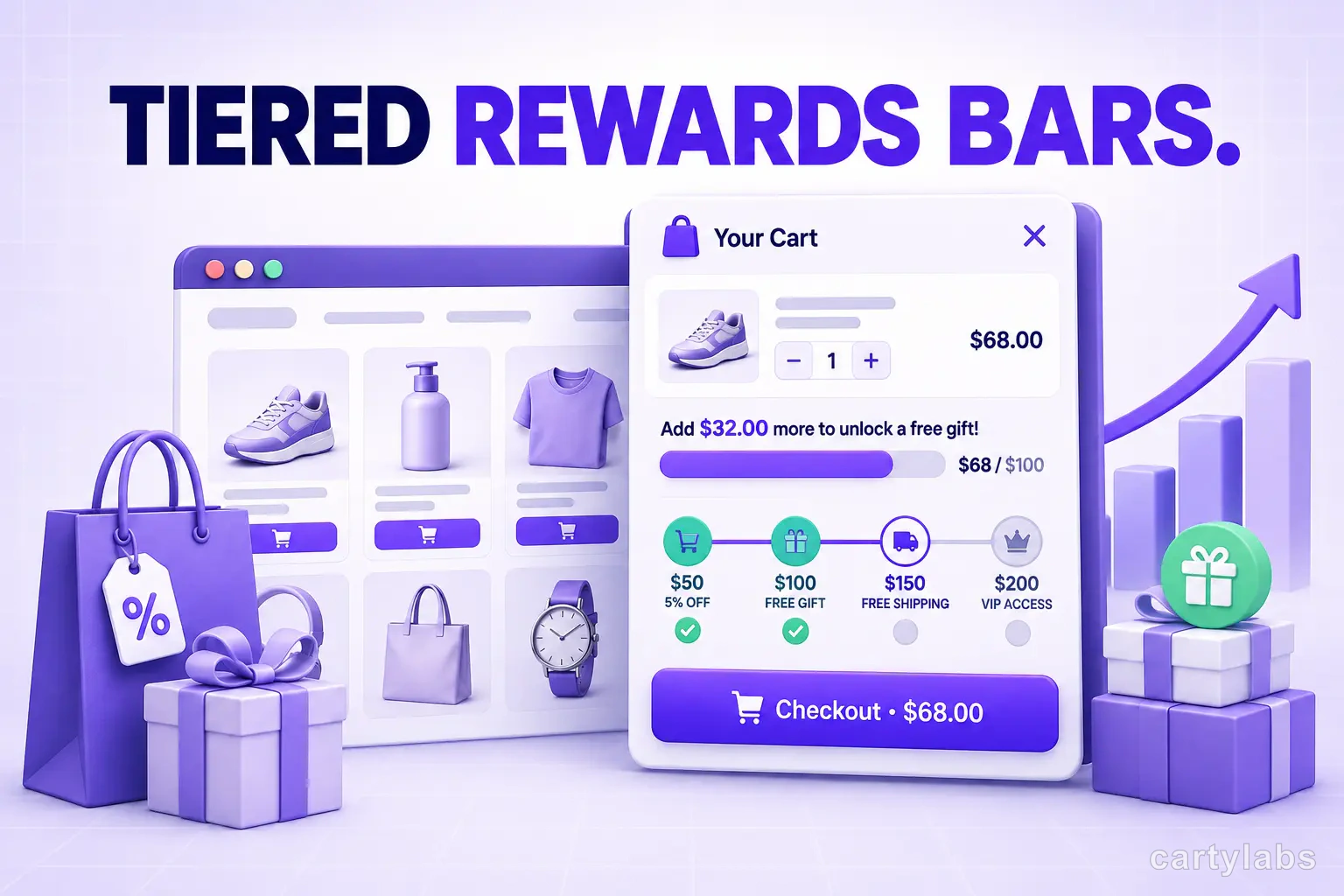
Tiered Rewards Bars: Stacked Incentives That 2x AOV on Shopify
A tiered rewards bar stacks free shipping, free gift, and discount unlocks into one progress bar. The math, the design, and how to ship it on Shopify.
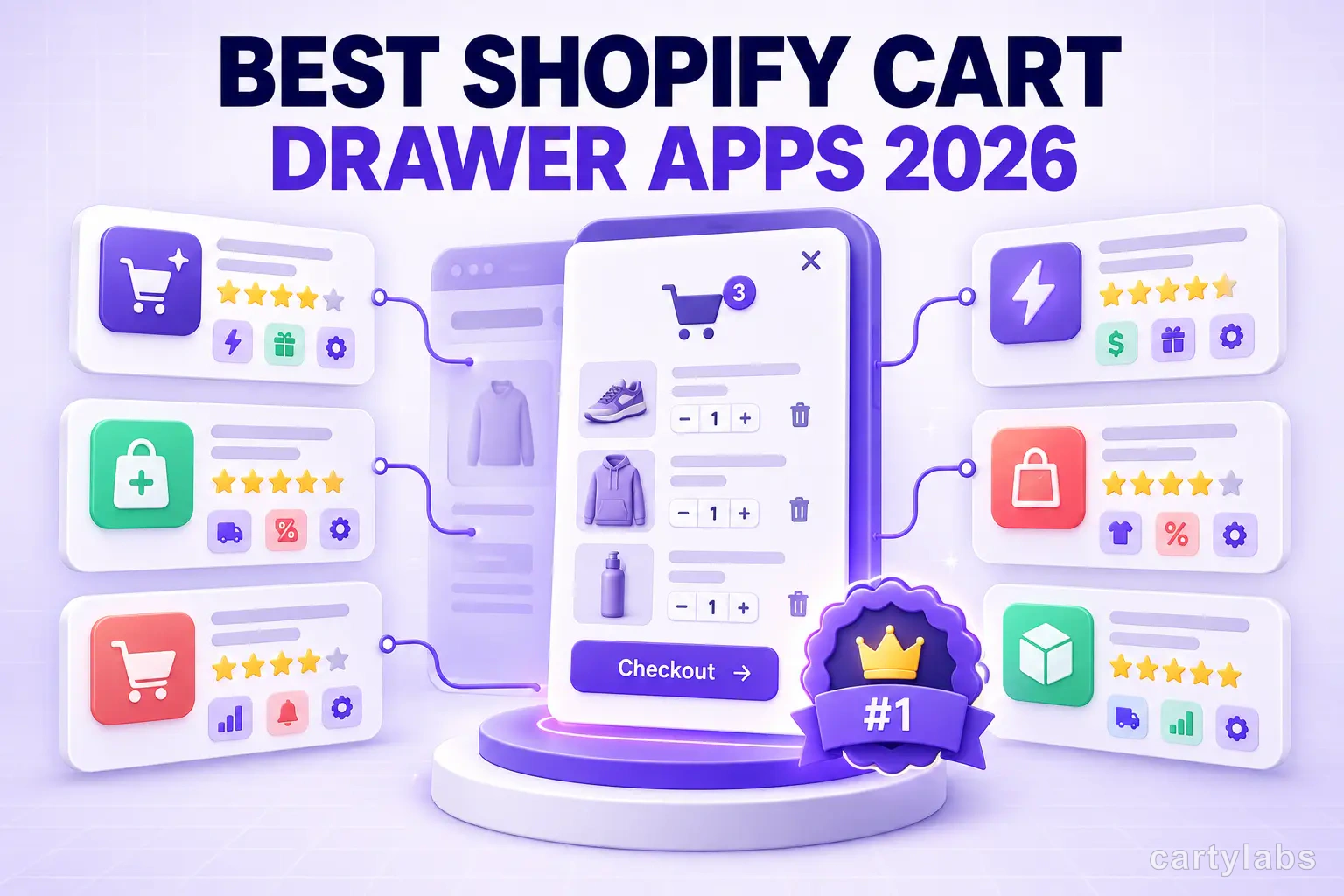
Best Shopify Cart Drawer Apps 2026 (Ranked & Tested)
The best Shopify cart drawer apps for 2026, ranked and tested on AOV lift, AI upsells, rewards, pricing, and setup time. Honest picks for every store size.
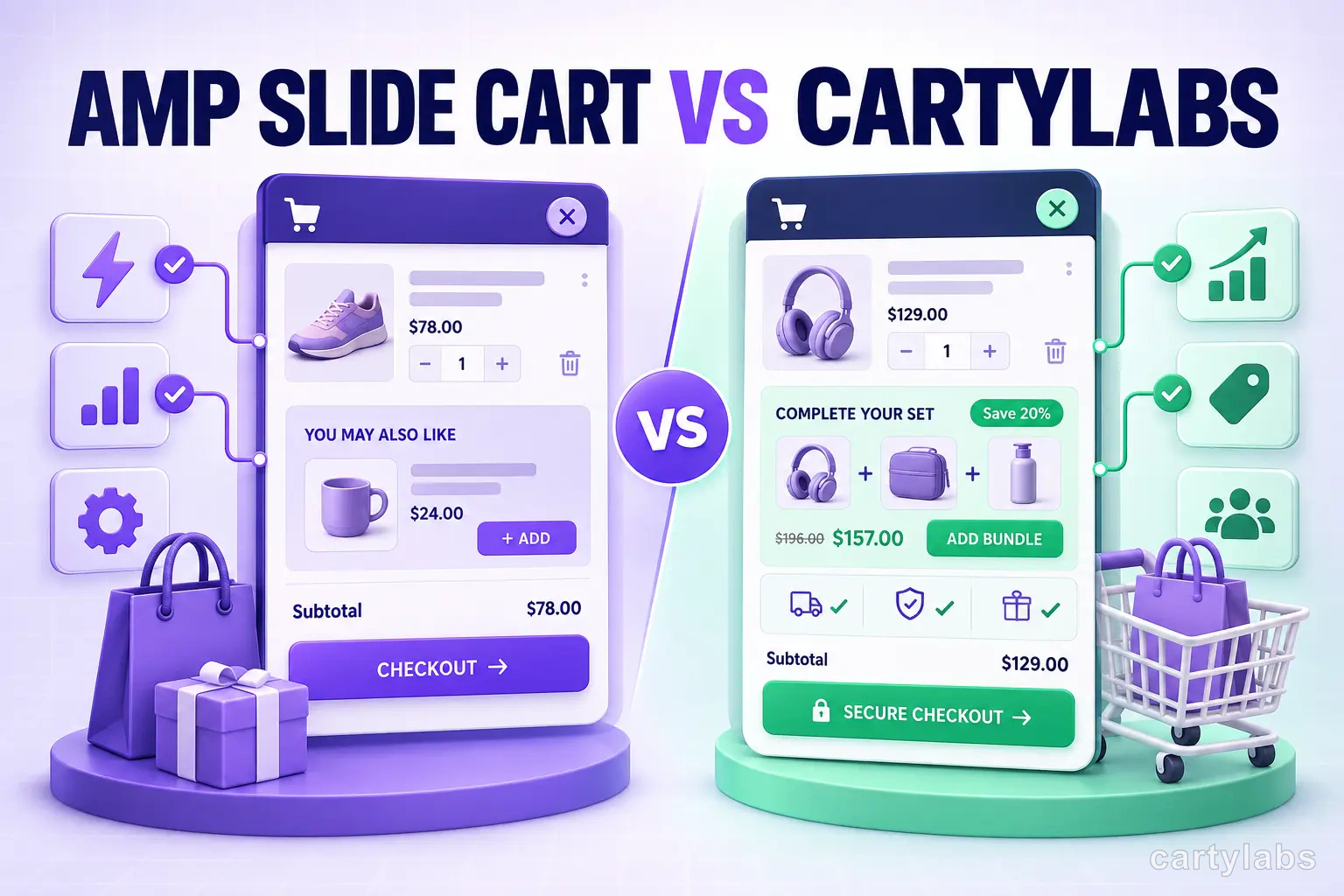
Amp Slide Cart vs Cartylabs: Feature-by-Feature Breakdown
Amp Slide Cart vs Cartylabs compared on Shopify cart drawers, AI upsells, rewards bars, pricing, and setup. An honest, tested breakdown for 2026 merchants.
 Install Cart — Free