
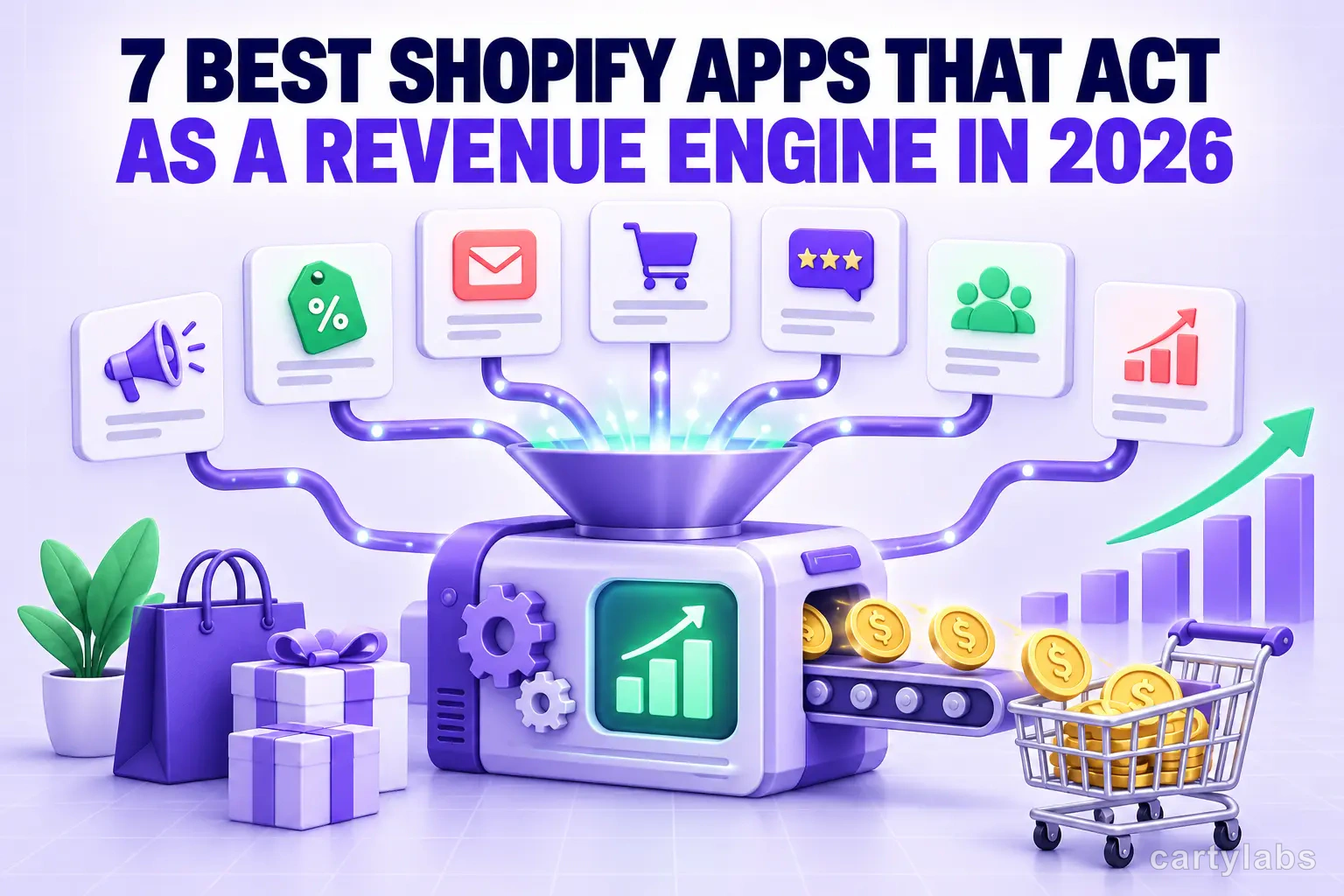
7 Best Shopify Apps That Act as a Revenue Engine in 2026
The 7 Shopify apps that function as true revenue engines in 2026 — not add-ons, but systems that compound cart value, recover sessions, build loyalty, and drive repeat purchase. Honest comparison by mechanic and ROI.
In this article
Most Shopify apps are point solutions. They solve one narrow problem — a countdown timer, a pop-up, a shipping bar — and they do it acceptably well. You install them, they run, and they do not meaningfully change your revenue trajectory.
A revenue engine is different. A revenue engine is an app (or a tight stack of apps) that touches multiple parts of the buying journey, compounds its impact over time, and produces measurable lift in the metrics that matter: average order value, conversion rate, repeat purchase rate, and customer lifetime value.
This post names the seven apps that meet that bar in 2026. Each one covers a distinct revenue lever. Together, they form a complete pre- and post-purchase system for Shopify stores that want to grow without proportionally increasing ad spend.
What separates a revenue engine from a feature app
Before the list, a distinction worth making. A feature app does one thing. A revenue engine does several things, and those things reinforce each other.
A cart drawer app that also does AI upsells, free-shipping bars, free gift rewards, and checkout trust signals is a revenue engine. A cart drawer app that is just a cart drawer is a feature app. The difference is compounding: when a shopper hits the free-shipping threshold and sees a relevant upsell in the same interface, both the upsell take rate and the checkout rate increase because the two signals reinforce each other.
The seven apps below were selected on three criteria:
- Direct revenue impact — the lift is measurable in AOV, CVR, or LTV
- Compounding mechanics — at least two revenue levers in one install, or a mechanic that improves over time with data
- Fit across store sizes — the app is viable from 100 orders/month to 10,000 orders/month
The 7 Shopify apps that act as a revenue engine
1. Cartylabs — pre-checkout revenue layer
Revenue levers: Cart drawer, AI upsells, free-shipping and free-gift progress bars, in-cart bundles, stacked reward tiers, checkout extensions, shipping protection
Cartylabs is the fullest implementation of the “convert more from existing traffic” thesis. Instead of driving more shoppers to your store, it extracts more value from every shopper already there.
The cart drawer replaces the default /cart page with a slide-out experience that keeps shoppers in context rather than breaking flow with a full page redirect. That alone lifts cart-to-checkout rate 5–12% on mobile and 3–7% on desktop for most stores.
What makes Cartylabs a revenue engine rather than a cart drawer app is everything layered on top of the drawer:
- AI upsells trained per store on real purchase data. Not generic “customers also bought” suggestions — model-trained per-SKU recommendations based on your catalog and order history.
- Stacked reward tiers: free shipping → free gift → discount threshold, each visualized with a progress bar. Shoppers spend to unlock the next tier, often adding a second unit or a complementary product.
- In-cart bundles and frequently-bought-together recommendations that surface before checkout rather than after.
- Checkout extensions for trust badges, social proof, return policy summaries, and upsells at the payment step where purchase anxiety is highest.
- Shipping protection as a margin-positive add-on that requires no inventory or fulfillment overhead.
Best for: Stores doing $20K–$3M/month in GMV where the primary gap is AOV and cart-to-checkout conversion. See how it compares in Cartylabs vs. ReConvert and AfterSell vs. Cartylabs.
Pricing: Free plan, then $9.99 / $29.99 / $99.99 flat tiers.
2. Klaviyo — email and SMS revenue automation
Revenue levers: Abandoned cart recovery, post-purchase flows, win-back sequences, browse abandonment, promotional campaigns
Klaviyo is not a conversion rate optimizer. It is a revenue recovery and re-engagement machine. For most Shopify stores with established email lists, Klaviyo is the single highest-ROI app in the stack — not because it improves the buying experience, but because it converts the intent that was already there.
The three flows that drive the bulk of Klaviyo revenue:
Abandoned cart sequence. Three emails over 24 hours. The first email recovers 3–5% of abandoned sessions. The second and third, spaced 4 and 24 hours later, recover another 2–4%. Combined, an optimized Klaviyo abandoned cart sequence recovers 5–9% of abandoned cart revenue, which for a $500K/month store is $25–$45K that would otherwise be lost.
Post-purchase flows. Day-7 and day-30 emails timed to when shoppers are running low on consumables or have had enough time to form an opinion about the product. These flows drive repeat purchase rate from a baseline of 18–25% for most stores to 30–40% with proper automation.
Win-back campaigns. 90-day and 180-day lapsed buyer segments re-engaged with a relevant offer. Win-back campaigns typically convert at 4–8% on lapsed segments, which is far cheaper than acquiring new customers via paid channels.
Best for: Stores with an email list of 5,000+ and monthly revenue above $30K, where email captures a meaningful percentage of returning traffic.
3. ReConvert — post-purchase upsell engine
Revenue levers: Post-purchase one-click upsells, thank-you page offers, order tracking page monetization
ReConvert operates in the window between order placement and fulfillment — a moment when the customer’s buying intent is at its peak and the friction of re-entering payment information is zero. One-click post-purchase upsells typically lift revenue per buyer by 5–12% for stores that implement them correctly.
The mechanics that separate a good post-purchase implementation from a poor one:
Relevance over discount depth. A 10% post-purchase offer on the exact complementary product to what was just ordered converts better than a 25% offer on an unrelated item. Post-purchase shoppers are in a “yes” state, but that state breaks if the offer feels like a grab for something they do not want.
Single-offer discipline. Post-purchase flows that show multiple products simultaneously convert worse than flows that show exactly one product. The decision complexity of choosing between three options produces enough friction to depress the overall take rate even when the individual offers are relevant.
Thank-you page beyond confirmation. ReConvert extends the thank-you page into a revenue surface: referral offers, review collection that converts to re-purchase intent, and email/SMS opt-in tied to future campaign flows.
Best for: Stores with product catalogs that have natural cross-sell relationships — consumables with accessories, supplements with add-on SKUs, apparel with complementary categories. Post-purchase adds less value when every SKU is one-time-purchase and catalog depth is shallow.
4. Recharge — subscription and recurring revenue
Revenue levers: Subscribe-and-save on first order, subscription management, prepaid plans, bundle subscriptions, churn prevention
For stores that sell consumables, supplements, pet supplies, coffee, or any category where customers buy the same thing repeatedly, Recharge converts one-time buyers into predictable recurring revenue. The impact is not measured in AOV — it is measured in LTV.
The core mechanics:
Subscribe-and-save on the product page. A discount offer (usually 10–15%) in exchange for a subscription commitment. Subscription buyers have 3–5x the LTV of one-time buyers in most consumable categories. The upfront discount pays itself back within the first two subscription cycles in nearly every case.
Prepaid plans. Offer 3-month or 6-month prepaid subscriptions at a deeper discount (15–25%). Prepaid subscribers have near-zero churn risk for the prepaid period and spend 2–3x more upfront than monthly subscribers.
Churn prevention. Recharge’s dunning and retention tools — payment failure recovery, pause-instead-of-cancel flows, swap-product offers — reduce involuntary and voluntary churn. Reducing churn by 2 percentage points on a 500-subscriber base adds meaningful revenue without acquiring a single new customer.
Best for: Stores where more than 20% of orders are repurchase orders (same product bought again by the same customer). If your repeat purchase rate for individual SKUs is below 10%, subscriptions are unlikely to find a meaningful audience.
5. Smile.io — loyalty and repeat purchase engine
Revenue levers: Points programs, referral programs, VIP tier incentives, discount code generation for repeat purchase
Smile.io operates on a mechanism that most Shopify stores underuse: the psychology of status and accumulated value. A shopper with 800 loyalty points does not churn the same way a shopper with zero points does. The sunk-cost effect of accumulated points is one of the most reliable retention mechanics in e-commerce.
The three Smile.io mechanics that actually move the needle:
Points on purchase. Straightforward accumulation drives repeat visit behavior. Shoppers who know they are earning points on every order have a concrete reason to return to your store rather than buying the same product from Amazon or a competitor.
VIP tiers. Moving a customer from “Silver” to “Gold” status with associated perks (free shipping, early access, exclusive discounts) produces loyalty behavior that points alone do not. VIP tier progression increases average order frequency by 15–30% for customers who enter the tier program.
Referral programs. Smile.io’s referral mechanic converts your best customers into acquisition channels. A well-configured referral program (the referred customer gets 10% off, the referrer gets $10 in points) typically produces referral-sourced revenue at 40–60% lower CAC than paid acquisition.
Best for: Stores with a product category where repeat purchase is natural but not habitual — beauty, pet supplies, home goods, food. If you sell big-ticket one-time purchases (furniture, electronics), loyalty programs produce lower ROI.
6. Zipify OneClickUpsell — upsell funnel builder
Revenue levers: Pre-checkout upsell pages, post-purchase upsell sequences, split-tested offer stacks
Zipify OCU covers the pre-checkout and post-purchase upsell surfaces with a funnel-builder approach rather than an in-app experience. The distinction matters: Cartylabs handles upsells inside the cart drawer (pre-checkout, ambient), while Zipify OCU handles dedicated upsell pages that interrupt the flow intentionally.
Both mechanics work; they work in different contexts.
Pre-checkout upsell pages (Zipify’s native strength) intercept the shopper between the cart and checkout with a full-page offer. The conversion rate on these pages is typically 6–15% for relevant offers, and the revenue lift is immediate because the offer is seen by every converting shopper rather than the subset who engages with in-cart suggestions.
Post-purchase sequences extend the funnel beyond order completion with stacked offers — an initial upsell, a downsell if the upsell is declined, and a second upsell for a lower-ticket add-on. Properly sequenced funnels recover 30–40% of initial upsell declines via the downsell step.
Split testing is Zipify’s strongest feature for stores that want to optimize offer stacks rather than install one and leave it. Multiple product tests, headline tests, and discount tests with statistical significance tracking.
Best for: Stores with catalog depth — multiple products, multiple price points, accessories and bundles. Upsell funnels underperform in single-product stores with no natural upsell or cross-sell path.
7. Judge.me — social proof and review-driven conversion
Revenue levers: Product reviews, photo and video UGC, review widgets, Q&A, store rating, review request automation
Judge.me is a conversion rate tool that functions as a revenue engine because conversion rate and revenue are multiplicative, not additive. A 15% CVR lift on a store doing $200K/month produces $30K in incremental monthly revenue without any additional traffic.
Social proof does two things simultaneously: it reduces purchase anxiety at the product decision moment, and it provides search engines with fresh UGC content that improves organic ranking over time.
Review request sequences. Judge.me’s post-purchase email sequences achieve review submission rates of 8–15% for most stores — significantly higher than manual request approaches. The timing matters: reviews requested 7 days after delivery (when the customer has used the product but the purchase is still recent) consistently outperform reviews requested at order confirmation or 30+ days later.
Photo and video UGC. Photo reviews convert 10–30% better than text-only reviews for categories where product appearance matters (apparel, home goods, beauty). Video reviews are even stronger for products that require demonstration.
Google Shopping star ratings. Judge.me integrates with Google Shopping to surface store and product ratings in paid and organic search results. Products with 4.5+ stars and 20+ reviews see 10–15% higher CTR from Google Shopping than identical products without ratings.
Best for: Stores with products that have aesthetic, tactile, or functional qualities that customers want validated before purchase. Reviews matter less for purely commoditized products where price is the only differentiator.
How these seven apps work together as a system
Installing each of these apps independently gives you seven individual improvements. Installing them with the right integration points gives you a compounding system.
The primary interaction loops:
Cartylabs + Klaviyo. Cartylabs captures cart abandonment events and triggers Klaviyo abandoned cart flows when a shopper leaves with items in the drawer. The drawer keeps more shoppers in context (reducing abandonment) while Klaviyo recovers the remainder.
Cartylabs + Smile.io. Cartylabs displays available loyalty points balance in the cart drawer and surfaces the “spend X more to earn Y points” nudge at the cart level. Smile.io provides the points data; Cartylabs provides the real-time display where it has the most impact on cart decisions.
ReConvert + Klaviyo. Post-purchase upsell acceptances and declines feed into Klaviyo segments. Shoppers who declined a specific product are eligible for a follow-up email offer on the same product at a slightly adjusted price point 48 hours later.
Recharge + Smile.io. Subscription customers accumulate loyalty points at a higher rate per dollar (1.5–2x points for subscriptions vs. one-time purchases). This incentivizes subscription over one-time purchase at the product page level without requiring a deeper subscription discount.
Judge.me + Klaviyo. Review request emails sent via Judge.me link back to the product page with the review already shown. Customers who submit reviews are automatically added to a Klaviyo “brand advocate” segment eligible for referral program outreach via Smile.io.
Which apps to install first
If you are starting from zero, install in this order:
- Cartylabs — AOV lift and cart-to-checkout lift happen immediately, before you have an email list, before you have reviews, before you have a loyalty base.
- Klaviyo — Once traffic is converting at an acceptable rate, capture abandoned cart revenue and build post-purchase flows.
- Judge.me — Once you have 30+ completed orders, start collecting reviews to build CVR compound interest.
- Smile.io — Once repeat purchase rate exceeds 20%, add loyalty mechanics to accelerate return visits.
- Recharge — When you can identify specific SKUs where 15%+ of buyers repurchase within 60 days.
- ReConvert — When catalog depth supports one-click cross-sell without stretching relevance.
- Zipify OCU — When you want to test dedicated upsell funnel pages separate from the cart experience.
The revenue engine is not one app
The most important thing to understand about the apps above is that none of them work as well in isolation as they do in combination. Cartylabs lifts AOV at the pre-checkout surface. Klaviyo recovers the sessions Cartylabs does not capture. Judge.me lifts the CVR that determines how many sessions see Cartylabs in the first place.
The stores seeing the largest revenue gains from the 2026 Shopify ecosystem are not the ones with the most apps — they are the ones with the right apps at each revenue surface, properly connected at the data layer.
Start with the pre-checkout layer. Expand to recovery and retention. Build social proof in parallel. The compounding starts once the fundamentals are in place.
For a detailed breakdown of the Cartylabs pre-checkout surface, see the Cartylabs cart drawer guide. For the complete AOV strategy across all surfaces, see the Shopify AOV playbook.
Next steps
Related Shopify resources
Practical tools and product pages related to this guide.
Keep reading
All articles →
How to Build a Shopify Revenue Engine App Stack in 2026
A structured guide to building the Shopify app stack that functions as a revenue engine: which apps belong at each layer, how they connect, and the order that maximizes ROI without over-engineering.
Shopify Apps That Pay for Themselves: The ROI-First Stack for 2026
An ROI-first breakdown of Shopify apps that generate more revenue than they cost — with the math, the realistic lift ranges, and the store profiles where each app earns positive ROI in 30 days or less.
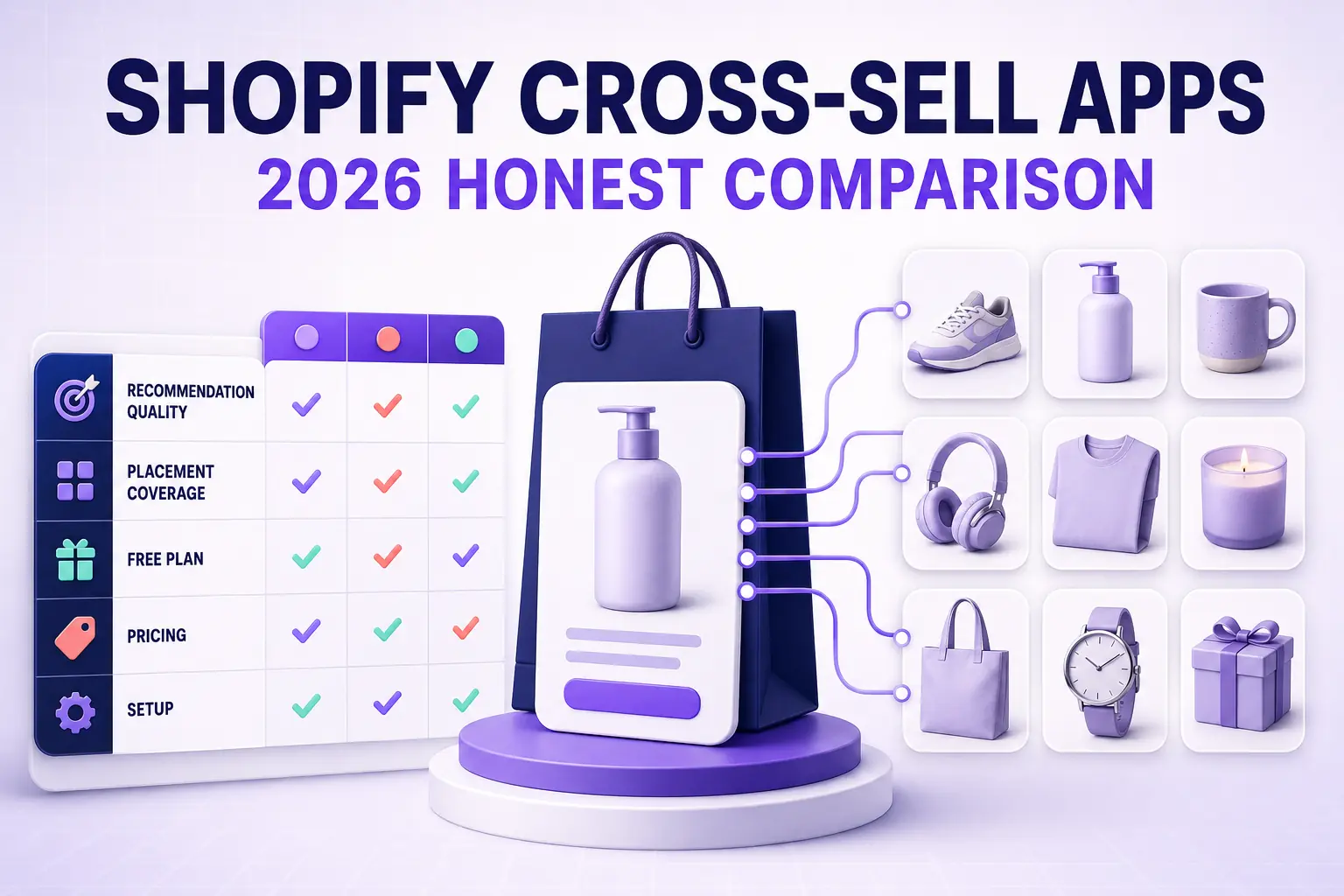
Best Shopify Cross-Sell Apps for 2026: The Honest Comparison
The 9 best Shopify cross-sell apps for 2026 compared on recommendation quality, placement coverage, free plans, pricing model, and setup time — plus which store profile each one actually fits.
 Install Cart — Free