
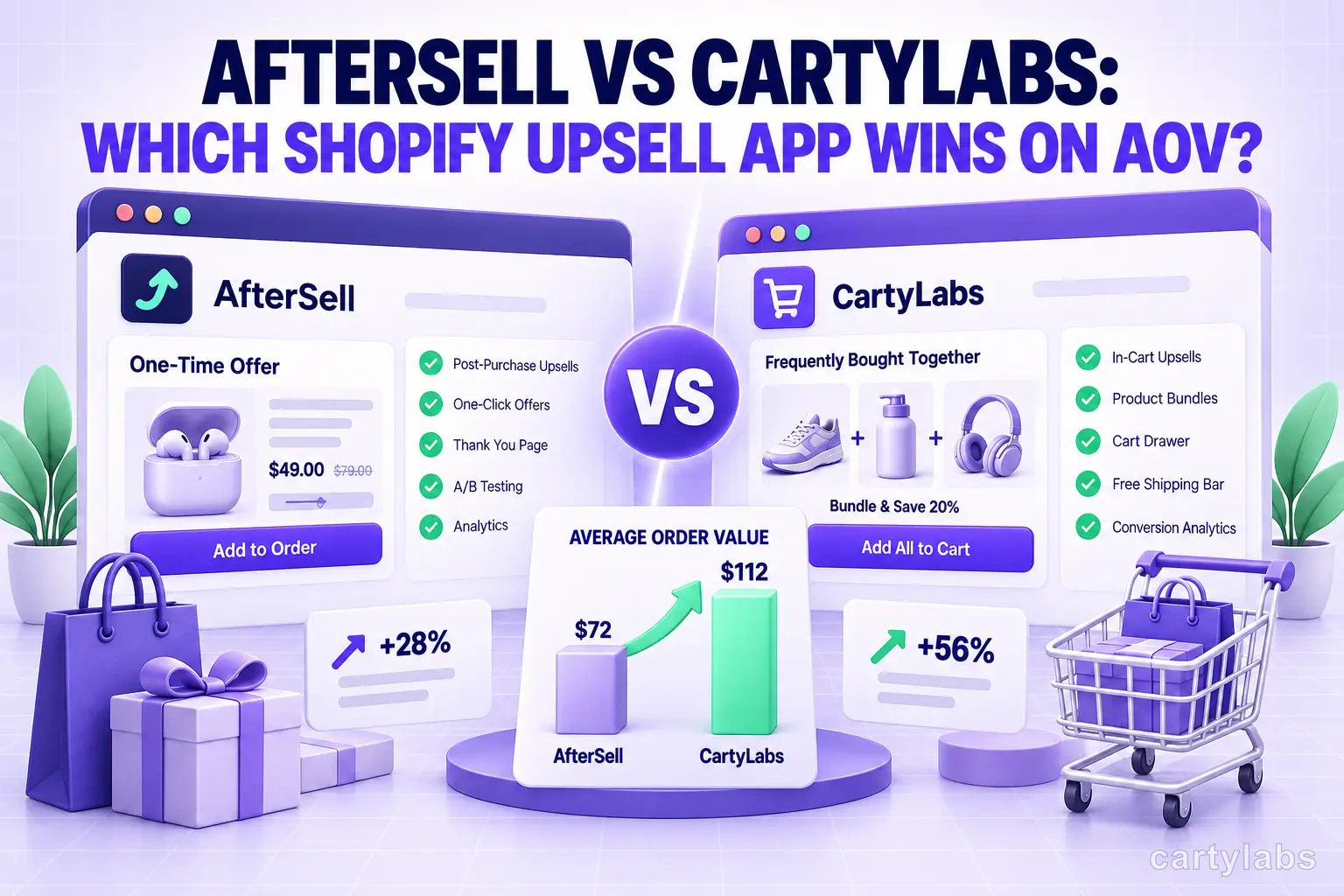
AfterSell vs Cartylabs: Which Shopify Upsell App Wins on AOV?
AfterSell vs Cartylabs compared head-to-head on Shopify cart drawer, AI upsells, AOV lift, pricing, and setup. An honest breakdown for 2026.
In this article
- 01 Quick answer#
- 02 What each app actually covers#
- 03 AOV lift: what to actually expect#
- 04 Pricing comparison#
- 05 Setup time and integration depth#
- 06 Feature-by-feature breakdown#
- 07 Where AfterSell wins outright#
- 08 Where Cartylabs wins outright#
- 09 When you might run both#
- 10 Analytics: what each app reports#
- 11 Decision tree#
- 12 A short summary#
If you’re shopping for a Shopify upsell app in 2026, AfterSell and Cartylabs both come up fast, and they’re closer competitors than they used to be. Since Rokt acquired both AfterSell and Upcart, AfterSell’s offering now spans the full upsell stack: a cart drawer with AI recommendations and rewards (the Upcart side), plus the post-purchase one-click upsell page AfterSell was originally known for.
Cartylabs covers the same surfaces (cart drawer, sticky cart, AI in-cart recommendations, rewards bar, countdowns) in a single app embed, with a different pricing model and a stronger emphasis on i18n and an independent product roadmap.
This post compares the two head-to-head: AOV lift, pricing math, setup, analytics, localization, and the trade-offs that actually determine which one fits your store.
Quick answer
- You want a flat-priced, all-in-one cart drawer plus AI upsells plus stacked rewards, with native 16-language support: Cartylabs.
- You want the broadest Rokt-network AI signal and don’t mind usage-based pricing or working across multiple Rokt products: AfterSell.
- You want to test both: install Cartylabs (free plan), then trial AfterSell on a duplicate theme. Compare AOV lift over 14 days on equal traffic.
If your store is under ~500 orders/month, the Cartylabs free plan is the lowest-risk starting point.
What each app actually covers
Cartylabs is an all-in-one cart drawer app: slide-out cart, sticky cart icon, AI product recommendations trained per store, free-gift and free-shipping progress bar with stacked tiers, countdown timers, shipping-protection upsell, and analytics. All in one Shopify App Embed. Setup typically runs under five minutes. No theme code, no JavaScript snippet, no separate dashboards. See our Shopify cart drawer guide for the underlying playbook.
AfterSell (Rokt-owned) bundles two product surfaces:
- Upcart, the cart drawer side: slide-out cart, sticky icon, AI in-cart recommendations, rewards bar, in-cart add-ons, express checkout buttons.
- AfterSell post-purchase, the thank-you-page side: one-click upsell pages, surveys, A/B testing, custom messages.
Both apps therefore cover pre-checkout (cart drawer plus AI upsells) and post-purchase. The differences are in execution, pricing, configurability, and which roadmap you’re betting on.
AOV lift: what to actually expect
Industry benchmarks and our data across 1,000+ Shopify stores suggest:
- Cart drawer plus AI upsells plus rewards: 5-15% AOV lift, with the long tail driven by stacked rewards tiers and recommendation quality.
- Post-purchase one-click upsells: 8-12% revenue lift on converted orders, with ~10-20% accept rate, so absolute dollars are smaller than the percentage suggests.
Both apps can deliver in-cart and post-purchase lift. The honest gap isn’t the percentage range. It’s how predictable that range is for your specific catalog. Per-store ML (Cartylabs) tends to ramp faster on small-to-mid catalogs (50-500 SKUs) because it learns your shopper signal. Larger network AI (AfterSell, Rokt) tends to win on very large catalogs or new stores with no purchase history yet.
For more on the underlying mechanics, see Shopify AOV upsell strategies and AI product recommendations on Shopify.
Pricing comparison
This is where the two diverge most.
| App | Entry price | Free plan | Pricing model | Usage scaling |
|---|---|---|---|---|
| Cartylabs | Free, then flat tiers | Yes | Order-volume tiers, predictable | Flat per tier |
| AfterSell | $34.99/mo entry | No | Tiered plus per-order fees on higher plans | Usage-based, scales with revenue |
Two consequences:
- For small stores: Cartylabs has a free plan. AfterSell does not. Under $5k/month revenue, the math rarely supports AfterSell yet.
- For high-volume stores: Cartylabs’ flat tiers don’t penalize a successful BFCM week. AfterSell’s usage-based fees mean a great month is also an expensive month.
Neither is wrong. They’re different bets. Predictability vs. pay-as-you-grow.
Setup time and integration depth
Cartylabs. Install from the Shopify App Store, toggle the App Embed on, pick a theme preset, set rewards thresholds. Live in 2-5 minutes. Single dashboard for all features.
AfterSell. Install, configure the cart drawer (Upcart side), then build a post-purchase funnel (trigger → offer → fallback) on the AfterSell side, then connect Shop Pay. Realistic setup is 30-60 minutes for a full configuration. The funnel editor is genuinely well-built. The friction is configuration breadth, not code.
If you’re early-stage and value time-to-first-value, Cartylabs’ setup curve is dramatically shorter. If you want fine-grained funnel logic on day one, AfterSell’s editor will reward the configuration time.
Feature-by-feature breakdown
Both apps cover most of the same ground. The differences are in the details.
| Feature | Cartylabs | AfterSell (Upcart + AfterSell) |
|---|---|---|
| Cart drawer | Yes | Yes (Upcart) |
| Sticky cart icon | Yes | Yes (Upcart) |
| AI in-cart recommendations | Yes (per-store ML) | Yes (Rokt network model) |
| Free-gift / shipping progress bar | Yes (stacked tiers) | Yes (single tier on lower plans) |
| Countdown timer | Yes | Yes |
| In-cart add-ons / shipping protection | Yes | Yes |
| Post-purchase one-click upsell | Roadmap | Yes (AfterSell core) |
| Thank-you page surveys | No | Yes |
| Funnel editor (if/then) | Limited | Strong |
| Native 16-language plus RTL | Yes | Partial |
| A/B testing | Yes | Yes |
| Free plan | Yes | No |
| Single embed / single dashboard | Yes | Two product surfaces |
| Independent roadmap | Yes | Rokt portfolio |
Where AfterSell wins outright
Honest scenarios where AfterSell is the better pick:
- Post-purchase is your priority surface. AfterSell is purpose-built for the thank-you-page upsell and has the deepest funnel editor and lift-attribution analytics in the category. Cartylabs’ post-purchase surface is on the roadmap, not shipping today.
- You want a single vendor across the full Rokt stack. If you’re already using or planning to use Rokt’s broader ad network or post-checkout monetization, AfterSell stays inside that ecosystem.
- High-AOV stores where one-click math obviously pencils out. $80+ AOV with a $15-25 post-purchase add-on is exactly AfterSell’s wheelhouse.
- You want extensive funnel branching on day one. AfterSell’s if/then editor handles multi-step accept/reject flows that Cartylabs’ simpler logic doesn’t.
For more competitor context across the Rokt stable, see our Rokt Upcart alternatives roundup.
Where Cartylabs wins outright
Equally honest:
- You want one app, one dashboard, one bill. AfterSell’s Upcart plus AfterSell (plus, sometimes, other Rokt products) means multiple surfaces to learn. Cartylabs is one embed, one dashboard.
- You’re price-sensitive or unpredictable in monthly volume. Flat tiers plus a free plan vs. usage-based fees can swing hundreds to thousands of dollars per month on a growing store.
- International or multilingual stores. Cartylabs renders cart, rewards, and recommendations in 16 languages with RTL support out of the box. AfterSell’s localization is improving but uneven across surfaces.
- Per-store AI recommendations matter to your catalog. A model trained on your specific shopper sessions tends to beat a network-average model for catalogs in the 50-500 SKU range.
- Stacked rewards tiers. “$50 free shipping → $100 free gift → $150 10% off.” Cartylabs supports this natively. Upcart’s rewards bar is limited to a single threshold on lower plans.
When you might run both
For stores doing $50k+/month, running Cartylabs in the cart drawer and AfterSell on the post-purchase page is a defensible stack, at least until Cartylabs ships its post-purchase surface. The two don’t conflict (Cartylabs runs pre-checkout, AfterSell runs post-checkout) and Shopify hands off cleanly between them.
The decision is whether the incremental ~8-12% post-purchase lift justifies the second app’s monthly cost. At $50k+/month, usually yes. Below that, pick one.
Analytics: what each app reports
Cartylabs reports cart-to-checkout conversion, AOV, items-per-cart, upsell click-through and accept rate, rewards-bar unlock rate, and per-product upsell performance. Dashboard updates daily. Experiments are configurable on the in-cart side.
AfterSell reports post-purchase impressions, accept rate, average upsell value, funnel-step conversion, and revenue lift versus a holdback group. Auto-run holdback testing on the post-purchase side is best-in-class. The Upcart side has its own dashboard, so you’re flipping between two views.
If lift attribution on post-purchase is your obsession, AfterSell wins. If you want one consolidated cart and upsell view, Cartylabs wins.
Decision tree
- Under $5k/month revenue → Cartylabs free plan
- Cart-to-checkout under 50% → Cartylabs (fix the drawer first)
- Checkout conversion above 5%, AOV above $80, post-purchase is the priority → AfterSell
- International or multilingual store → Cartylabs
- Want flat predictable pricing → Cartylabs
- Want one vendor across cart, post-purchase, and funnel branching → AfterSell
- $50k+/month, want maximum incremental revenue → Cartylabs in-cart plus AfterSell post-purchase
For broader cart leak diagnostics, the Shopify cart abandonment playbook walks through which surface to fix first based on your funnel data.
A short summary
AfterSell and Cartylabs cover most of the same ground today: cart drawer, AI upsells, rewards, post-purchase (AfterSell only, for now). The real differentiation is in pricing model (flat vs. usage-based), product surface area (one embed vs. two products under Rokt), localization (Cartylabs is native i18n, AfterSell is partial), and AI approach (per-store ML vs. network model).
For most independent Shopify stores under $50k/month, especially international, price-sensitive, or one-app-please merchants, Cartylabs is the cleaner fit. For high-AOV stores that need post-purchase funnel depth or want a single Rokt stack, AfterSell remains a strong pick.
Want to see Cartylabs on your store? Install Cartylabs free on Shopify, or book a 15-minute demo and we’ll walk through your funnel together.
Learn more: Post-purchase upsell for Shopify, Shopify upsell app
Next steps
Related Shopify resources
Practical tools and product pages related to this guide.
Keep reading
All articles →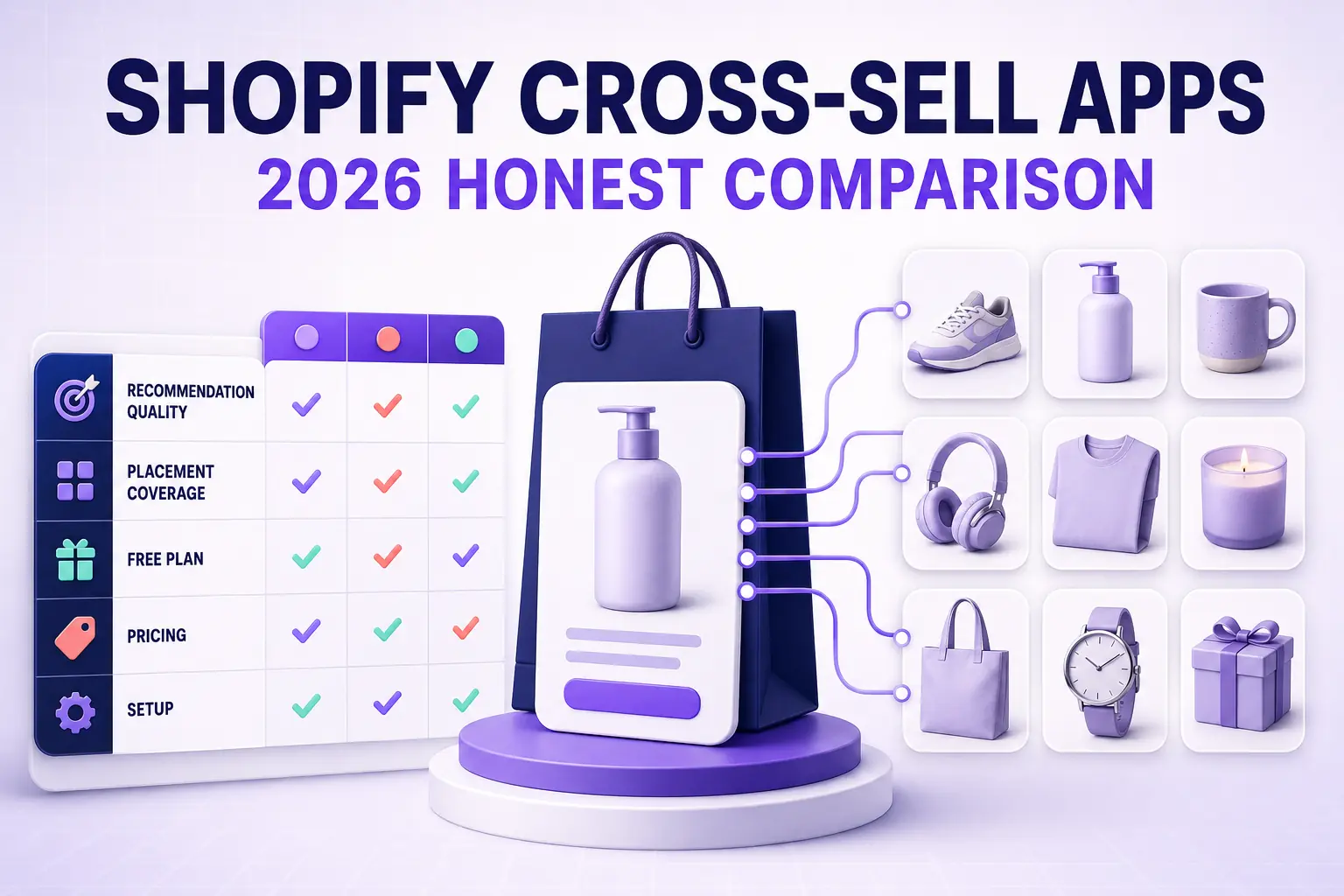
Best Shopify Cross-Sell Apps for 2026: The Honest Comparison
The 9 best Shopify cross-sell apps for 2026 compared on recommendation quality, placement coverage, free plans, pricing model, and setup time — plus which store profile each one actually fits.
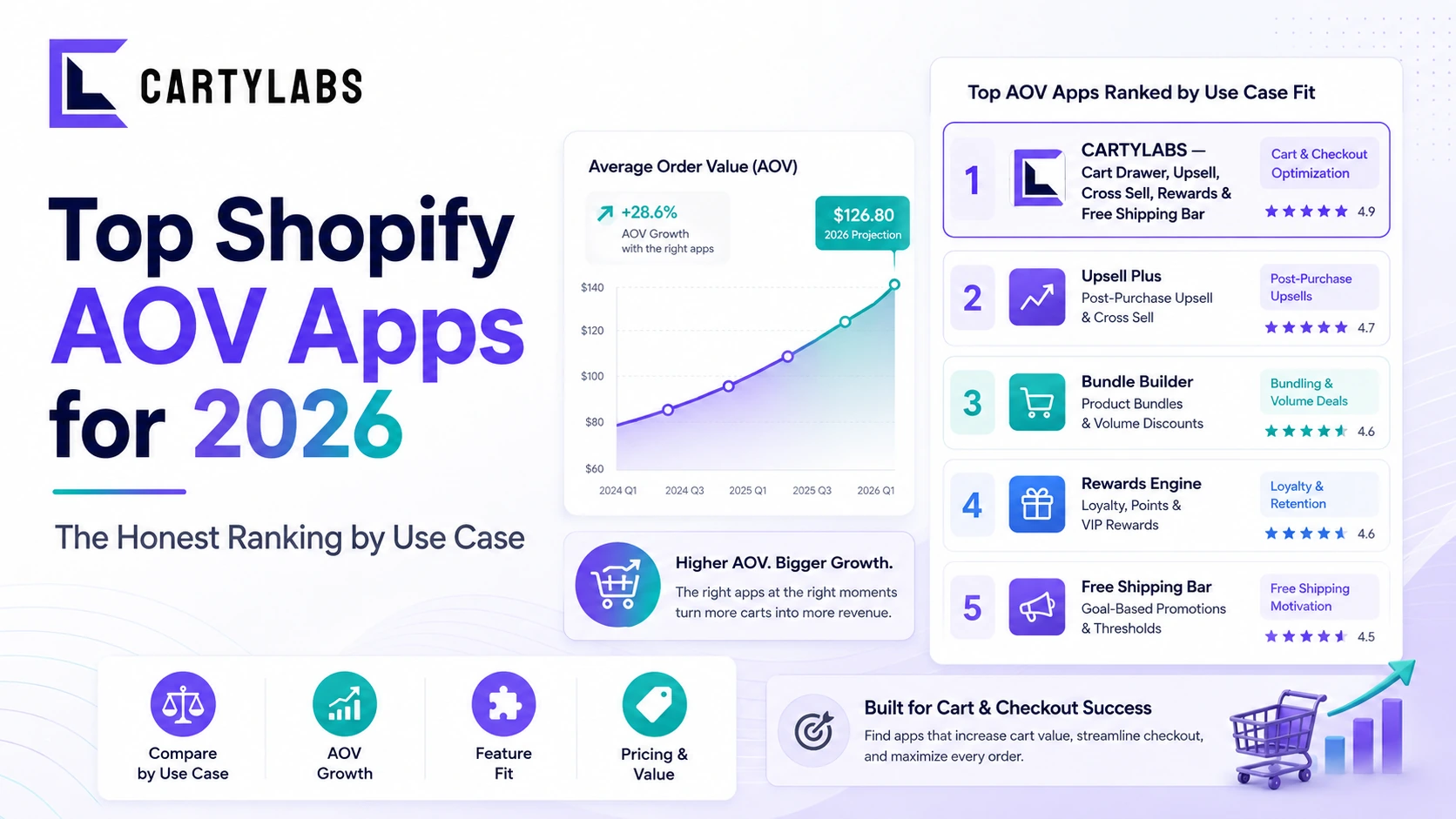
Top Shopify AOV Apps for 2026: The Honest Ranking by Use Case
The 12 best Shopify apps for increasing average order value in 2026. Cart drawer, upsells, bundles, post-purchase, subscriptions, shipping protection, compared on lift, pricing, and fit.
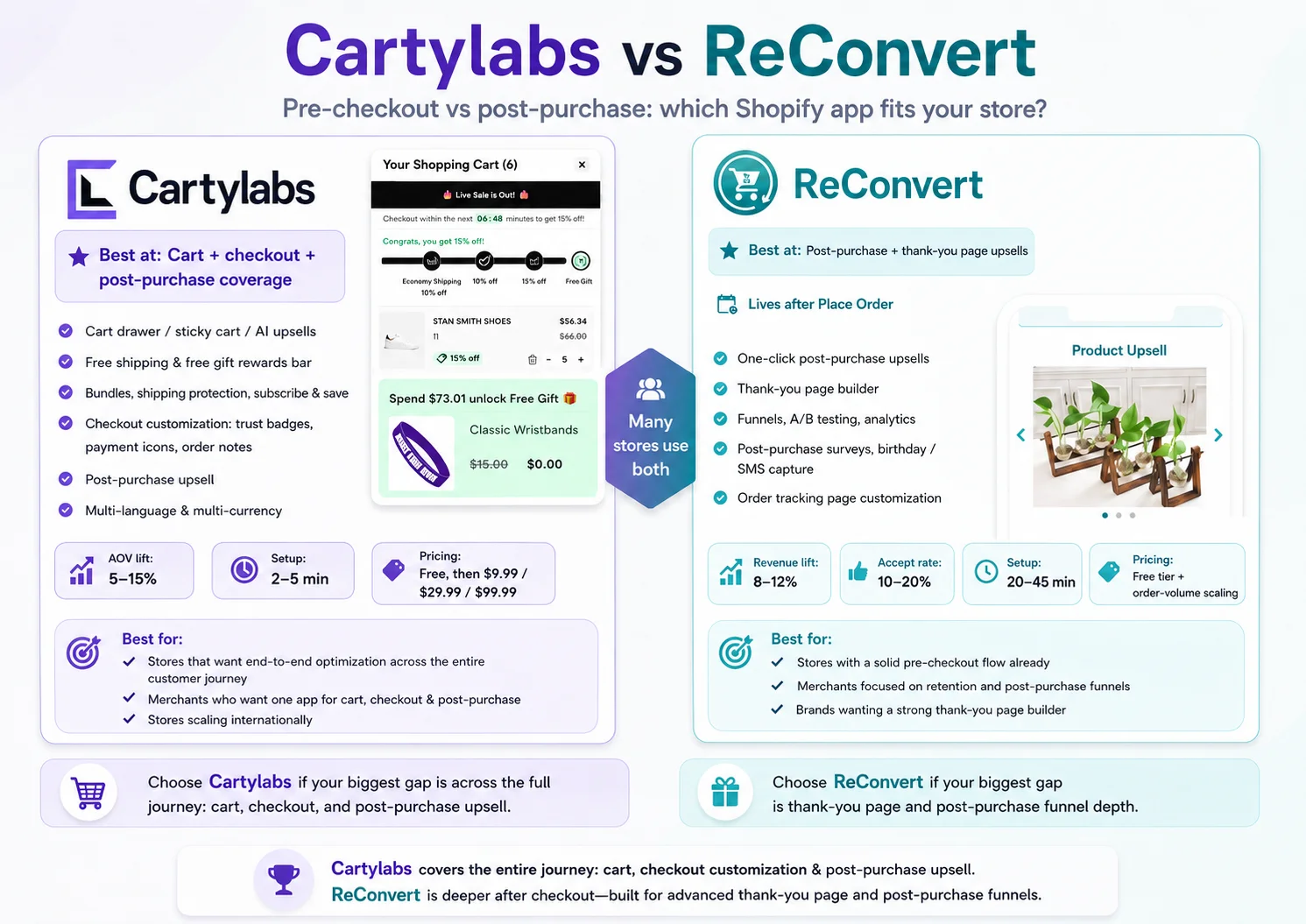
Cartylabs vs ReConvert: How the Two Compare Across Shopify Checkout Surfaces
Cartylabs vs ReConvert compared head-to-head. What each one does, where they overlap, pricing, setup, and which store profiles each one fits in 2026.
 Install Cart — Free