
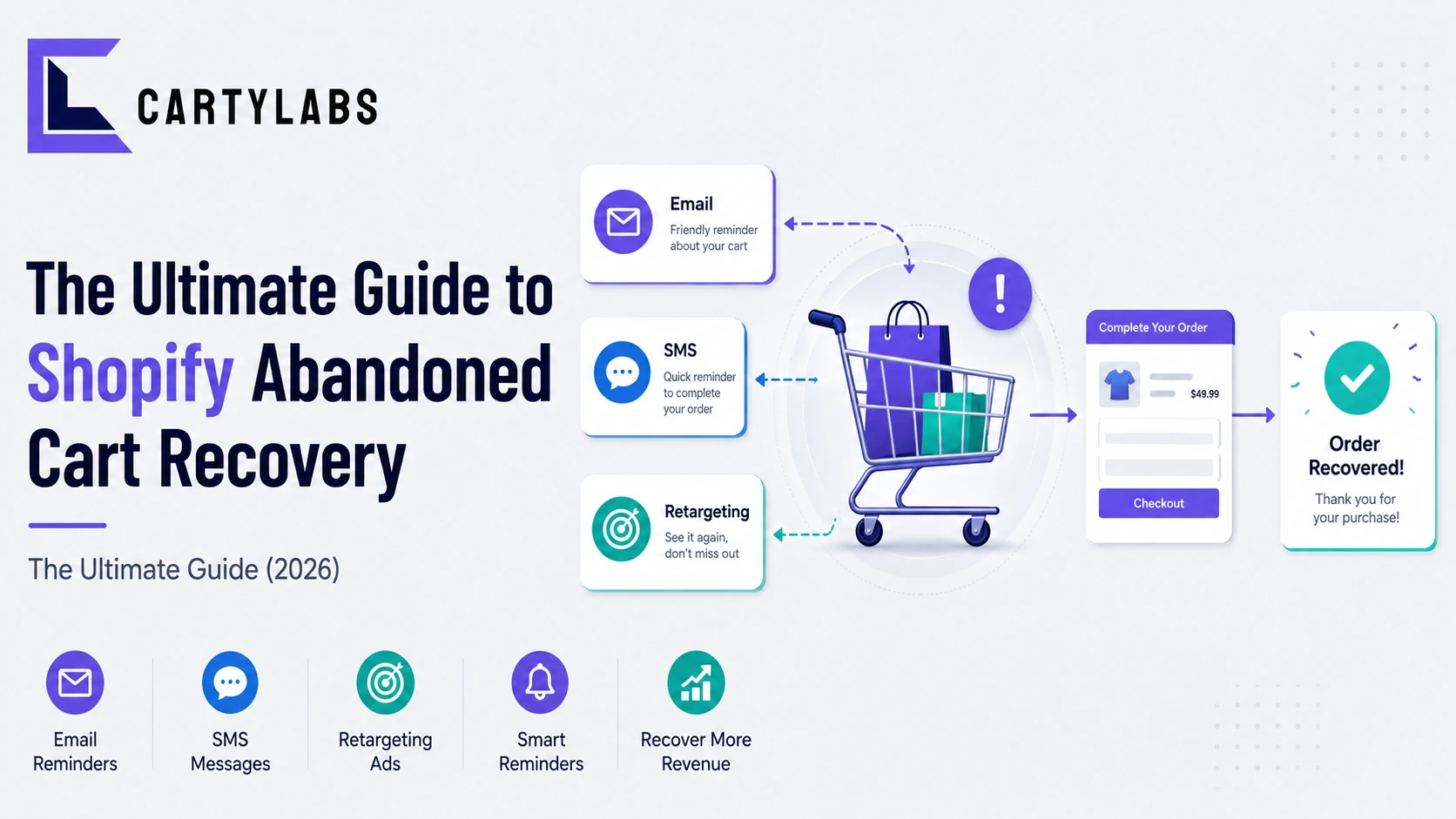
The Ultimate Guide to Shopify Abandoned Cart Recovery (2026)
Recover more abandoned carts on Shopify with a complete playbook covering email and SMS sequences, segmentation, on-site recovery, retargeting, and the recovery-rate benchmarks that matter.
In this article
Shopify quietly tells you that the average store recovers between four and twelve percent of abandoned carts. The reality is that top-decile merchants recover thirty to forty percent, and the difference is almost never the email subject line. It is the entire recovery stack: the trigger, the channel, the timing, the personalization, and the on-site experience that catches the buyer when they come back.
This is the complete Shopify abandoned cart recovery guide for 2026. It covers the full stack, not just the email.
For the upstream prevention work, our Shopify cart abandonment playbook covers reducing abandonment before recovery becomes necessary. For benchmarks on what good actually looks like, see the Shopify checkout abandonment statistics post.
What “abandoned cart” really means
Shopify defines an abandoned cart as a session where the buyer reached the checkout (entered an email or used express checkout) but did not complete the order within sixty minutes. This is narrower than what most merchants mean. The complete definition should include:
- Browse abandoners (saw a product, did not add to cart)
- Cart abandoners (added to cart, did not start checkout)
- Checkout abandoners (Shopify’s definition)
- Post-purchase non-buyers (declined upsells)
Each segment needs a different recovery flow.
The three-channel cadence
Single-channel recovery (email only) tops out around eight percent recovery. Adding SMS pushes you to fifteen to twenty. Adding browser push and retargeting ads pushes you toward thirty.
A modern Shopify recovery cadence looks like this:
- One hour after abandonment: SMS one-liner with cart link, no discount
- Three hours: email reminder with cart contents, light social proof
- Twenty-four hours: email with shipping reassurance or scarcity
- Forty-eight hours: SMS or email with first discount
- Seventy-two hours: final email with strongest discount
The discount escalates only at the end so the cadence does not train buyers to wait.
Segmentation that actually moves recovery rate
Generic recovery emails recover about three percent of carts. Segmented recovery emails recover four to seven times that. Segment by:
- First-time vs. returning buyer (returning needs no incentive)
- Cart value (high-value carts deserve a human reach-out)
- Discount eligibility (do not give a discount to a buyer who used a code)
- Product category (different copy and imagery)
- Device (mobile abandoners get SMS, desktop get email)
Klaviyo and Postscript both make segmentation trivial. The work is in defining the segments, not in building them.
On-site recovery, not just inbox recovery
When the buyer comes back to your site (through any channel), the experience matters as much as the email. The cart should still contain their items. The discount should auto-apply. The checkout should pre-fill everything possible. A buyer who returns to a cleared cart abandons again at nearly the same rate as the first time.
A persistent cart that survives across devices via Shop Pay or a Klaviyo cookie is the single highest-leverage on-site recovery move. Most Shopify stores have this turned off by default. Turn it on.
Browser push and retargeting
Browser push notifications via Web Push are a free recovery channel most Shopify stores ignore. Opt-in rates are higher than email and click-through is two to three times higher. The trade-off is you have to ask permission and message frequency must stay low.
Meta and Google retargeting ads should run for fourteen days after abandonment, with frequency capped at three impressions per day. Higher frequency exhausts the audience without lifting recovery.
What the best recovery emails look like in 2026
The format that consistently wins:
- Subject: short, name-checked, no emoji (“Sarah, your cart is waiting”)
- Hero: actual cart contents with product photos
- Body: two sentences, one social proof line, one CTA
- CTA: “Return to checkout,” not “Buy now”
- Footer: simple, with a one-click unsubscribe
The “send a long email with three reasons to buy” pattern lost to the “send a short email that respects the buyer’s time” pattern around 2024.
Measuring recovery the right way
The metric most stores track (recovery rate) is the wrong one. Track recovered revenue per recovered cart, recovery rate by channel, and incremental recovery (recovery rate above the no-flow baseline). The last one is the only number that proves your flow is doing work and not just taking credit for buyers who would have returned anyway.
If you want to handle on-site recovery (persistent cart, in-cart upsells, post-purchase win-back) in one app, Cartylabs covers the back half of the recovery stack. Pair it with Klaviyo or Postscript for the outbound half.
Next steps
Related Shopify resources
Practical tools and product pages related to this guide.
Keep reading
All articles →
Best Shopify Abandoned Cart Recovery Apps for 2026: The Honest Comparison
The 10 best Shopify abandoned cart recovery apps for 2026 compared on channel coverage, recovery rate, attribution honesty, pricing model, and free tiers — plus why prevention beats recovery on most stores.
How to Turn Cart Additions Into Completed Sales on Shopify
Convert more Shopify cart additions into completed sales with proven tactics for reducing cart-to-checkout drop-off, optimizing the cart drawer, and timing reassurance messaging.
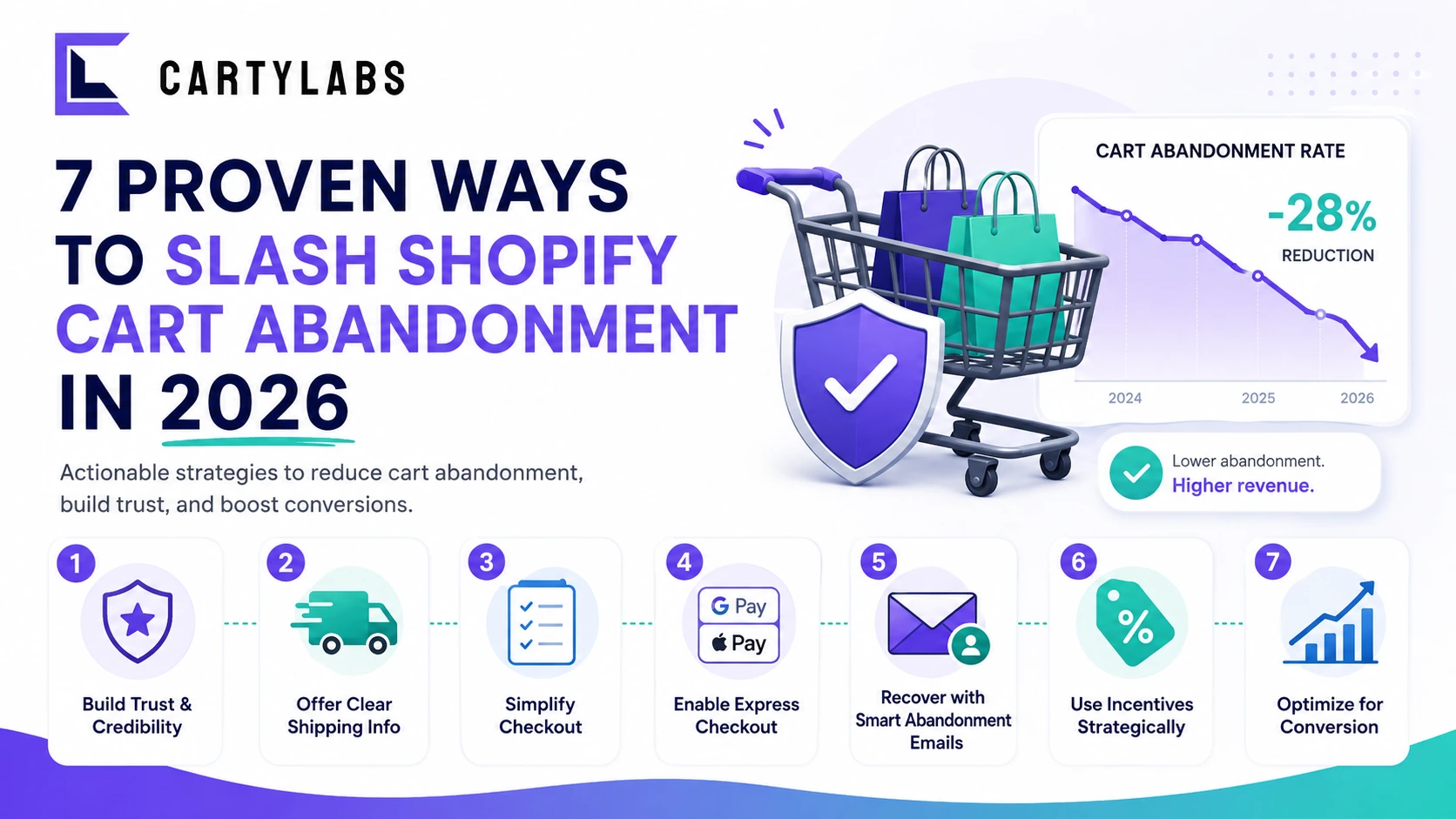
7 Proven Ways to Slash Shopify Cart Abandonment in 2026
Cut Shopify cart abandonment fast with seven field-tested tactics covering shipping transparency, express checkout, exit recovery, trust signals, and post-purchase win-back.
 Install Cart — Free