
How Transparent Shipping Fees Save Your Shopify Checkout Conversions
Stop losing sales to surprise shipping costs on Shopify. Surface shipping fees on the product page, cart drawer, and checkout with clear policies that lift conversion four to nine percent.
In this article
- 01 Why shipping shock is so expensive#
- 02 Where to surface shipping cost in the funnel#
- 03 The specific copy patterns that work#
- 04 When to offer free shipping and when not to#
- 05 How to communicate shipping during slow periods#
- 06 Shipping cost transparency on mobile#
- 07 Measuring the impact of transparency#
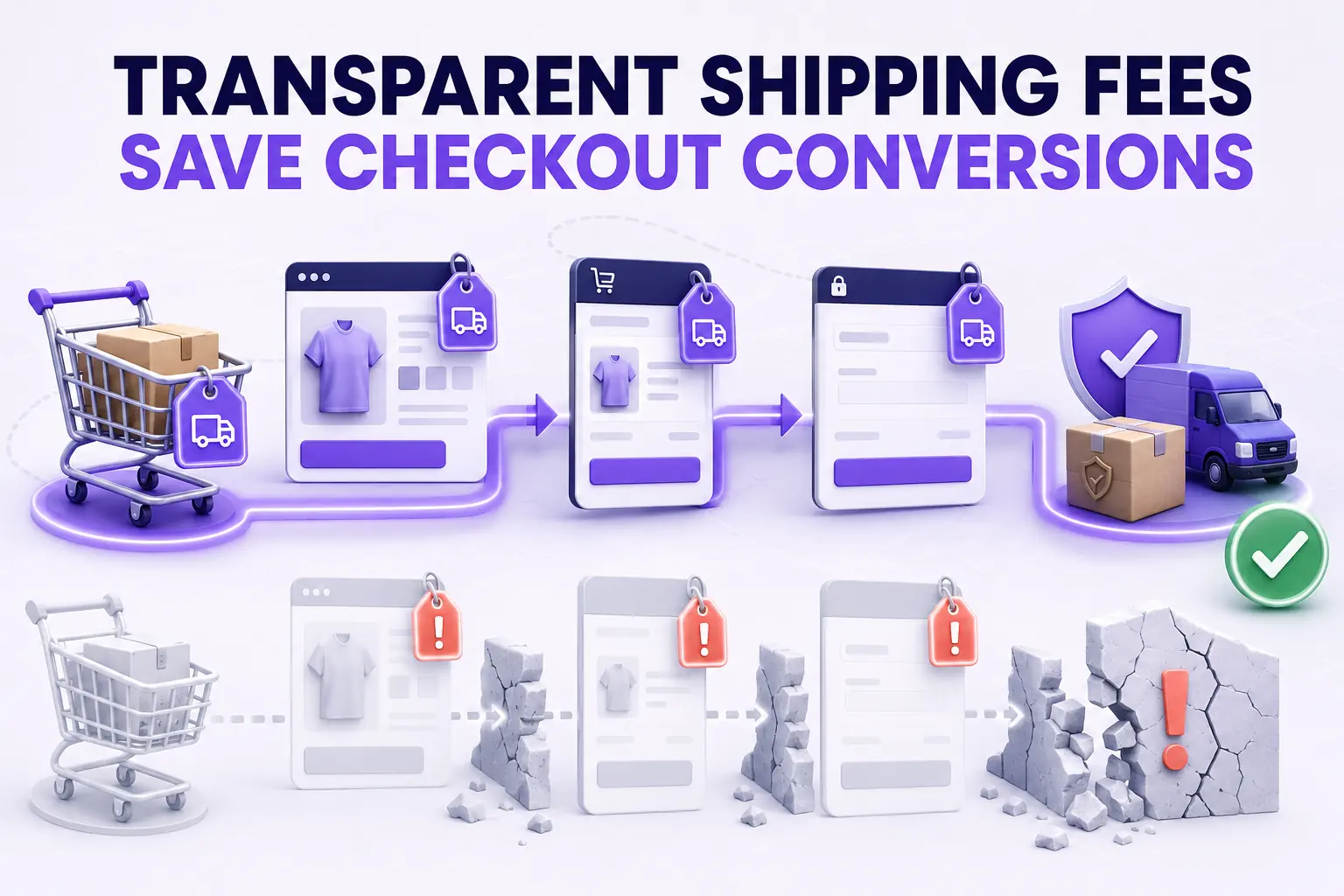
Unexpected shipping cost is the most-cited reason for cart abandonment in every major checkout study from the last decade. Shipping has been the leading killer of Shopify checkouts since the early 2010s and it still is. The fix is almost embarrassingly simple: tell the buyer the shipping cost before checkout, not at it. Stores that take this seriously consistently lift completion four to nine percent.
This guide covers exactly how to surface shipping costs across your funnel, and the messaging patterns that turn shipping from a source of friction into a source of trust.
For the free-shipping-threshold strategy specifically, see our Shopify free shipping bar strategy. For the broader cart abandonment context, the Shopify cart abandonment playbook walks through every leak.
Why shipping shock is so expensive
The cognitive sequence at checkout is: buyer decides to buy, buyer commits emotionally, buyer enters address, buyer sees shipping cost, buyer feels the cost as a loss against their committed expectation. Loss aversion runs roughly two-to-one, so the perceived pain of an unexpected eight-dollar shipping fee is closer to a sixteen-dollar pain. Many buyers abandon at this moment even when the total still represents good value, because the surprise itself feels like a betrayal.
The fix is not cheaper shipping. The fix is no surprise.
Where to surface shipping cost in the funnel
1. The site header (a sitewide policy bar)
A thin bar above the navigation that reads “Free shipping on orders over $X” or “Flat $4.95 shipping, free over $50” sets expectations on the first page view. Every buyer who reaches the cart already knows the rule.
2. The product detail page
Below the buy button: “Ships free over $X | Estimated delivery 3 to 5 business days to your area.” The “to your area” line uses geo-IP. This is the highest-leverage placement because the buyer is still deciding whether to add to cart, not whether to complete an existing decision.
3. The cart drawer
A progress bar to the next shipping reward, plus a current shipping line (“Standard shipping calculated at checkout, around $4.95 to your area”). The progress bar doubles as an AOV lift mechanism. Our free gift progress bar guide covers the threshold patterns that work.
4. The checkout shipping step
The shipping cost should be a confirmation by the time the buyer sees it here, not a reveal. If the buyer hits this step and the cost is more than they expected, every prior placement in this list failed.
The specific copy patterns that work
Specific over vague
“Standard shipping: $4.95, arrives Tuesday June 30” beats “Standard shipping: $4.95, 3 to 5 business days.”
Quantified over qualitative
“Free shipping on orders over $50” beats “Free shipping on most orders.”
Concrete over abstract
“Ships from our Atlanta warehouse within 24 hours” beats “Fast shipping.”
Honest over optimistic
“Standard shipping: $9.95, arrives June 30 to July 5” beats a falsely tight window that produces a delivery failure email. Promised delivery dates that miss are worse than wider promised windows that hit.
When to offer free shipping and when not to
Free shipping is the single highest-converting price signal on Shopify. It also crushes margin if structured wrong. The frameworks that work:
- Free shipping above a threshold set just above your current AOV (lifts AOV and absorbs the shipping cost)
- Free shipping on subscriptions to drive subscription rate
- Free shipping on first order to convert new buyers
- Free shipping by region for areas with low shipping cost
Free shipping on every order regardless of basket size only works if your margin can absorb it. Most Shopify stores cannot, and a smart threshold is the correct middle ground.
How to communicate shipping during slow periods
When holidays or peak seasons stress your shipping operation, the trust move is to tell buyers up front. A sitewide banner that reads “Orders ship within 48 hours due to holiday volume” is better than silent slippage that produces angry post-order emails. Buyers respect transparency.
Shipping cost transparency on mobile
Mobile shoppers have less screen real estate and less patience. The shipping cost should be visible without scrolling on every key surface: product page (below buy button), cart drawer (progress bar at top), checkout shipping step (always visible). Hidden shipping cost on mobile is the most expensive UX mistake on Shopify in 2026.
Measuring the impact of transparency
Before / after measurement is straightforward: implement transparent shipping messaging across cart and product pages, hold for thirty days, compare overall checkout completion rate. Most stores see a two to five percent absolute lift in completion plus an AOV lift from threshold-based free shipping.
The Cartylabs cart drawer ships a free shipping bar with threshold progress, configurable messaging, and geo-IP-aware copy as defaults so the transparency layer is in place without you building it.
Next steps
Related Shopify resources
Practical tools and product pages related to this guide.
Keep reading
All articles →
Micro-Copy, Mega Results: Writing Better Shopify Checkout Text
Master Shopify checkout micro-copy with specific examples for button labels, error messages, field hints, trust lines, and Thank You page text that quietly lifts conversion two to five percent.
Guest Checkout vs. Account Creation on Shopify: Which Wins in 2026?
Should you force account creation or offer guest checkout on Shopify? Data-backed comparison of conversion, retention, LTV, and the hybrid post-purchase signup pattern that beats both.

The Psychology of the Checkout: Why Simple Beats Shiny on Shopify
Apply behavioral psychology to Shopify checkout: cognitive load, loss aversion, default bias, and choice architecture explain why simple checkouts convert better than visually impressive ones.
 Install Cart — Free