
Tiered Rewards Bars: Stacked Incentives That 2x AOV on Shopify
A tiered rewards bar stacks free shipping, free gift, and discount unlocks into one progress bar. The math, the design, and how to ship it on Shopify.
In this article
- 01 What “tiered” actually means#
- 02 Why stacked outperforms single-threshold#
- 03 The tier math#
- 04 What rewards to stack#
- 05 Design patterns that work#
- 06 Mobile-specific rules#
- 07 A 6-step rollout playbook#
- 08 Mistakes that kill the lift#
- 09 How tiered rewards interact with other AOV mechanics#
- 10 When not to stack tiers#
- 11 A short summary#
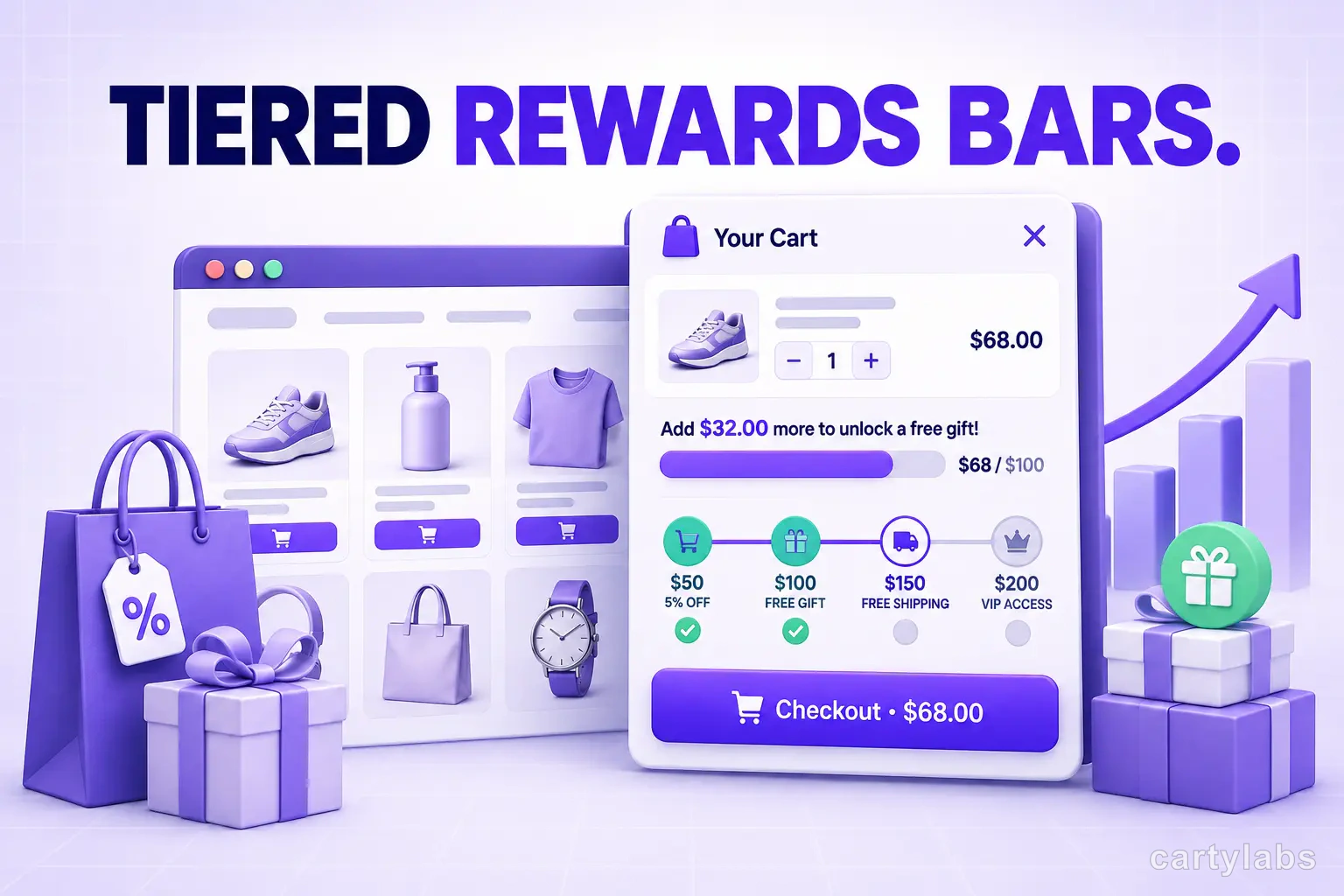
A single-threshold free shipping bar is good. A tiered rewards bar — three or four stacked unlocks in a single progress UI — is the difference between a 12% AOV lift and a 28% one. The mechanic exploits the same goal-gradient psychology as a single threshold, but extends it past the first unlock so shoppers keep pushing all the way through the cart.
Most Shopify cart apps cap at a single threshold. The ones that support stacking (Cartylabs included) treat the rewards bar as the central organizing UI of the cart drawer, not a side-feature. This guide covers the math behind tier ladders, the design patterns that work, and how to ship a stacked bar on Shopify in 2026.
What “tiered” actually means
A tiered rewards bar is a single visual progress element that fills past multiple unlock points, each tied to a different reward:
$0 ─────── $50 (free shipping) ─────── $100 (free gift) ─────── $150 (10% off)As the cart total rises, the bar fills. Each unlock fires with a small animation. The bar then “resets” toward the next tier. Shoppers see one continuous goal, not three disconnected offers.
This contrasts with the typical Shopify pattern: three separate banners (“Spend $50 for free shipping,” “Spend $100 for a free gift,” “Spend $150 for 10% off”). Three banners convert worse than one bar because attention splits and the goal-gradient effect resets at each banner.
Why stacked outperforms single-threshold
A single-threshold bar gets you the lift from shoppers crossing one line. A tiered bar gets you:
- The single-threshold lift (shoppers crossing the first line).
- A second-line lift from shoppers who hit the first line and notice “I’m only $X from the next reward.”
- A third-line lift from the smaller cohort who push all the way to the top.
In our data across stores running stacked vs. single-threshold rewards bars, the lift breakdown looks roughly:
| Configuration | AOV lift over baseline |
|---|---|
| No rewards bar | 0% (baseline) |
| Single threshold (free shipping) | +12-18% |
| Two-tier (shipping + gift) | +18-24% |
| Three-tier (shipping + gift + discount) | +22-30% |
| Four-tier (rare; usually choice paralysis) | +20-28% |
Three tiers is the sweet spot. Four starts to hurt conversion because shoppers see the top tier as out of reach and disengage.
The tier math
Each tier has its own threshold formula. The combined version:
Tier 1 = AOV × 0.85 (free shipping, must be hit by ~60-70% of orders)
Tier 2 = AOV × 1.30 + (gift COGS × 3) (free gift)
Tier 3 = AOV × 1.75 (discount, must be hit by ~10-15% of orders)
Why those percentages: tier 1 should be hit often enough to teach shoppers the bar works. Tier 2 should be hit by 25-35% of orders. Tier 3 is the aspiration tier — most shoppers won’t hit it, but its existence pulls tier 2 conversions up.
Worked example. AOV $80, gift COGS $9:
- Tier 1 = $80 × 0.85 = $68 → round to $69 (free shipping)
- Tier 2 = $80 × 1.30 + ($9 × 3) = $104 + $27 = $131 → round to $129 (free gift)
- Tier 3 = $80 × 1.75 = $140 → round to $149 (10% off)
Spacing matters: tiers should be 30-45% apart in dollar terms. Closer than 25% and the tiers blur together; farther than 60% and shoppers give up between them.
What rewards to stack
The standard ladder, in order:
- Free shipping (lowest tier). Universal friction-remover; almost every catalog should run this.
- Free gift (middle tier). Adds tangible value; see the free-gift progress bar guide for selection criteria.
- % discount (top tier). Compounds the reason to add more.
Alternative ladders that work:
- Shipping → Sample → Subscription unlock for replenishable categories. See subscribe-and-save.
- Shipping → Bonus units → Bundle pricing for consumables.
- Shipping → Mystery gift → Exclusive SKU for hype/community brands.
Don’t stack two of the same type (two free gifts at different tiers feels redundant; two discount tiers is just a confusing volume discount).
Design patterns that work
The bar is a tiny piece of UI doing big behavioral work. Five rules:
1. One bar, multiple markers. Use a single horizontal bar with notches/markers at each tier, not three separate bars.
2. Show the next tier prominently, not all three. Once tier 1 unlocks, the messaging should focus on tier 2. Listing all three at all times splits attention.
3. Animate the unlock. A 300ms pulse or color change when the bar crosses a marker. The animation is what triggers the dopamine hit.
4. Pin the bar to the top of the cart drawer. Not the page header. See the cart drawer guide.
5. Real-time updates. When the shopper changes quantity, the bar should fill (or empty) immediately. A bar that updates only on page reload kills the goal-gradient effect.
Mobile-specific rules
70% of Shopify traffic is mobile, and stacked bars are where mobile UI most often breaks:
- Vertical orientation is sometimes better than horizontal on small screens. Test both.
- Truncate copy aggressively. “$12 to free gift” beats “Spend $12 more to unlock your free gift.”
- Show only the next unlock by default. The full ladder can live behind a “see all rewards” tap.
- Sticky behavior matters. The bar should stay visible as the shopper scrolls the cart line items.
A 6-step rollout playbook
- Calculate the three tiers using the formulas above. Round to numbers ending in 9.
- Pick the rewards. Free shipping + free gift + 10% off is the default. Substitute as the catalog requires.
- Configure the bar in your cart app. Cartylabs handles three-tier stacks natively; many other apps require workarounds.
- Test the bar in cart on mobile and desktop. Verify real-time updates, unlock animations, and copy truncation.
- Measure for 21 days. AOV (target +20-30%), tier-2 attach rate (target 25-35%), tier-3 attach rate (target 8-15%).
- Adjust thresholds in $10-15 increments. Big jumps disorient repeat shoppers.
Mistakes that kill the lift
Tiers too far apart. A $50 → $200 → $500 ladder skips the middle entirely.
Tiers too close together. A $50 → $60 → $75 ladder feels like noise.
Showing all three tiers at once. Decision paralysis — pick the next-uncrossed tier as the focus.
No animation on unlock. The behavioral trigger is the visual moment, not the threshold itself.
Stacking the bar with promo codes. A 15%-off code on top of a 10% tier-3 unlock blows past margin. Disable codes when tiers fire, or scope codes to exclude tier-rewarded orders.
Ignoring mobile truncation. “$12 more to unlock your free gift, free shipping, and 10% off your entire order” overflows on a 320px screen and renders as garbage.
Resetting the bar between pages. A bar that re-renders to $0 when the shopper navigates between cart and PDP destroys progress perception. Use persistent state.
How tiered rewards interact with other AOV mechanics
Layered correctly, tiered rewards stack with:
- AI cross-sells inside the cart drawer (recommendations guide). The cross-sell suggests what to add; the rewards bar gives the reason.
- Volume discounts at the SKU level. Volume discounts trigger on quantity; rewards bars trigger on cart total. They don’t conflict if scoped correctly.
- Post-purchase upsells. Tiered rewards lift the order, post-purchase extracts a second order from the same shopper.
The combined uplift across all three is roughly:
Baseline → +28% (rewards bar) → +6% (cross-sell) → +5% (post-purchase) ≈ +42% revenue per shopperWhen not to stack tiers
- Stores under $20k/month. You don’t have order volume to read tier-2 and tier-3 conversion. Run a single-threshold bar for 60 days first.
- Luxury catalogs. Stacked rewards feel promotional in a way that breaks brand positioning.
- Single-SKU stores. Use a volume discount instead.
- Catalogs with thin margins (under 30% gross). The tier 3 discount math breaks; cap at two tiers.
- B2B / wholesale. Tier ladders don’t fit purchase-order workflows.
A short summary
A tiered rewards bar is the highest-leverage AOV change most Shopify stores can make beyond shipping the cart drawer itself. Three tiers, 30-45% apart, with one continuous progress bar and an unlock animation, lift AOV 22-30% over no-bar baseline.
Pick free shipping → free gift → discount as the default ladder, calibrate thresholds against actual AOV, and let it run for 21 days. Most stores see AOV move within the first week.
Want stacked rewards tiers in one app, with the threshold math built in? Install Cartylabs free on Shopify, or book a 15-minute demo and we’ll calibrate the ladder against your live data.
Next steps
Related Shopify resources
Practical tools and product pages related to this guide.
Keep reading
All articles →
15 Shopify Cart Drawer Examples That Increase AOV
15 real Shopify cart drawers, graded on free-shipping bars, upsells, bundles, rewards, and mobile UX — with the exact tactic to copy from each.

25 Best Shopify Apps to Increase Sales in 2026
25 best Shopify apps to increase sales, organized by revenue problem — with verified pricing and ratings, plus a lean app stack for new, growing, and established stores.
Free Shipping Bar Strategy: Threshold Math That Actually Works
Set a free shipping threshold that lifts AOV without burning margin. The math, psychology, and Shopify patterns that actually move revenue.
 Install Cart — Free