
Monster Upsells Alternatives for Shopify Merchants
Looking for a Monster Upsells alternative on Shopify? Compare 6 cart and bundle apps on price, AOV lift, AI logic, and analytics. Honest picks for 2026.
In this article
- 01 Quick answer#
- 02 Why merchants leave Monster Upsells#
- 03 What to look for in a Monster Upsells alternative#
- 04 1. Cartylabs — the all-in-one alternative#
- 05 2. Rokt Upcart — the established default#
- 06 3. Amp — the four-app suite#
- 07 4. Honeycomb Upsell Funnels — the funnel-builder#
- 08 5. AfterSell — the post-purchase specialist#
- 09 6. Shopify’s native cart + manual bundles#
- 10 Feature comparison#
- 11 How to choose: a decision tree#
- 12 When Monster Upsells is still the right call#
- 13 Migrating off Monster Upsells: what to expect#
- 14 A short summary#
Monster Upsells is one of the more aggressive bundle and tiered-discount apps on Shopify. It does one thing well: shoves “buy more, save more” mechanics into a branded cart drawer and pushes shoppers to bigger basket sizes. But merchants drift away from Monster Upsells for three reasons that come up repeatedly: the analytics dashboard is thin, the cart drawer’s polish lags Cartylabs and Upcart, and the upsell engine is rules-based rather than AI-driven, so it doesn’t adapt to your catalog over time.
This post covers six Monster Upsells alternatives worth comparing in 2026, what each one wins at, and the honest cases where Monster Upsells is still the right pick.
Quick answer
- Best all-in-one (cart drawer + AI upsells + rewards): Cartylabs
- Best for established brand recognition: Rokt Upcart
- Best for full-suite consolidation (cart + bundles + back-in-stock): Amp
- Best for funnel-style upsell flows: Honeycomb Upsell Funnels
- Best for post-purchase add-ons: AfterSell
- Best free option: Shopify’s native cart with theme bundles
Why merchants leave Monster Upsells
Three patterns in the churn data:
- Analytics depth. Monster Upsells reports basic accept rates and bundle revenue, but lacks the per-product, per-segment cohort analytics that mid-size stores want once they’re spending real money on traffic.
- Drawer polish. The branded drawer is functional, but theme-matching is more limited than Upcart or Cartylabs. Merchants on premium themes often end up writing CSS overrides.
- Rules-based logic ceiling. Monster’s “if cart contains X, show Y” editor is flexible at first, then becomes a maintenance burden as the catalog grows past 100 SKUs. AI-trained recommendations scale; manual rules don’t.
If any of those describe your situation, the alternatives below address each gap directly.
What to look for in a Monster Upsells alternative
Before comparing apps, decide which of these matter for your store. Most stores need three or four:
- Bundle / tiered discount logic (“buy 2 save 10%, buy 3 save 20%”)
- AI-driven cross-sells inside the cart drawer
- Free-gift / free-shipping progress bar
- Slide-out cart drawer with brand-matching design
- Cohort and segment analytics
- Multi-language / RTL support
- A/B testing of bundle offers
- Post-purchase upsells (separate surface)
Monster Upsells covers 1, 3, and 4 well. The alternatives below were each built to win on one of the gaps.
1. Cartylabs — the all-in-one alternative
Best for: stores that want one app to replace bundles + cart drawer + rewards + recommendations.
Cartylabs ships the cart drawer, AI product recommendations, free-gift progress bar with stacked tiers, sticky cart icon, countdowns, and analytics in a single Shopify App Embed. It handles bundle-style mechanics through the rewards bar (cross-sell unlocks at $X spend) and through AI cross-sells that surface complementary products in real time.
Where it wins versus Monster Upsells:
- AI upsells trained per store rather than rules you have to maintain. Recommendations adapt as your catalog and shopper behavior change.
- Stacked rewards tiers ($50 free shipping → $100 free gift → $150 10% off) instead of a single threshold.
- 16-language and RTL support out of the box. Monster Upsells localization is limited.
- Analytics dashboard with cart-to-checkout, AOV, items-per-cart, upsell accept rate, and per-product attribution.
- Free plan for stores under a usage threshold.
Where Monster still wins: deeper bundle-pricing UI (volume discounts with custom tier labels) for stores whose entire merchandising strategy is built around stacks and kits.
2. Rokt Upcart — the established default
Best for: stores that want the most installed cart drawer with a large template library.
Rokt Upcart is the category default. Wider template selection than Monster Upsells, more polished drawer animations, and a brand recognized by every Shopify agency. The trade-off is pricing creep on higher plans and a thinner AI upsell engine than Cartylabs. Full breakdown in our Rokt Upcart alternatives guide.
3. Amp — the four-app suite
Best for: stores already running cart drawer, bundles, back-in-stock, and post-purchase as separate apps.
Amp’s pitch is consolidation: one vendor, four apps. If you’re paying for four tools today, Amp can collapse the bill. The Amp Slide Cart sits at 91k+ installs with a 5.0 rating, and the Bundles app is closer to Monster Upsells in spirit than Cartylabs is.
Where it falls short: each Amp app is decent on its own, but the slide cart has fewer customization knobs than Upcart, and the AI upsell engine is less mature than Cartylabs’. The win is the suite math.
4. Honeycomb Upsell Funnels — the funnel-builder
Best for: merchants who think in multi-step flows.
Honeycomb’s editor is a visual funnel: trigger → offer → fallback → split. If your upsell strategy involves more than two steps (“if accepted, show upsell B; if rejected, show downsell C”), Honeycomb’s editor will feel right. Entry pricing is $49.99/mo, which is steeper than Monster.
For a single in-cart cross-sell, it’s overkill. For complex post-purchase flows, it’s hard to beat.
5. AfterSell — the post-purchase specialist
Best for: stores with strong cart UX but weak thank-you-page conversion.
AfterSell isn’t a Monster Upsells replacement; it’s an add-on. It runs the post-purchase surface (one-click upsell after checkout) where Monster and Cartylabs don’t operate. If your in-cart bundle game is fine but you’ve never offered a post-purchase add-on, AfterSell stacks on top of any cart drawer cleanly.
6. Shopify’s native cart + manual bundles
Best for: stores under $10k/month or merchants who want zero recurring app fees.
Shopify’s default Dawn cart is fine if you’re early-stage. You can hand-build “frequently bought together” mechanics with metafields and a few liquid blocks. You won’t get AI, stacked rewards, or analytics, but you also won’t pay $19/mo. Our first $10k/month playbook covers when it’s worth upgrading.
Feature comparison
| App | Cart drawer | AI upsells | Bundle logic | Stacked rewards | Analytics depth | Starting price |
|---|---|---|---|---|---|---|
| Monster Upsells | Yes | Rules-based | Strong | Single tier | Thin | $19/mo |
| Cartylabs | Yes | Per-store ML | Via rewards + AI | Stacked tiers | Deep | Free plan |
| Rokt Upcart | Yes | Basic | Add-ons | Single tier | Medium | $19.99/mo |
| Amp Slide Cart | Yes | Basic | Strong (separate app) | Single tier | Medium | $19.99/mo |
| Honeycomb | Yes | Rules-based | Via funnels | No | Deep | $49.99/mo |
| AfterSell | No | N/A | Post-purchase only | N/A | Deep (post-purchase) | $34.99/mo |
| Shopify default | Yes | No | Manual liquid | No | Native only | Free |
Pricing reflects published entry tiers as of 2026; all paid apps add usage-based fees on higher plans.
How to choose: a decision tree
- You want one app for cart + upsells + rewards + AI → Cartylabs
- You’re paying for four separate apps today → Amp
- Your upsells are multi-step funnels → Honeycomb
- Your bottleneck is genuinely post-purchase → AfterSell
- You’re under $10k/month → stick with Shopify’s native cart
- You want the established default → Upcart
When Monster Upsells is still the right call
In fairness to a real product, pick Monster Upsells over the alternatives if:
- Your entire merchandising story is bundle-based (skincare routines, supplement stacks, vitamin kits) and you need detailed volume-discount UI.
- You don’t care about AI or deep analytics yet.
- You want a single, focused tool rather than an all-in-one suite.
- Your catalog is small enough (under 50 SKUs) that hand-maintained bundle rules are reasonable.
For everyone else, one of the six apps above will likely fit better.
Migrating off Monster Upsells: what to expect
If you’re switching, three practical notes from merchants we’ve helped move:
- Export your bundle rules first. Monster’s UI doesn’t auto-export; screenshot or copy your top rules so you don’t lose configuration.
- Rebuild rewards thresholds rather than bundles. In Cartylabs, “buy 2 save 10%” becomes a stacked rewards tier; the math is the same but the merchandising frame is different.
- Watch the cart-to-checkout rate for the first 7 days. Most stores see a 3-8% lift in that window after switching to a polished drawer with AI upsells, but the first 48 hours can be noisy.
For broader cart leak diagnostics, see Shopify cart abandonment playbook.
A short summary
Monster Upsells is a solid bundle-first app, but bundle-first isn’t the same as AOV-optimal. If your store is past the early-bundle stage and starts caring about AI logic, deep analytics, multi-language support, or a polished drawer, the alternatives above each beat Monster on a specific axis.
Cartylabs is purpose-built for the all-in-one case: cart drawer, AI upsells, stacked rewards, sticky cart, countdowns, and analytics in one embed, in 16 languages, with a free plan to start.
Want to see it on your store? Install Cartylabs free on Shopify, or book a 15-minute demo and we’ll walk through your bundle strategy.
Next steps
Related Shopify resources
Practical tools and product pages related to this guide.
Keep reading
All articles →
Best Shopify Upsell Apps: 12 Apps Compared
The best Shopify upsell apps for 2026 compared on AOV lift, pricing, AI logic, and funnel position. 12 apps tested for in-cart, post-purchase, and bundle upsells.
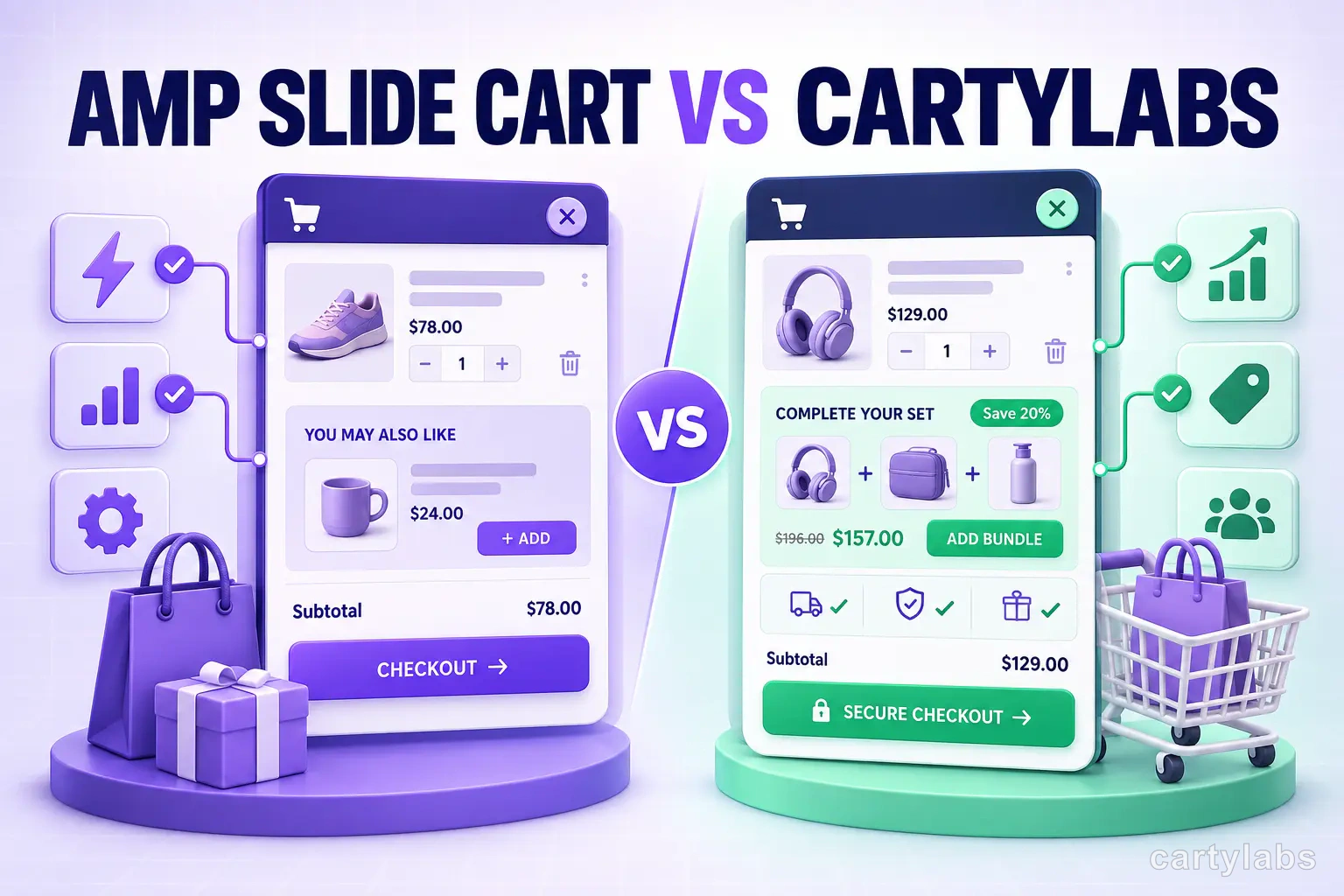
Amp Slide Cart vs Cartylabs: Feature-by-Feature Breakdown
Amp Slide Cart vs Cartylabs compared on Shopify cart drawers, AI upsells, rewards bars, pricing, and setup. An honest, tested breakdown for 2026 merchants.
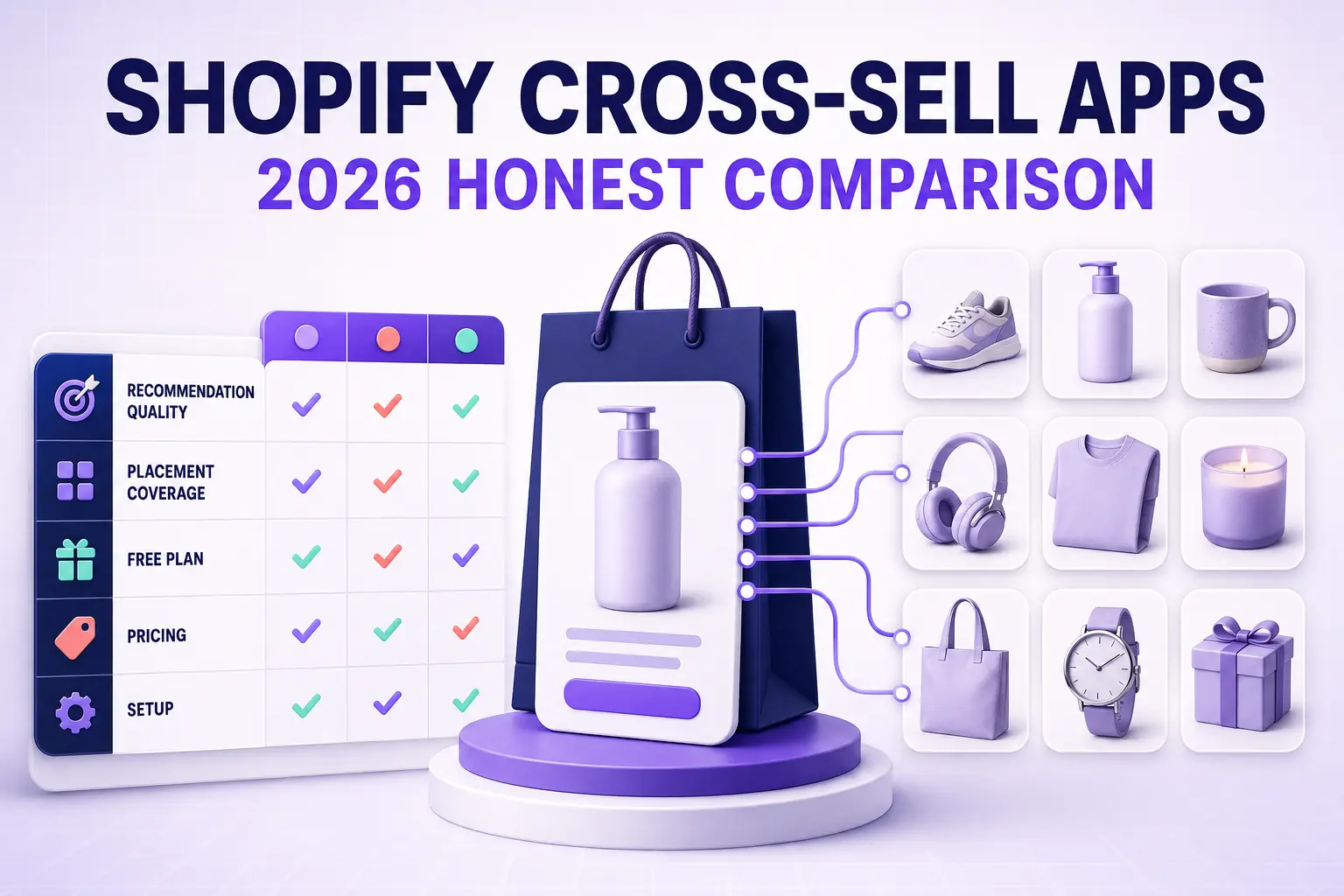
Best Shopify Cross-Sell Apps for 2026: The Honest Comparison
The 9 best Shopify cross-sell apps for 2026 compared on recommendation quality, placement coverage, free plans, pricing model, and setup time — plus which store profile each one actually fits.
 Install Cart — Free